.webp)


Integrated Dual Diagnosis Treatment in Hilliard, OH
Key Takeaways
- Hilliard-area care sits inside Franklin County, where roughly 25% of adults live with mental illness and 21% with a substance use disorder 10, making co-occurring conditions common rather than rare.
- Integrated treatment means one team, one chart, and one plan handling both conditions together, unlike sequential care that demands sobriety first or parallel care that splits providers.
- Before committing locally, ask whether a program uses a named model like IDDT, DDCAT, or DDCMHT 9, shares a single treatment plan, and skips sobriety gates at intake.
- Ohio Medicaid applies ASAM placement criteria and requires OhioMHAS certification for community substance use services 5, so verify level-of-care logic and benefits before signing anything.
When one condition keeps pulling the other down
You already know the pattern. The drinking gets quieter for a few weeks, and then the panic attacks come back louder. Or the antidepressant starts working, and somewhere in that opening you find yourself using again. You get treated for one, the other flares, and the ground you gained slips out from under you.
If you've been through this loop more than once, please hear this: you are not the problem. The way care was set up for you probably was. For decades, addiction and mental health were treated in separate buildings, by separate teams, with separate paperwork. People with both were often told to get one thing "under control" before the other place would even open the door. That approach doesn't work, and national guidance has been clear about it for years. SAMHSA's own advisory on co-occurring disorders states plainly that integrated care, where both conditions are treated together by one team, is the preferred model 1.
Integrated dual diagnosis treatment starts from a different assumption. Your depression and your alcohol use, your PTSD and your opioid use, your anxiety and your stimulant use, are not two separate stories that happen to share a body. They are one story. And they deserve one team, one plan, and one place where nothing about you has to be hidden to qualify for help.
You have not failed treatment. Treatment, in the shape it was handed to you, may have failed you. That distinction matters, because it changes what you look for next.
What integrated care actually means (and what it doesn't)
Integrated, parallel, and sequential care in plain language
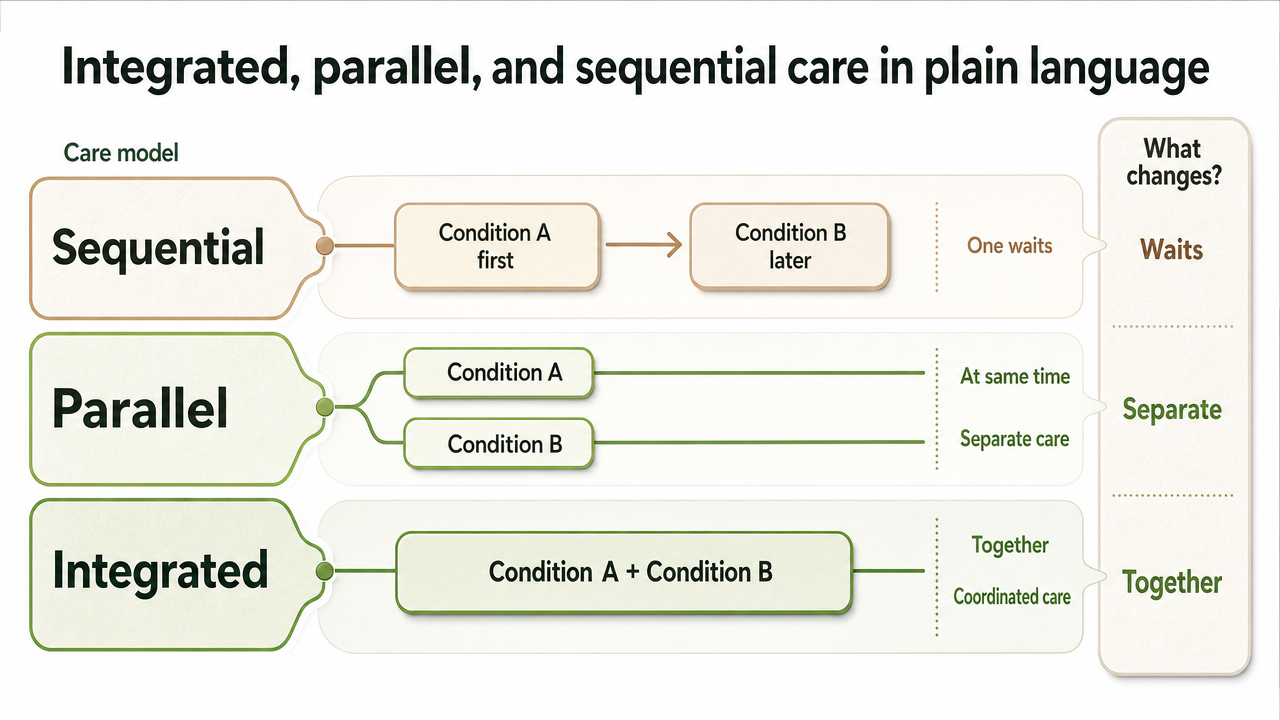
You've probably lived inside one of three treatment models without anyone naming which one you were in. Naming them helps, because once you can see the shape of the care you received, you can tell whether it ever had a real chance of working.
Sequential care is the oldest, and honestly the most painful. One condition gets treated first. The other has to wait. You may remember hearing something like, "We can talk about your depression once you've got 90 days sober," or the reverse: "Get the drinking handled somewhere else, and then come back for the anxiety work." SAMHSA's own guidance on building integrated programs points out that non-integrated systems have historically excluded people from one door until the other problem was "under control" — a practice tied to poor outcomes and a lot of people falling through the cracks 8.
Parallel care feels more modern, but it can be just as exhausting. You see an addiction counselor on Tuesdays and a psychiatrist on Thursdays. Two charts. Two treatment plans. Two waiting rooms. Nobody is officially in charge of your whole story, and you end up being the messenger between clinicians who rarely, if ever, talk. If one provider changes a medication, the other might not know for weeks.
Integrated care is different in a way you can feel. The same team treats both conditions at the same time, in a stage-wise, motivational way. Substance use work and mental health work happen inside one plan, with clinicians who share notes and decisions. Ohio's Center for Evidence-Based Practices calls the fidelity version of this Integrated Dual Disorder Treatment, or IDDT — the specific model Ohio has adapted for inpatient and community settings 9.
This matters more than it sounds. Up to 56% of people with the most serious mental illnesses will have a co-occurring substance use disorder at some point in their lives 8. If that's the norm, splitting care in half was never going to be enough. If sequential or parallel care is what you've had, and it didn't hold, you weren't failing the model. The model was failing you.
How to tell if a program is truly integrated or just co-located
Here's where things get slippery. Almost every program in Central Ohio will tell you they treat co-occurring conditions. Some do. Some just have a psychiatrist down the hall from an addiction counselor and call it integrated. Co-located is not the same thing as integrated, and you have every right to ask which one you're walking into.
You can test this with a few concrete questions, and you don't have to soften them:
- Is the same team treating both conditions, or are you being referred out for one of them? In a truly integrated program, the therapist working with your PTSD is on the same team as the clinician managing your medication and the counselor addressing your substance use. They meet about you, together.
- Do they use a named model like IDDT, DDCAT, or DDCMHT? These aren't marketing terms — they're fidelity frameworks that tell you a program has been measured against a standard for co-occurring care 9. If the answer is a blank stare, that tells you something.
- Will they treat you if you're still using, or only if you're already abstinent? Integrated care meets you where you are, stage by stage. If entry requires you to already be sober, that's a sequential-care rule wearing new paint.
- Is there one treatment plan or two? One plan, one chart, one care team is the standard. Two plans that live in two different systems means you're still the messenger.
Asking these questions is not being difficult. It's you protecting the effort you're about to make. A good program will welcome the questions and answer them without hedging.
You are not the only one in Franklin County
What local data says about need and access
When you've been carrying this alone, it can feel like everyone else on your block has their life sorted. They don't. The numbers coming out of your own county say something very different, and they're worth sitting with for a minute.
The Franklin County Alcohol, Drug and Mental Health Board's 2025 Levy Fact Book estimates that 25% of Franklin County adults live with a mental illness, 21% have a substance use disorder, and 11.9% have unmet mental health care needs 10. That is one in four of your neighbors dealing with something on the mental health side. One in five dealing with something on the substance use side. And roughly one in nine who know they need mental health care and can't get to it.
Read those together, not separately. When a quarter of adults are living with a mental illness and a fifth are living with a substance use disorder in the same county, a large group of people is carrying both at once. That's not a rare, complicated edge case. That's the shape of the room.
Columbus Public Health's mental health data brief adds more texture. About 7% of Franklin County adults met criteria for an alcohol use disorder in the past year 4. If you've been quietly wondering whether your drinking has crossed a line the people around you haven't noticed, you are in a very large, very quiet group of people wondering the same thing.
Here's why these numbers matter for you specifically. When 11.9% of adults in your county say they have unmet mental health needs 10, that gap is not a character flaw of the people inside it. It's a signal about a system that has been hard to enter and harder to stay in, especially if your story includes both substance use and a mental health condition. You are not late. You are not alone. And you are not asking for something unusual.
Why the local picture demands responsive, integrated care
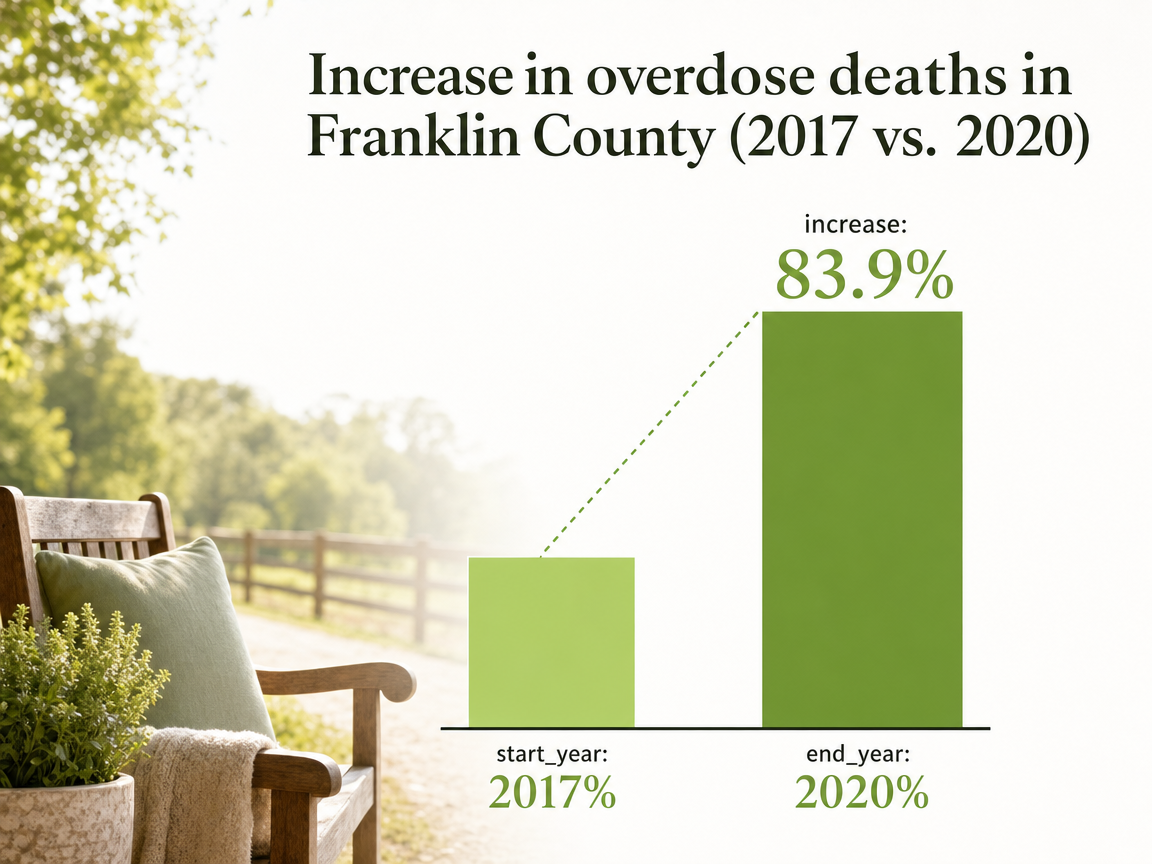
There's another Franklin County number you should know, because it explains why the tone of local care has shifted, and why waiting is not the neutral choice it can feel like.
What that spike changed, on the ground, is the pace and the design of care. Local hospitals and the ADAMH network have been pushed to build faster, more responsive front doors, including mobile crisis teams and a planned Crisis Care Center meant to work as a "no wrong door" hub for behavioral health 10. Emergency departments in Central Ohio have felt the strain of psychiatric capacity gaps firsthand 6.
For you, this means two things. First, the urgency you're feeling isn't imagined or dramatic. The county's own data backs it up. Second, when you look at programs in and around Hilliard, you have room to expect responsiveness — same-week assessments, clinicians who will meet you where you are, and a team that treats both sides of your story from day one instead of asking you to solve one before you're allowed help with the other. That's not a premium request. Given the local picture, it's the baseline.
What an integrated intake looks like when it's done right
The first appointment tells you almost everything you need to know about how the rest will go. If you leave the intake feeling like you were asked about your drinking on one form and your depression on another, and no one connected them out loud, you've probably walked into a co-located program wearing an integrated label.
An integrated intake feels different from the first ten minutes. One clinician, or a small team working from one shared chart, asks about both sides of your story in the same conversation. When you mention that the panic attacks started around the time the drinking picked up, they don't redirect you to "save that for the psychiatrist." They follow the thread. The TIP 42 clinician guide is direct about this: everyone coming in for substance use treatment should be screened for co-occurring mental disorders, and everyone coming in for mental health treatment should be screened for substance use 3. Universal, in both directions, no exceptions.
A good intake will also ask about where you are, not just what you have. Are you thinking about change, actively working on it, or somewhere in between? Integrated programs use a stage-wise approach, which is a plain way of saying they meet you at the readiness level you actually have, not the one they wish you had 2. If you're ambivalent about the drinking, they don't kick you out. They work with the ambivalence.
Expect questions about medications you're taking, medications that helped before, medications that made things worse, and any trauma history you're willing to name today. You don't have to tell them everything on day one. You do get to expect that whatever you share lands in one plan, not two.
One honest sentence to one honest person is enough to start. That's a real win, even if the rest of the day feels heavy.
When mental health challenges and addiction intersect, it can feel isolating. At Arista, we offer compassionate, evidence-based, and trauma-informed care to help you heal, grow, and move forward.
What the first two weeks can feel like
Nobody hands you a map for this part, so here's a rough one. Your first two weeks in integrated care won't look identical to anyone else's, but the shape tends to rhyme. Knowing that shape ahead of time can take some of the dread out of walking in.
Days one to three are mostly about landing. You'll do an integrated assessment where one team asks about your substance use, your mental health, your medical history, your medications, and what's happening at home — all in the same conversation. If detox is part of your picture, that's where medical stabilization happens. This is not the week you're expected to have insight. This is the week you're expected to be honest about small things and sleep when they let you.
Days four to seven start to feel like a plan. Your team meets, and you meet with them. Together you build one treatment plan that names both conditions and lays out what you're working on first, second, and later. If a psychiatric medication needs adjusting, that conversation happens in the same room where your substance use goals live. Group sessions usually begin around here — not to perform recovery, just to sit with people who get it. TIP 42 describes this kind of stage-wise, recovery-oriented approach as the reason integrated care tends to hold people better than parallel or sequential handoffs 2.
Week two is where the work starts to feel less like triage and more like therapy. You might have individual sessions twice a week, a psychiatric follow-up, group most days, and family contact if you want it. You'll notice smaller wins: sleeping through a night, telling your therapist about a craving without minimizing it, taking your medication three days in a row. None of those are dramatic. All of them count.
If you leave week two still ambivalent, still scared, still not sure this is going to work — that is not a failure of the program or of you. It's what week two looks like for most people. The point isn't that you feel fixed. The point is that both sides of your story are finally in the same room.
How care gets decided and paid for in Ohio
Money and paperwork are the parts nobody wants to think about when they're already tired. You still need a rough map, because how care gets decided in Ohio shapes what a program can actually offer you on day one.
Here's the practical piece. Ohio Medicaid uses the American Society of Addiction Medicine (ASAM) placement criteria as its standard for deciding what level of substance use care you need, and that same standard applies when you also have a co-occurring mental health condition 5. In plain English: a clinician assesses your situation across several dimensions — withdrawal risk, medical needs, emotional and behavioral conditions, readiness to change, relapse potential, and your living environment — and that assessment points to a level of care. Outpatient. Intensive outpatient. Partial hospitalization. Residential. Medically managed withdrawal. It's not a coin flip, and it's not a sales pitch. It's a structured decision you're allowed to see and ask questions about.
Ohio Medicaid also requires that community-based substance use services be delivered by programs certified by the Ohio Department of Mental Health and Addiction Services 5. If you're on Medicaid, that certification is a floor, not a ceiling. If you have commercial insurance, most plans in Central Ohio follow similar level-of-care logic and cover integrated behavioral health, though your specific benefits, in-network status, and prior authorization rules will vary. Call the number on the back of your card, ask about co-occurring or dual diagnosis coverage, and ask the program to verify benefits with you. You do not have to figure the billing out alone before you're allowed to ask for help.
Questions to ask a Hilliard-area program before you commit
You've already been asked a lot of questions in your life. It's your turn to ask some. Before you sign intake paperwork with any program in Hilliard, Dublin, Upper Arlington, or anywhere else in the Franklin County corridor, walk in with a short list. Not to interrogate anyone — just to hear how they answer.
Start with the model. Ask, "Do you use Integrated Dual Disorder Treatment, or another named co-occurring framework like DDCAT or DDCMHT?" 9. You're not quizzing them. You're listening for whether they can name what they do and how they measure it. "We treat both" is a marketing line. "We're an IDDT-informed program with one team and one plan" is an answer.
Then ask about the team. "Will the person managing my medication, the therapist doing my trauma work, and the counselor addressing my substance use meet about me together?" One shared chart. One treatment plan. If the answer involves a lot of "we coordinate with outside providers," you're likely looking at parallel care with a friendlier front desk.
Ask about the door. "Do I have to be sober or stable to start, or will you meet me where I am today?" Integrated programs use stage-wise, motivational approaches 1. Sobriety requirements at intake are a red flag for the older sequential model.
Ask about money and level of care. "Do you use ASAM criteria to decide where I start, and can you walk me through what that assessment looks like?" That's the standard Ohio Medicaid expects, and most commercial plans mirror it.
Finally, ask about pace. "How soon can I be assessed?" You deserve a real answer, not a vague one.
If you're the family member reading this
You've been carrying a lot, and it doesn't show on your face at work. You're the spouse, the adult child, the parent, the sibling who keeps a mental spreadsheet of pill bottles, moods, and empty bottles in the recycling. First thing: you didn't cause this, and you can't out-love it into remission. What you can do is make the next right thing easier to reach.
Push for one team, one plan. When you call a Hilliard-area program on someone's behalf, ask the same questions in section seven — named model, shared chart, no sobriety gate at the door. If they'll accept a release, offer to be a warm handoff so your person doesn't retell their whole life on day one.
Take care of your own nervous system too. Al-Anon, Nar-Anon, and family programming inside integrated treatment aren't extras. They're how you stay standing long enough to be useful. Making the call for someone you love is already a hard, brave thing. That counts.
Frequently Asked Questions
What is integrated dual diagnosis treatment, and how is it different from what I've tried before?
Integrated dual diagnosis treatment means one team treats both your substance use and your mental health condition at the same time, using one shared plan. If you've been to an addiction program in one place and a therapist in another, that was likely parallel care. If you were told to get sober first before mental health work could start, that was sequential care. SAMHSA names integrated care as the preferred model 1.
How do I know if a Hilliard-area program is truly integrated or just co-located?
Ask three questions before you commit. Does one team share a single chart and treatment plan for both conditions? Do they follow a named framework like IDDT, DDCAT, or DDCMHT 9? Will they meet you where you are today, without requiring you to be sober before starting mental health work? Co-located programs have both services in the building. Integrated programs have both services on the same team, meeting about you together.
Does Ohio Medicaid cover dual diagnosis treatment in Franklin County?
Yes. Ohio Medicaid covers substance use and co-occurring mental health treatment, and it uses ASAM placement criteria as the standard for deciding what level of care you need 5. Community-based substance use services must be delivered by programs certified by the Ohio Department of Mental Health and Addiction Services 5. Ask any Hilliard-area program to verify your Medicaid benefits and walk you through the ASAM assessment before you sign anything.
What happens during an integrated intake assessment?
One clinician, or a small team working from one chart, asks about your substance use, mental health, medical history, medications, trauma, and home life in the same conversation. TIP 42 is direct: everyone entering substance use treatment should be screened for co-occurring mental disorders, and vice versa 3. Expect questions about where you are in the change process. You don't have to tell them everything on day one. One honest answer starts the work.
Do I have to be sober before I can get mental health treatment?
No. That was the old sequential model, and SAMHSA's guidance on building integrated programs points out that excluding people from one door until the other problem is "under control" is tied to poor outcomes 8. Integrated programs use a stage-wise, motivational approach that meets you at whatever readiness level you actually have. If a program in Hilliard requires abstinence before you can start, that is a signal to keep looking.
How can I help a family member in Hilliard who has both a mental health condition and a substance use disorder?
Start by making one call for information, not an ultimatum. Ask the same questions you'd want them to ask: one team, one plan, no sobriety gate at the door. Offer to be a warm handoff if they'll sign a release. Look into family programming and support groups like Al-Anon or Nar-Anon for yourself. You didn't cause this, and making the call on someone's behalf is already a hard, brave thing.
References
- Substance Use Disorder Treatment for People with Co-Occurring Disorders (Advisory based on TIP 42). https://library.samhsa.gov/sites/default/files/pep20-06-04-006.pdf
- Substance Use Disorder Treatment for People With Co-Occurring Disorders (NCBI Bookshelf version of TIP 42). https://www.ncbi.nlm.nih.gov/books/NBK571020/
- Quick Guide for Clinicians Based on TIP 42—Substance Abuse Treatment for Persons With Co-Occurring Disorders. https://radarcart.boisestate.edu/library/files/2017/07/TIP-42_QuickG_co-occurring_clinician_SMA07-4034.pdf
- Franklin County, Ohio – Mental Health Data Brief. https://www.columbus.gov/files/sharedassets/city/v/1/public-health/data-and-reports/mental-health-brief-2020.pdf
- Medicaid Behavioral Health State Plan Services – Provider Requirements Manual (Ohio). https://dam.assets.ohio.gov/image/upload/medicaid.ohio.gov/BH/provider/Manuals/Posted%20Manuals/BH-Manual-03182021.pdf
- Mental and Behavioral Health and Substance Use Disorder – Wexner Medical Center. https://wexnermedical.osu.edu/health-equity/mental-and-behavioral-health-and-substance-use-disorder
- OHYES! Youth Survey – Franklin County Report 2021–2022. https://youthsurveys.ohio.gov/wps/wcm/connect/gov/a80e54af-7a5e-4537-8897-d4b36bef108f/OHYES!+Franklin+County+Report+2021-2022.pdf?MOD=AJPERES&CONVERT_TO=url&CACHEID=ROOTWORKSPACE.Z18_K9I401S01H7F40QBNJU3SO1F56-a80e54af-7a5e-4537-8897-d4b36bef108f-oxJiOuu
- Integrated Treatment for Co-Occurring Disorders: Building Your Program. https://library.samhsa.gov/sites/default/files/ebp-kit-building-your-program-10112019.pdf
- Substance Abuse & Mental Illness | Center for Evidence-Based Practices. https://case.edu/socialwork/centerforebp/practices/substance-abuse-mental-illness
- 2025 ADAMH Levy Fact Book. https://www.franklincountyohio.gov/files/assets/public/v/1/budget/documents/human-services-levy-review-committee/alcohol-drug-and-mental-health-board/proposed-levy-2027-to-2036/2025-adamh-levy-request.pdf
You’re not alone in this.
When mental health challenges and addiction intersect, it can feel isolating. At Arista, we offer compassionate, evidence-based, and trauma-informed care to help you heal, grow, and move forward.
Support that moves with you.
You’ve taken a brave first step. At Arista Recovery, we’re here to help you continue with best-in-class care designed for long-term healing and support.