.webp)


Key Takeaways
- The substance matters more than the setting — alcohol and benzodiazepine withdrawal can cause fatal seizures or delirium tremens, while opioid withdrawal rarely kills directly but raises overdose risk afterward 2, 5, 7.
- Red flags like daily heavy drinking, past seizures or DTs, daily benzodiazepine use, mixed opioid-and-alcohol use, pregnancy, or other medical conditions push the safe choice toward medical detox 1, 3, 6.
- Medical detox exists to prevent seizures and delirium tremens through monitoring and tapered medications, not to flush substances faster — ultra-rapid protocols are linked to serious harm 3, 8.
- Supervised outpatient detox is a real third option for mild-to-moderate withdrawal with clinical oversight at home, and research shows it can be as safe as inpatient in those cases 1, 4.
- Detox alone isn't recovery — without a follow-on plan like MOUD, residential, or outpatient treatment, relapse and overdose risk climb sharply once tolerance drops 4, 5.
What Your Body Actually Needs to Come Off This Safely
If you're reading this, you've probably already done the hard part: you've decided something needs to change. Maybe you're sitting with a coffee and a quiet panic, wondering whether you can just power through a few rough days and be done with it. Wanting to handle this on your own makes sense. A lot of people start there.
Here's the honest reframe, though. The right question isn't really "home or hospital?" It's "what does my body actually need to come off this substance without getting hurt?" That answer changes everything about which path is safe for you.
Withdrawal isn't one experience. It's a spectrum. Stopping alcohol after years of daily heavy drinking can range from shaky and miserable to a genuine medical emergency, with seizures and a condition called delirium tremens that can be fatal if it isn't caught in time 2, 7. Stopping opioids usually won't kill you during the worst days, but the days after carry their own serious risk that most people don't see coming 5. Benzodiazepines sit closer to the alcohol side of the danger map. Stimulants are more about the psychological crash than the body. Same word, very different stakes.
So before you decide where to detox, your body is asking you a few quiet questions:
- How much, how often, and for how long have you been using?
- Which substance — or substances — are involved?
- Have you been through withdrawal before, and what happened?
- Do you have other medical conditions, prescriptions, or a pregnancy in the picture?
- Is anyone with you, and can they get you help fast if something turns?
Those answers point you somewhere specific. For some people, a supervised taper at home with a clinician checking in is reasonable 1, 4. For others, the safest first 72 hours look like a quiet room, a nurse, and medication on hand to keep withdrawal from doing damage you can't undo 3.
The rest of this guide walks you through how to tell which person you are — without guessing.
The Substance Matters More Than the Setting
Before you weigh "home or hospital," weigh what you've been putting in your body. The substance — and how your nervous system has adapted to it — decides most of the safety question for you.
Alcohol and Benzodiazepines: The Withdrawals That Can Kill You
This is the part most people don't want to hear, so you're going to hear it gently and straight: alcohol and benzodiazepines (think Xanax, Klonopin, Ativan, Valium) are the two substances where stopping suddenly can actually kill a person. Not "feel awful." Not "end up in the ER dehydrated." Kill.
Here's why. Both alcohol and benzos quiet the brain. When you've used them heavily for a long time, your brain pushes back by ramping up its excitatory side to keep you functional. Pull the alcohol or the benzo out fast, and that ramped-up system has nothing pressing the brake pedal. The result can range from shaking and sweating to hallucinations, seizures, and a condition called delirium tremens — severe confusion, fever, racing heart, and seizures that can be fatal if no one is watching for them 2, 7.
Alcohol withdrawal usually follows a rough timeline:
- The first tremors and anxiety often show up 6–12 hours after your last drink.
- Hallucinations can appear around hour 12–24.
- The seizure window peaks roughly 24–48 hours in.
- Delirium tremens, when it happens, typically lands between 48 and 72 hours and can stretch longer 2.
Knowing the clock matters because it tells you when not to be alone.
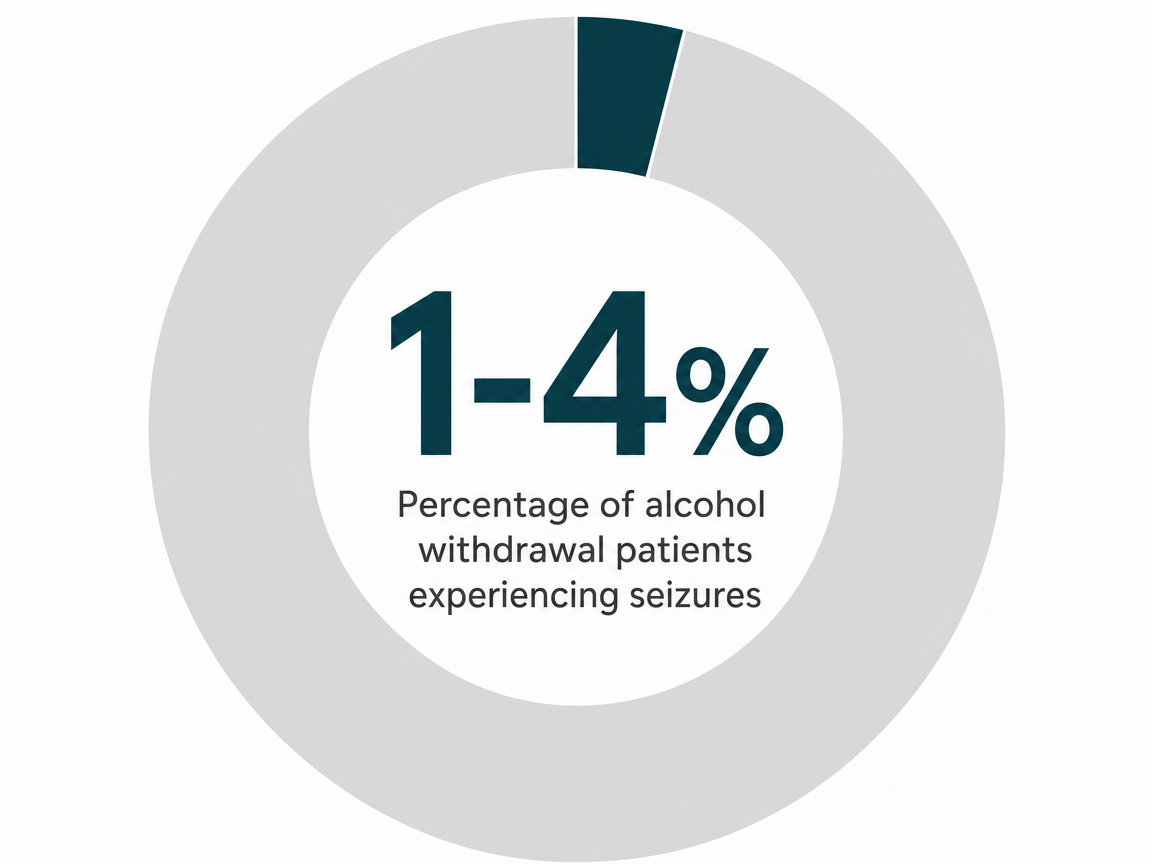
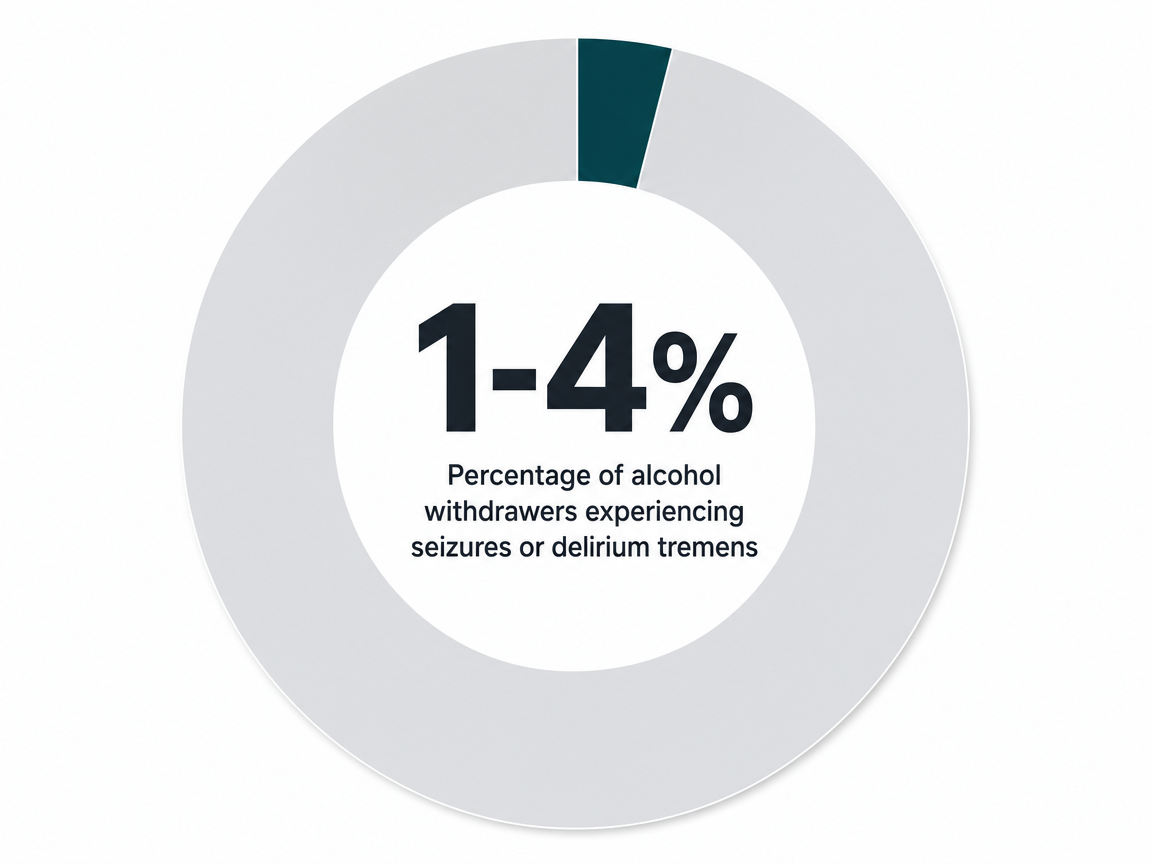
The hard number to sit with: withdrawal seizures occur in roughly 1–4% of people going through alcohol withdrawal 1. That sounds small until you remember nobody knows in advance which group they're in. The whole goal of medical detox in alcohol cases is simple — keep you out of the seizure and DT lane by using monitoring and medications (usually benzodiazepines, given on a tapering schedule by a clinician) before things escalate 3.
Benzodiazepines deserve their own warning. If you've been on a daily prescribed or non-prescribed benzo for more than a few weeks, do not stop on your own. Benzo withdrawal can also cause seizures, and the timeline stretches longer than alcohol — sometimes weeks. A slow, supervised taper is the standard, not a cold-turkey weekend.
If alcohol or benzos are in your daily picture, home is not the place to find out how your body reacts.
Opioids: The Discomfort Won't Kill You, the Aftermath Might
Opioid withdrawal is a different animal, and the honesty here goes the other direction. Coming off heroin, fentanyl, oxycodone, hydrocodone, or methadone is brutal — bone aches, vomiting, diarrhea, chills, the kind of restless misery that makes the clock feel broken — but it almost never kills you directly. That truth gets twisted online into "so you can just tough it out at home." That's where people get hurt.
The danger with opioids isn't the withdrawal itself. It's what happens on day five, day ten, day thirty. When you stop using opioids, your tolerance drops fast. If you relapse — and relapse is common after an unsupported detox — the dose your body used to handle can now stop your breathing. The CDC is direct about this: detoxification on its own is not recommended for opioid use disorder because of the increased risk of overdose death afterward 5. A 2024 review of home-based detox echoed the same caution. Supervised home detox showed few serious adverse events during the withdrawal itself, but post-detox overdose risk for opioids stayed elevated 4.
That's the gap most people don't see coming. You make it through the worst week. You feel proud, maybe a little fragile. A bad day shows up. You use what feels like "your old amount." Your body, now reset, can't handle it.
This is why the standard of care for opioid use disorder isn't "detox and good luck." It's medication for opioid use disorder (MOUD) — buprenorphine, methadone, or naltrexone — paired with counseling. Those medications reduce cravings, stabilize the brain, and dramatically lower overdose risk in the months after you stop using 5. Non-opioid medications can also bridge the worst symptoms during withdrawal itself, making the transition into long-term treatment realistic instead of theoretical 10.
If opioids are part of your story, the right question isn't "can I get through withdrawal at home." It's "what's my plan for the months after." Detox without that plan isn't a finish line. It's a setup. A medical team builds the after-plan with you before the withdrawal even starts, which is most of the reason it works.
The 60-Second Red Flag Self-Check
Read this list slowly. If any one of these is true for you, home is not the safe place to detox — even if a friend swears they did it once and were fine.
- You drink heavily every day, or near-daily. If you've been having 6+ drinks a day for weeks or months, your nervous system has rewired around alcohol. Stopping suddenly is when seizures and delirium tremens enter the picture, and those land in roughly 1–4% of people withdrawing from alcohol 1.
- You've had a withdrawal seizure before. One past seizure during a quit attempt is the single strongest predictor of another. This is a medical-detox conversation, not a willpower one 3.
- You've had DTs before — or symptoms that sound like them. Severe confusion, hallucinations, fever, racing heart during a past quit attempt mean your body has shown you what it can do. Don't audition it again 2.
- You take a benzodiazepine daily. Xanax, Klonopin, Ativan, Valium, even at "just my prescription." Benzos require a slow, supervised taper. Cold turkey can cause seizures 3.
- You're using opioids and alcohol together. Concurrent withdrawal from both is not a home project. The standard of care is a controlled inpatient setting where clinicians can manage both withdrawals at once with the right medications 6.
- You have another medical condition in the mix. Heart disease, uncontrolled high blood pressure, diabetes, liver disease, a seizure disorder, or a serious mental health condition all raise the stakes of withdrawal. So does being on multiple prescriptions 3.
- You're pregnant. Withdrawal during pregnancy carries risks for you and the baby — including miscarriage and preterm labor with alcohol or opioid withdrawal. This needs an OB and an addiction medicine team, not a quiet weekend at home.
- You've tried to quit at home before and it didn't hold. That isn't a character flaw. It's information. Each unsupervised attempt tends to be harder, not easier — and a different setting changes the odds 1.
Zero red flags, and you're talking about a few weeks of moderate drinking or a short stimulant run? A supervised outpatient detox with a clinician checking in is often a reasonable starting point 1, 4. One red flag? Pick up the phone before you pick a date. More than one? Medical detox isn't being cautious — it's matching the level of care to what's actually happening in your body.
What Medical Detox Actually Does (and Doesn't) Do
Medical detox isn't a TV scene. There are no straps, no white walls, no shouting. Most of it is quiet. Vital signs every few hours. A nurse who already knows what hour 36 looks like. Medication ready before you need it, not after. Here's what the work actually involves — and the part it can't do for you.
Monitoring, Medications, and the Goal of Preventing Seizures
The whole point of medical detox, in plain language, is to keep you out of the emergency you didn't see coming. SAMHSA and ASAM put it bluntly: the major goal of alcohol detox is to avoid seizures and delirium tremens 3. Not to make you comfortable, though they try. Not to fix your life, though they help you start. To keep your nervous system from doing something irreversible while it recalibrates.

What that looks like in practice is steady monitoring. A nurse checks your blood pressure, heart rate, temperature, and a withdrawal symptom scale on a regular schedule — usually every few hours during the first day or two, when the risk window is widest. If your numbers start climbing or your symptoms shift, the team adjusts before things escalate, not after.
Medication is the other half.
- For alcohol withdrawal, that typically means a benzodiazepine given on a tapering schedule, which calms the overactive nervous system enough to ride out the danger window without seizing 3.
- For opioid withdrawal, it can mean buprenorphine or methadone to ease symptoms, plus non-opioid medications — clonidine, anti-nausea drugs, sleep support — to take the sharp edges off 10.
- For someone coming off both opioids and alcohol at once, both withdrawals can be managed at the same time, but only in a controlled inpatient setting where clinicians can layer the medications safely 6.
What detox isn't doing: it isn't "flushing" anything. There's no IV bag that pulls the substance out faster. Ultra-rapid detox protocols that promise to compress the timeline have been linked to serious side effects and death, and they're not the standard of care anywhere reputable 8. Real detox runs at the speed your body can handle, with the medications and monitoring that make that speed survivable.
That's the trade. You give up a few days of being in your own bed. You get a team whose only job, those days, is making sure you're still here next week.
Why Detox Alone Isn't the Finish Line
Here's the part that gets glossed over in most online conversations about detox: finishing withdrawal isn't the same as being in recovery. Detox stabilizes your body. It doesn't rewire the cravings, the triggers, or the patterns that built up around using in the first place. If you walk out of a detox bed on day five with no plan, you walk into the same life that shaped the original problem.
For opioids, that gap is the one that quietly takes lives. The CDC is clear: detoxification on its own is not recommended for opioid use disorder because it raises the risk of overdose death afterward 5. Your tolerance has dropped. The dose that felt familiar two weeks ago can stop your breathing now. That's why the standard of care pairs medical detox with medication for opioid use disorder — buprenorphine, methadone, or naltrexone — and ongoing counseling, not just a clean exit interview 5.
For alcohol and other substances, the same logic holds in a softer form. A 2024 review of home-based detox found that even when the withdrawal itself goes smoothly, relapse rates climb without a follow-on treatment plan 4. Detox is the doorway. The room you walk into matters more than the doorway did.
That's why a good detox program isn't selling you five days of beds. It's connecting those five days to whatever comes next — residential treatment, partial hospitalization, intensive outpatient, sober living, ongoing therapy, medication management. SAMHSA's clinical guidance frames detox as the preparation phase for treatment, not the treatment itself 11. The team you detox with should be having the "what's next week" conversation before you ever finish the first one.
If you're weighing this decision for yourself or someone you love, that's the question worth asking any program before you walk in: not just "how will you get me through withdrawal," but "what does the month after look like, and are you still with me for it?" That answer tells you whether you've found a finish line or a real start.
The Middle Path Most People Don't Know Exists
A lot of people picture two doors. Door one: tough it out alone in your apartment. Door two: a hospital bed for a week with strangers checking your blood pressure at 3 a.m. If both of those feel wrong, you're not stuck. There's a third door most online conversations skip past entirely.
It's called supervised outpatient detox, and it's exactly what it sounds like. You sleep in your own bed. You see a clinician, often daily, sometimes through telehealth check-ins paired with in-person visits. You get medication on a structured schedule — usually a tapering dose of a benzodiazepine for alcohol withdrawal, or comfort medications for opioid symptoms — and someone with a license is tracking your numbers. The NIH compared outpatient and inpatient alcohol detox directly and found outpatient is as safe and effective as inpatient for mild-to-moderate withdrawal, with lower cost and stronger social support, though completion rates run a little lower 1. A 2024 review of supervised home-based detox reported no serious adverse events when people had real clinical oversight in the loop 4.
The keyword in both findings is supervised. This isn't "detox at home" the way the internet sometimes uses the phrase — alone, with a bottle of Gatorade and willpower. It's a clinician building a plan with you, prescribing the right medications, and being reachable when something shifts.
Outpatient detox tends to fit when your withdrawal risk lands on the milder end: no history of seizures or DTs, no daily benzodiazepines, no opioid-and-alcohol overlap, no major medical or psychiatric complications, and someone reliable at home with you 1. If any of those red flags are in the picture, a residential medical detox bed is the right call — not because outpatient "failed," but because the level of care should match what your nervous system is actually doing.
The honest takeaway: home, alone, with no clinician — that's the path the research keeps warning against. Home, with a treatment team holding the other end of the rope — that can be a real option. Worth asking about by name when you call.
If There's Any Risk, Don't Guess — Call First
Here's where the article ends and your next move begins. You've read the substance breakdown. You've run the red-flag check. You probably already know, somewhere underneath the noise, which side of the line you're on.
If you're not sure — that's the answer. Not sure means call.
A phone screening with a detox team takes about ten minutes. They'll ask what you've been using, how much, how long, what's happened during past quit attempts, what other medications and conditions are in the picture. By the end of the call, you'll know whether a supervised outpatient detox is reasonable for you, or whether the safer first step is a few days in a medical bed with a nurse, monitoring, and the right medications on hand to keep withdrawal from doing damage you can't undo 3.
If you're in Kansas, Ohio, Missouri, or Oklahoma, Arista Recovery runs medical detox at our Paola, Kansas and Hilliard, Ohio campuses, with 24/7 admissions, same-day intake when a bed is open, and in-network coverage with most major insurance plans. The team that walks you through detox is the same team that helps you build the month-after plan — residential, partial hospitalization, intensive outpatient, medication-assisted treatment — so day six isn't a cliff.
If we're not the right fit for your situation, that's fine too. SAMHSA's National Helpline (1-800-662-HELP) is free, confidential, and open 24/7 in English and Spanish, and they'll route you to a local option 9.
One last thing, and then you can put the phone down or pick it up. Choosing medical support isn't a failure of willpower. It's matching the level of care to what your body is actually doing. The people who come through this well usually aren't the toughest ones in the room. They're the ones who asked early.
If there's any risk, don't guess — call first.
Frequently Asked Questions
Can I start detox at home and switch to medical care if it gets bad?
You can, but the timing is the trap. Alcohol withdrawal seizures and delirium tremens often land in the 24–72 hour window, and they can escalate fast — sometimes faster than a ride to the ER 2. By the time "it got bad" is obvious, you may already be past the point where you can safely drive yourself or make the call clearly. Better move: get a 10-minute phone screening before you stop. The team will tell you whether home is reasonable or whether starting in a medical bed is the safer first day.
How do I know if my drinking history puts me in the dangerous category?
The rough markers clinicians look for: daily or near-daily drinking for weeks or months, heavier amounts (commonly six or more drinks a day), morning drinking to stop the shakes, or any past withdrawal symptoms — tremors, sweats, racing heart, hallucinations, or a seizure during a previous quit attempt 2, 7. A history of delirium tremens puts you firmly in the medical-detox category 3. If you're not sure where you land, that uncertainty itself is the signal to call. A clinician can tell you in one conversation what a self-assessment can't.
I've tried to quit at home before and failed. Does that change things?
Yes, and not in the way you might think. A past home attempt that didn't hold isn't a character verdict — it's data. Each unsupervised attempt tends to come with a harder withdrawal the next time around, because your nervous system has been through the cycle before 1. It also means a different setting is worth trying, not the same one with more willpower. Supervised outpatient detox or a few days of medical detox gives your body a different experience to work with — medication, monitoring, and a plan for what comes after.
Is medical detox covered by insurance?
Most major insurance plans cover medical detox as a medical necessity, though specifics vary by plan and diagnosis. At Arista Recovery, the admissions team verifies your benefits during the intake call — usually within the same conversation — so you know what's covered before you commit to anything. If you don't have insurance or your plan won't cover what you need, SAMHSA's National Helpline (1-800-662-HELP) is free and confidential 24/7, and they'll route you to local options that can work with your situation 9.
How long does medical detox take?
For most people, the acute withdrawal window runs 3 to 7 days, depending on the substance and your history. Alcohol detox typically takes 3–5 days, with the riskiest hours falling between 24 and 72 2. Opioid withdrawal is usually 5–7 days of acute symptoms, sometimes longer for methadone 12. Benzodiazepine tapers run longer — weeks, not days. Detox itself is the short part. The plan that follows it — residential, outpatient, medication-assisted treatment — is where the real recovery work happens, and it should be set up before you finish day one.
References
- An Overview of Outpatient and Inpatient Detoxification - PMC - NIH. https://pmc.ncbi.nlm.nih.gov/articles/PMC6761814/
- Alcohol withdrawal: MedlinePlus Medical Encyclopedia. https://medlineplus.gov/ency/article/000764.htm
- Quick Guide For Clinicians Based on TIP 45—Detoxification and Substance Abuse Treatment - NIDA. https://nida.nih.gov/sites/default/files/samhsa_detoxification_and_substance_abuse_treatment.pdf
- Home‐based detoxification for individuals with alcohol or drug dependence - PMC - NIH. https://pmc.ncbi.nlm.nih.gov/articles/PMC11814356/
- Opioid Use Disorder: Treating | Overdose Prevention - CDC. https://www.cdc.gov/overdose-prevention/hcp/clinical-care/opioid-use-disorder-treating.html
- Concurrent opioid and alcohol withdrawal management - PMC - NIH. https://pmc.ncbi.nlm.nih.gov/articles/PMC10696169/
- Complications of Alcohol Withdrawal: Pathophysiological Insights - PMC. https://pmc.ncbi.nlm.nih.gov/articles/PMC6761825/
- Pharmacological strategies for detoxification - PMC - NIH. https://pmc.ncbi.nlm.nih.gov/articles/PMC4014033/
- National Helpline for Mental Health, Drug, Alcohol Issues - SAMHSA. https://www.samhsa.gov/find-help/helplines/national-helpline
- Review article: Effective management of opioid withdrawal symptoms. https://pmc.ncbi.nlm.nih.gov/articles/PMC6590307/
- Quick Guide for Administrators Based on TIP 45. https://radarcart.boisestate.edu/library/files/2017/07/TIP-45-QuickGuideAdmin_SMA06-4226.pdf
- Clinical Guidelines for Withdrawal Management and Treatment of Drug Dependence in Closed Settings. https://www.ncbi.nlm.nih.gov/books/NBK310652/