.webp)


Key Takeaways
- Inpatient rehab in Paola fits people for whom weekly outpatient sessions, repeated detox attempts, or unstable home environments have stopped holding the work in place.
- Rural Kansas barriers like transportation, travel time, and small-town stigma are real obstacles that shape both admission and follow-through after discharge 8, 7.
- KanCare can now pay for qualifying residential SUD stays after the IMD exclusion was removed, so older assumptions about Medicaid not covering inpatient care are outdated 4.
- Before committing, compare licensing and accreditation, what insurance or KanCare actually covers same-day, the step-down plan after 30 days, and how you'll handle work, family, and the ride home.
When a weekly appointment stops being enough
You've probably tried. Maybe you cut back for a stretch. Maybe you've sat through a Tuesday-evening counseling slot in Olathe or Ottawa, said the right things, and then driven home and walked straight back into the thing you were trying to leave. That doesn't make you a failure. It usually means the level of care you've been given is smaller than what you're actually carrying.
Outpatient works for a lot of people. It does not work when the drinking starts before noon, when withdrawal is making you sick, when your kid found a bottle behind the couch again, or when you can't picture making it through a single weekend at home without something giving way. At that point, an hour a week isn't a treatment plan. It's a holding pattern.
Inpatient rehab, also called residential treatment, is what comes next. You live on-site. You eat, sleep, and do the work in the same place, usually for somewhere between two weeks and a couple of months, with medical staff in the building and structure built into every day. National data show that most people who meet criteria for a substance use disorder never get specialty treatment at all 5. If you're reading this, you're already further along than the statistic suggests. The rest of this article is about what that next step actually looks like in Paola, and how rural Kansans are getting there.
The rural Kansas backdrop you're deciding inside of
What the overdose numbers look like close to home
If you've lost someone in the last few years, you already know the numbers without needing a chart. Kansas has been losing more people to drug overdose deaths each year through the early 2020s, with synthetic opioids like fentanyl driving the steepest part of the climb. KDHE's own 2020–2024 overdose summary tracks that trajectory year by year and breaks it down by drug category and county, so you can see how the curve has bent for the region that includes Miami County and the towns feeding into Paola 2.
That data isn't there to scare you. It's there because the people compiling it know what families in places like Osawatomie, Louisburg, La Cygne, and Garnett have been living through. A nonfatal overdose on a Saturday night is not in the headlines. Neither is the third hospital visit, the second car wreck, the morning your mom couldn't be woken up but eventually was. KDHE's dashboard also tracks those nonfatal events, which is the part most people miss 1.
What this means for the decision you're weighing: the need for residential-level care in this part of Kansas is not theoretical, and you're not overreacting by considering it.
Alcohol, not just opioids, is filling Kansas beds
Most coverage of substance use these days starts and ends with fentanyl. In Kansas, that misses a lot of what's actually happening at the kitchen table. Alcohol use disorder is still the most common reason people end up in residential treatment in this state, and KDHE's own work on binge drinking prevalence among Kansas adults backs that up across age groups, income levels, and counties 11.
You may not have ever touched an opioid. You may not know what a fentanyl test strip is. And you may still need inpatient care, because what's been happening with alcohol in your life has its own physical hold, its own withdrawal risk, and its own way of running a household into the ground.
If you've been telling yourself that what you're dealing with isn't "as bad" as the stories you see on the news, please hear this: residential programs in Paola are built for alcohol use disorder, not just opioid use disorder. You do not need to qualify your suffering against someone else's to deserve a bed.
Why 'there's nothing around here' has been partly true
For a long time, the line you've heard from neighbors, from your primary care doctor, sometimes from your own family, has been some version of: there's nothing around here. That wasn't entirely wrong. Rural Kansans have run into a stack of barriers that urban patients usually don't — and the research on it is unusually specific.
A qualitative study of substance use treatment access compared rural and urban communities through counselors' eyes and found that transportation difficulties, fewer local services, longer travel times, and stigma in tight-knit communities consistently surfaced as the major obstacles for rural patients 8. A separate peer-reviewed study looking specifically at what happens after detox or residential treatment found that travel time directly shapes whether rural clients actually make it into follow-up care, which is the part that protects the work you do inside a 30-day program 7.
Layer on the broader rural health workforce crunch — fewer providers, hospital closures, long drives to anything specialty — and the math gets bleak fast 14. The Kansas Center for Rural Health has been naming this for years.
The honest reframe is this: you weren't imagining the wall. It was real. What's changed is that the wall has doors in it now, and a residential program in Paola is one of them — close enough to home for family visits, far enough to break the daily pattern.
What inpatient rehab in Paola actually means
Who this level of care is built for
Inpatient rehab isn't the first stop. It's the stop you make when the other stops haven't held.
The people who land in residential treatment in Paola usually share some version of the same situation. Withdrawal is medically risky — shaking hands in the morning, a seizure history, a benzodiazepine taper that's been put off for years. Outpatient has been tried, sometimes more than once, and the home environment keeps undoing the work between sessions. There's a co-occurring mental health piece — depression you stopped naming, anxiety that drinking quiets for an hour and worsens for ten, PTSD from something you don't talk about. Or the substance use has tangled itself into every part of the day, and unhooking it requires being somewhere it isn't.
You don't have to have lost everything to qualify. The national picture from the 2024 NSDUH release shows the treatment gap is enormous — most people who meet criteria for a substance use disorder never get specialty care 5. A lot of those people are functioning. They're paying bills. They're showing up. They also know, privately, that the wheels are loosening.
If outpatient hasn't been enough, that's the signal. Not rock bottom. Just enough.
Detox is the doorway, not the treatment
Here's a thing that gets confused, often by people who've been through detox before and felt like nothing worked.
Medical detox is the supervised process of getting a substance out of your body safely. For alcohol, benzodiazepines, and opioids, that can mean medication to soften withdrawal, vitals monitored around the clock, and a clinician within reach if something goes sideways. It usually takes a few days to a week. It's necessary when your body has gotten used to a substance enough that quitting cold is dangerous on its own.
That's what residential treatment is for. You move from detox into inpatient with the physical part stabilized, so you can actually be present for the therapy, the groups, the sleep, the meals, the routine. If you've detoxed before and watched it not stick, this is probably why. The doorway opened, and there was nowhere to walk to.
What a week inside looks like
People imagine a residential program as a hospital ward or a movie set. It's neither.
A typical day in Paola starts early, but gently. Breakfast with the other residents. A morning check-in or community meeting where you say how you slept, how you're showing up. From there, the day stacks together blocks of work — individual therapy with your assigned counselor, group therapy on a specific topic (relapse triggers, family roles, grief, anger, shame), and a psychiatric or medical appointment if you have one that week.
The therapies aren't all sitting in chairs. Cognitive behavioral therapy and dialectical behavioral therapy are the spine — practical skills for noticing a thought, naming it, and choosing what to do next. Trauma therapy comes in when you're ready, not on day one. Around those, experiential pieces — equine therapy with horses on the campus, horticultural work in the garden, art, sand tray — give your nervous system somewhere to go that isn't language. For people who have spent years explaining themselves and getting nowhere, that matters more than it sounds.
Afternoons usually include a movement piece, free time, and family contact windows. Evenings are quieter — a community group, reading, a phone call home, sleep that actually happens because nothing is keeping you up.
The first week is hard. You'll be tired in a way you forgot was possible. By the second week, most people notice something small — eating a full plate, sleeping through the night, laughing at something a peer said. Those count. Hold onto them.
What happens after the 30 days
Discharge day is not the finish line. It's the handoff. And the handoff is where a lot of the work gets won or lost.
SAMHSA's TIP 45 guidance is direct about this: detoxification by itself "does little to change long-term drug use," and the same logic extends to residential care that ends without a plan 10. A 30-day stay can stabilize you, teach you skills, and give your body a real reset. Without something structured waiting on the other side, those gains start to slip.
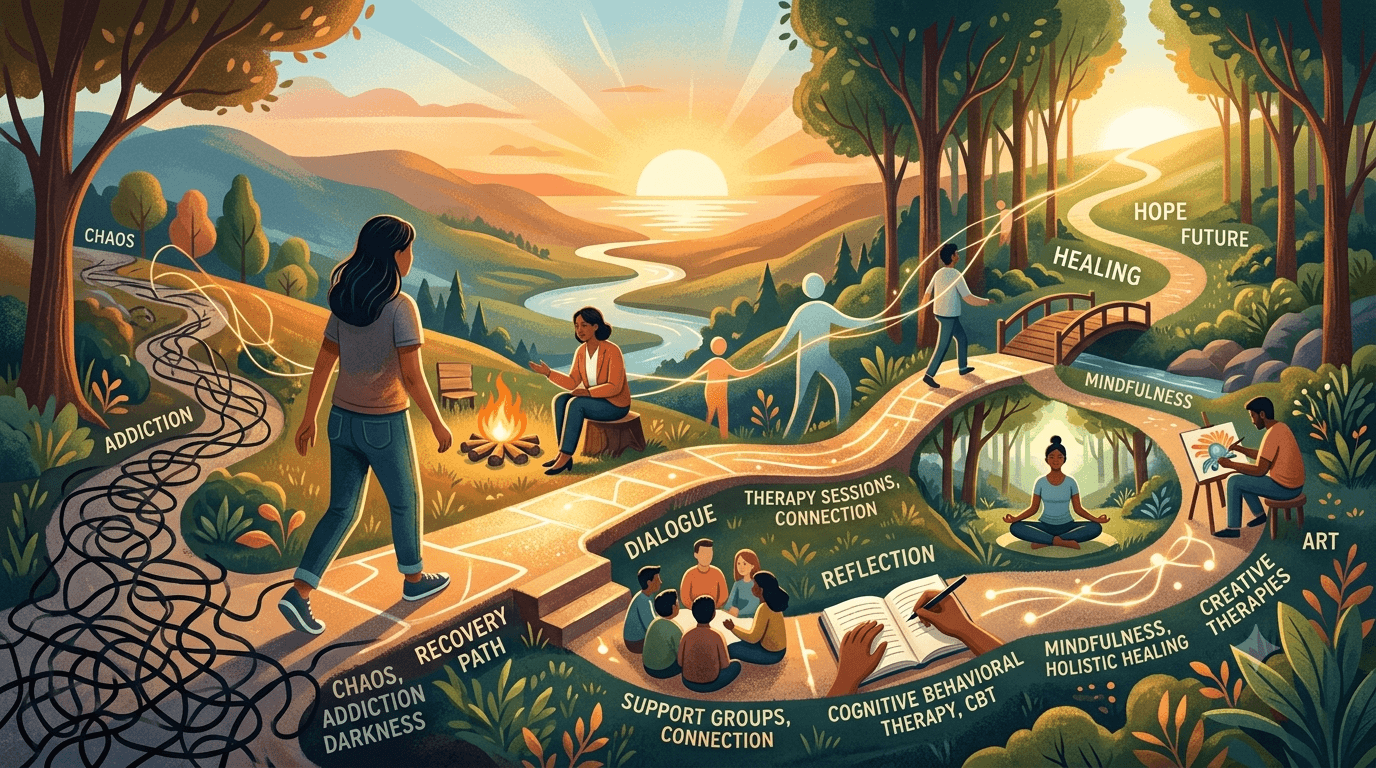
The continuum most Paola residents step through, in order, looks like this:
- Medical detox if you needed it.
- Residential inpatient for the immersive stretch.
- Partial hospitalization (PHP), where you're in programming most of the day but sleeping somewhere else — often a sober living home nearby.
- Intensive outpatient (IOP), usually three evenings a week, designed to fit around work.
- Standard outpatient — a counselor, a medication check-in, a group.
Recovery supports like peer groups and family programming run alongside all of it.
For rural Kansans, the step-down piece is where the geography bites again. The peer-reviewed study on rural continuity into follow-up care found that travel time directly shapes whether people actually make it to those next appointments after leaving residential treatment 7. That's why a good discharge plan in Paola maps the drive home before you ever pack a bag — telehealth slots, a sober living option closer to campus for the first stretch, family rides booked in advance. Leaving treatment without that map is the part that quietly undoes thirty days of work.
How Kansans actually pay for it
The KanCare change most people haven't heard about
For years, the standard answer about Medicaid and residential treatment in Kansas went something like this: it won't cover the bed, only the doctor visits, so you're on your own for the stay. Families heard that, did the math, and walked away.
That answer is out of date.
If you've been quietly assuming Medicaid wouldn't touch a 30-day residential program, it's worth a phone call to find out where you actually stand today. The rule that kept that door shut for a long stretch isn't the rule anymore. Same KanCare card, different answer than the one you got three years ago.
Commercial insurance, self-pay, and same-day verification
If you carry employer insurance — Blue Cross, Aetna, Cigna, United, one of the regional plans — residential SUD treatment is usually a covered benefit when it's medically necessary. The catch is almost always the in-network piece and the prior authorization, not the diagnosis itself.
Most programs in Paola will run a benefits verification the same day you call. You give them your member ID, they call the back of your card, and they come back with what your plan covers, what your out-of-pocket looks like, and whether authorization is needed before admission. That call takes a couple of hours, not weeks.
Self-pay is also on the table, and if you're uninsured, the admissions team can usually walk you through KanCare eligibility on the same call. You don't have to have the money figured out before you pick up the phone.
Leaving a small town for 30 days without it becoming the story
The job, the kids, the pickup in the church lot
Here's the part nobody wants to say out loud: in a town where people recognize your truck before they recognize your face, going away for treatment feels like writing a press release about yourself. You're already exhausted. Adding the story of where you went on top of it can feel like one weight too many.
So plan the story before you go.
- For work, you don't owe anyone a diagnosis. Federal medical leave protections and most employer handbooks treat residential treatment the way they treat any other medical absence — "a medical issue I'm getting treated for" is a complete sentence. Your HR contact needs dates. Your supervisor needs a return window. Neither needs the rest. Many people in Paola programs keep their job by giving exactly that much and nothing more.
- For the kids, age-appropriate honesty does more for them than a cover story that unravels later. Mom or Dad is going somewhere to get help getting better. They'll be safe. You'll call.
- For the church lot, the school pickup line, the feed store — pick one or two people who actually need to know and let the rest of the town fill in their own blanks. They will anyway.
The qualitative work on rural treatment barriers names stigma as one of the biggest obstacles people face 8. Naming it doesn't make it disappear. It does make it something you're managing instead of something managing you.
Getting to Paola when you don't have a ride
If transportation has been the wall, you're not alone in that, and you're not stuck behind it the way you used to be.
Research on rural substance use treatment access keeps landing on the same finding: transportation difficulties and long travel times are among the biggest reasons people don't start or finish care 8. A separate study following rural clients after detox or residential treatment found travel time directly shapes whether they make it to follow-up appointments at all 7. The road is real.
Practical options for getting to Paola:
- A family member or friend drop-off on admission day
- Rideshare arrangements that some programs coordinate through medical transport partners
- KanCare non-emergency medical transportation if you're enrolled
- Admissions teams that will help map the trip before you ever leave the driveway
You don't have to solve the ride alone before you call.
Licensing, oversight, and what 'licensed in Kansas' is supposed to mean
You don't need to become an expert in regulatory code to make this decision, but it helps to know a residential program in Kansas isn't operating on a handshake. Licensed substance use providers are required to develop and follow written policies covering how they manage SUD and medication-assisted treatment, including how medications are stored, dispensed, and documented 13. That's the floor, not the ceiling.
On the structural side, Kansas doesn't require a Certificate of Need for residential behavioral health facilities, but licensed programs are subject to ongoing monitoring after they open their doors 3. Translation: someone outside the building is checking the work.
If you want to verify a specific program before you go, two practical moves — ask whether they're licensed by the state of Kansas for residential SUD services, and ask whether they hold an independent accreditation like Joint Commission. Either answer tells you more than a brochure can.
Deciding to go
There's a moment most people describe later as quieter than they expected. Not a dramatic bottom. Just a Tuesday morning where you sat in the truck for an extra minute before going inside, and something in you said, this isn't working anymore.
If you're there, or close to there, a few things are true at the same time. Leaving home for a few weeks is a real disruption. The job, the kids, the dog, the rent — none of that pauses politely. And the alternative, which is another six months of the same pattern, costs more than the disruption does. You've probably already done that math, even if you haven't said it out loud.
What helps is making the call before you've decided. A benefits check, a conversation about what admission would look like, the question of whether KanCare or your plan covers the stay — none of that commits you to a bed. It just gives you real information instead of guesses. SAMHSA's National Helpline is open 24/7 if you want a starting place that isn't tied to any one program 9. Arista Recovery's admissions team in Paola can run verification the same day. Either door gets you to the same place: knowing what's actually possible. You don't have to be sure. You just have to be willing to find out.
Frequently Asked Questions
How long does inpatient rehab in Paola usually last?
Most stays run between 28 and 90 days, depending on what your body and your situation need. Some people stay two weeks, some stay closer to three months. The length isn't a number you pick on day one — it's a clinical call that gets revisited as you go. You won't be held to an arbitrary date if you need more time, and you won't be kept longer than you need.
Can I keep my job if I leave for 30 days of treatment?
Often, yes. Federal medical leave protections and most employer handbooks treat residential treatment like any other medical absence. You don't owe your employer a diagnosis — "a medical issue I'm getting treated for" is enough. HR needs dates and a return window. Your supervisor needs to know you'll be back. Many people in Paola programs hold onto their job by giving exactly that and nothing more.
Will KanCare or my insurance actually pay for residential treatment?
Often, yes — and the KanCare answer changed recently. CMS's interim evaluation confirms the IMD payment exclusion has been removed, so KanCare can now pay for SUD residential stays at qualifying programs 4. Commercial plans (Blue Cross, Aetna, Cigna, United) usually cover medically necessary residential care in-network. A same-day benefits verification call tells you what you actually owe before you commit.
What if I don't have a ride to Paola?
You're not the first person to hit that wall — research keeps naming transportation as one of the biggest reasons rural Kansans don't start care 8. Workable options include a family or friend drop-off, rideshare arranged through medical transport partners, and KanCare non-emergency medical transportation if you're enrolled. Admissions teams will help map the trip before you leave the driveway. Call first, sort the ride second.
Do I have to detox before I get admitted?
No — and trying to detox alone from alcohol or benzodiazepines can be dangerous. Most Paola programs admit you straight into medical detox if your body needs it, with vitals monitored and medication to soften withdrawal. From there you move into residential care with the physical part stabilized. SAMHSA's TIP 45 guidance is clear that detox alone "does little to change long-term drug use" 10.
How private is this in a small Kansas town?
Federal health privacy law (HIPAA) plus tighter rules specific to SUD records (42 CFR Part 2) mean your treatment information can't be shared without your written consent. Programs won't confirm you're there to a caller. You decide who knows. The harder part is the social piece — the truck in the parking lot, the neighbor's questions — and naming one or two people you'll tell helps more than hoping no one notices.
References
- Overdose Data Dashboard | KDHE, KS. https://www.kdhe.ks.gov/1309/Data-Dashboard
- Overdose Reports & Resources | KDHE, KS. https://www.kdhe.ks.gov/1308/Reports-Resources
- Kansas Summary -- State Residential Treatment for Behavioral Health Conditions (ASPE).
- KanCare SUD Section 1115 Demonstration Interim Evaluation Report (Kansas). https://www.medicaid.gov/medicaid/section-1115-demonstrations/downloads/ks-kancare-appvd-int-eval-rpt-sud-01042023.pdf
- 2024 National Survey on Drug Use and Health (NSDUH) Releases. https://www.samhsa.gov/data/data-we-collect/nsduh-national-survey-drug-use-and-health/national-releases/2024
- Provisional Drug Overdose Death Counts (CDC). https://www.cdc.gov/nchs/nvss/vsrr/drug-overdose-data.htm
- Rural Clients' Continuity Into Follow-up Substance Use Disorder Treatment. https://pmc.ncbi.nlm.nih.gov/articles/PMC6856385/
- Barriers to Substance Abuse Treatment in Rural and Urban Communities. https://pmc.ncbi.nlm.nih.gov/articles/PMC3995852/
- National Helpline for Mental Health, Drug, Alcohol Issues - SAMHSA. https://www.samhsa.gov/find-help/helplines/national-helpline
- Quick Guide for Clinicians Based on TIP 45—Detoxification and Substance Abuse Treatment. https://nida.nih.gov/sites/default/files/samhsa_detoxification_and_substance_abuse_treatment.pdf
- Binge Drinking Prevalence, Frequency and Intensity in Kansas (KDHE). https://www.kdhe.ks.gov/ArchiveCenter/ViewFile/Item/541
- Prescription Drug Monitoring Program: Kansas State Profile (2021). https://www.ojp.gov/ncjrs/virtual-library/abstracts/prescription-drug-monitoring-program-kansas-state-profile-2021
- Kan. Admin. Regs. § 26-52-17 - Alcohol and substance abuse services. https://www.law.cornell.edu/regulations/kansas/K-A-R-26-52-17
- The Crisis in Rural Health Care (KUMC). https://www.kumc.edu/communications/about/publications/kansas-medicine-and-science/fall-winter-2023/the-crisis-in-rural-health-care.html