.webp)


Key Takeaways
- Make one confidential call to SAMHSA's National Helpline at 1-800-662-HELP (4357) or text your ZIP code to 435748, so a trained person can map local options without you needing a plan 1, 2.
- Ask for an assessment that screens substance use and mental health together, because the two conditions commonly co-occur and split care lets people fall through the gaps 3, 5.
- Match the recommended level of care — detox, residential, PHP, IOP, outpatient, or sober living — to the assessment, and expect to move between levels as needs change 15, 9.
- Verify insurance details before the first appointment, and if a plan denies care, request the denial in writing and appeal using parity protections strengthened by 2024 final rules 12, 11.
- Plan for the logistics that quietly derail treatment — work leave, childcare, transportation, privacy, pets, and bills — by naming them to the intake coordinator rather than solving them alone.
Start here: what to do in the next ten minutes
If you are reading this on your phone right now, you are already doing the hardest part. You opened the search. That counts.
Here is what the next ten minutes can look like, whether the help is for you or for someone you love:
- Check for immediate danger first. If someone has stopped breathing, is turning blue, cannot be woken up, is having a seizure, or is talking about ending their life, skip the rest of this article and call 911. For a mental-health crisis, call or text 988.
- Save one number. SAMHSA's National Helpline is 1-800-662-HELP (4357). It is free, confidential, open 24 hours a day, and answered in English and Spanish. TTY is 1-800-487-4889. You can also text your ZIP code to 435748 (HELP4U) 1, 2.
- Write down one sentence to say when someone answers. Something like: "I'd like a confidential assessment for substance use and mental health." That's it. You don't need a diagnosis, a plan, or the right words.
You do not have to decide about treatment today. You only have to make one call, or send one text, so a trained person can walk you through what's near you. The rest of this guide covers what comes after that first contact, step by step.
If someone is in danger right now
Suspected overdose: the exact steps
If a person is unresponsive, breathing is slow or stopped, lips or fingertips look blue or gray, or you cannot wake them, treat it as an opioid overdose until proven otherwise. Seconds matter, and you do not need to be certain to act.
Here is what the CDC recommends you do, in order 10:
- Give naloxone if you have it. Follow the instructions on the box. Naloxone is available over the counter in all 50 states 10.
- Call 911. Tell the dispatcher what you see and where you are.
- Support their breathing. Rescue breaths can help if you are trained; if not, keep the airway clear.
- Lay them on their side so they cannot choke if they vomit.
- Stay with them until emergency responders arrive. A second dose of naloxone may be needed if breathing does not return.
Naloxone reverses the opioid, but it does not treat what caused the overdose. Follow-up care matters, and you can start arranging it once the person is safe 10.
Benzodiazepine and alcohol withdrawal are different
Heavy daily alcohol use carries its own withdrawal risks, including seizures and delirium tremens, which can be life-threatening without medical care.
The safer path is a medically supervised detox or a clinician-guided taper. When you make the call in the next step, say exactly what the person is taking, how much, and for how long. That one piece of information changes what the intake team recommends.
Suicidal thoughts or a mental-health crisis
If you or someone with you is thinking about suicide, feeling unsafe, or in acute emotional pain, call or text 988. It is the Suicide and Crisis Lifeline, free and confidential, 24 hours a day.
You can call 988 even if you are not sure the moment qualifies as a crisis. Trained counselors listen, help you steady the next hour, and can connect you with local support. If a substance is involved too, tell them. That matters, and they can still help.
The five-step path from search to first appointment
Finding help feels huge when you look at it all at once. It gets smaller when you break it into five steps you can actually do, one after the other.
Here is the path the rest of this guide follows:
- Make one confidential call. You dial a hotline or a local program. You don't need a plan yet. You just need to connect with a trained person who can tell you what's near you 1.
- Ask for an assessment that covers both. Substance use and mental health often show up together, so you want a program that screens for both at the same time 3.
- Match the right level of care. Based on what the assessment finds, you'll be pointed toward detox, residential, a day program, outpatient visits, or a mix.
- Handle insurance, cost, and parity. You verify what's covered and learn what to do if a plan pushes back.
- Handle the logistics that stop most people. Work, kids, transportation, pets, privacy — the quiet stuff that keeps a good plan from happening.
You do not have to think about step five on the day you make the call. Just take step one. The rest unfolds from there.
Step one: make one confidential call
The numbers to save before you dial
Before you make the call, put these in your phone. Having them saved means you don't have to search again when you're already nervous.
- SAMHSA National Helpline: 1-800-662-HELP (4357). Free, confidential, 24 hours a day, every day of the year. English and Spanish. TTY is 1-800-487-4889 1.
- HELP4U text line: Text your ZIP code to 435748. You'll get treatment referrals near you without having to speak out loud 1, 2.
- FindTreatment.gov: SAMHSA's searchable directory of licensed programs. Useful if you'd rather read than talk first 2.
- 988: Suicide and Crisis Lifeline. Call or text if the moment feels unsafe, even if you're not sure.
None of these numbers show up on a credit card bill. None of them call your employer. The person who picks up is not a salesperson.
What to say when someone answers
You do not need a speech. You need one sentence. Try this one, or something like it:
"Hi. I'd like a confidential assessment for substance use and mental health. Can you help me find something near me?"
That's enough to start. If you're calling for someone else, say so: "I'm calling for my son. He's 24. He's using opioids and I think he's also really depressed."
The person on the other end is trained to take it from there. They'll ask a few questions — your city or ZIP code, what substance is involved, whether there's insurance, whether anyone is in danger right now. You can say "I don't know" to anything. That's a complete answer.
Keep a pen nearby. Write down the names and numbers of two or three programs they suggest. If you start to cry or need to hang up, that's okay. You can call back. The line is open 24 hours 1.
Step two: ask for an assessment that covers both
Why the co-occurring question changes everything
Here is the single most useful filter you can apply to any local program: do they treat substance use and mental health at the same time, in the same place, with the same team?
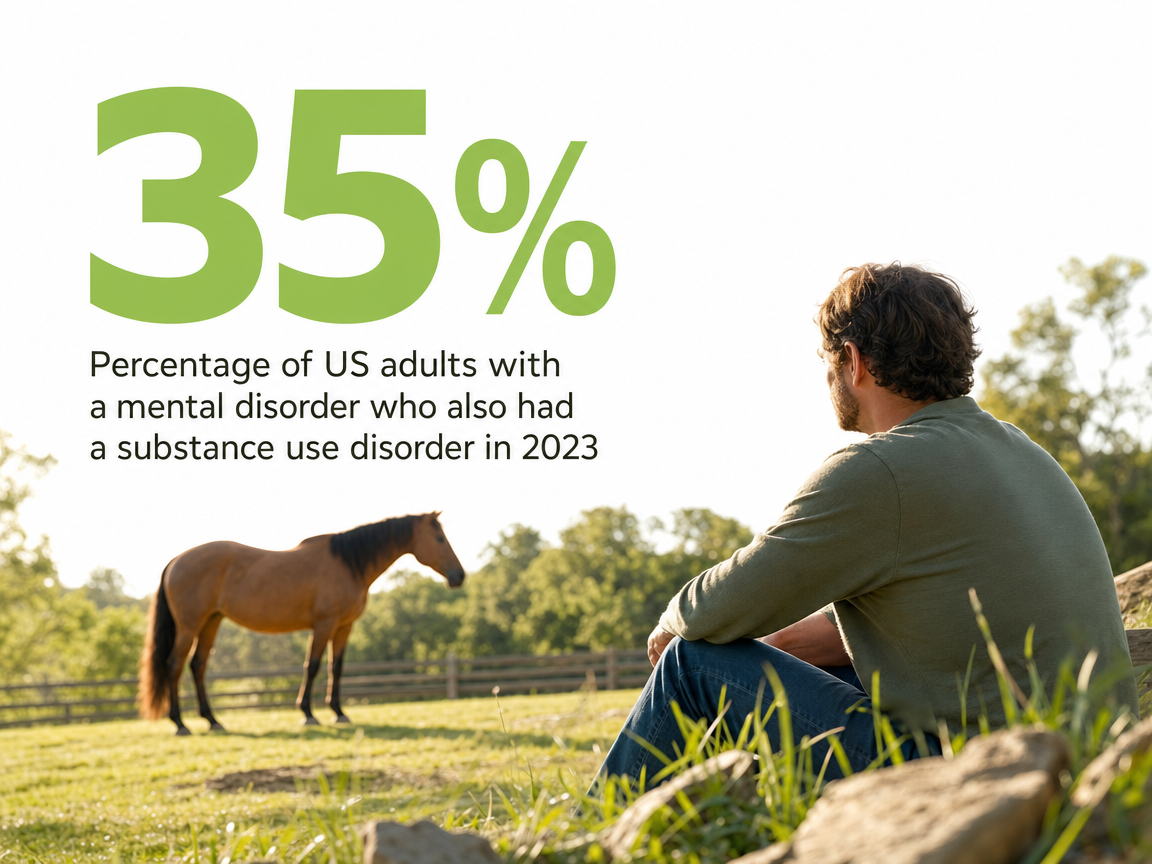
That question matters because the two conditions travel together more often than not. NIDA reports that in 2023, 35% of U.S. adults aged 18 and older with another mental disorder also had a substance use disorder 5. That is a nationally representative figure for adults, drawn from federal survey data — not a clinical sample, not a treatment population. If depression, anxiety, PTSD, or bipolar disorder is part of the picture for you or someone you love, you are not an exception.
When care is split — one place for the drinking, a different place for the depression, two sets of appointments, two sets of records — people fall through the gaps. NIMH recommends integrated care, where mental-health and substance-use treatment are coordinated in one place, by professionals trained in both 3. SAMHSA's clinical guidance says the same: concurrent treatment, tailored to where the person actually is 7.
You don't have to argue for this on the call. You just have to ask.
Five questions to ask any program before you book
When you call a program the hotline suggested — or one you found yourself — keep this short list nearby. You can read them straight off the screen. No one on the other end will think it's strange. Good programs expect these questions.
- "Do you treat substance use and mental health at the same time, with the same team?" This is the integrated-care question. If the answer is vague or they refer you elsewhere for the mental-health side, keep calling 3, 6.
- "Who does the assessment, and does it screen for both?" You want a comprehensive evaluation by someone trained in both conditions, not a substance-only intake form 3.
- "Can you start medication if it's indicated, and keep it going after discharge?" This matters for opioid, alcohol, and some mental-health conditions. Ask whether a prescriber is on staff 8, 9.
- "What levels of care do you offer, and how do you decide which one fits?" You want options — detox, residential, day program, outpatient — not a one-size recommendation.
- "Are you in-network with my insurance, and what will I owe?" You'll get into the detail in step four, but ask now so there are no surprises.
Write down the answers. If something feels off, trust that. You are allowed to call the next program on your list.
Step three: match the right level of care
From medical detox to outpatient, in plain language
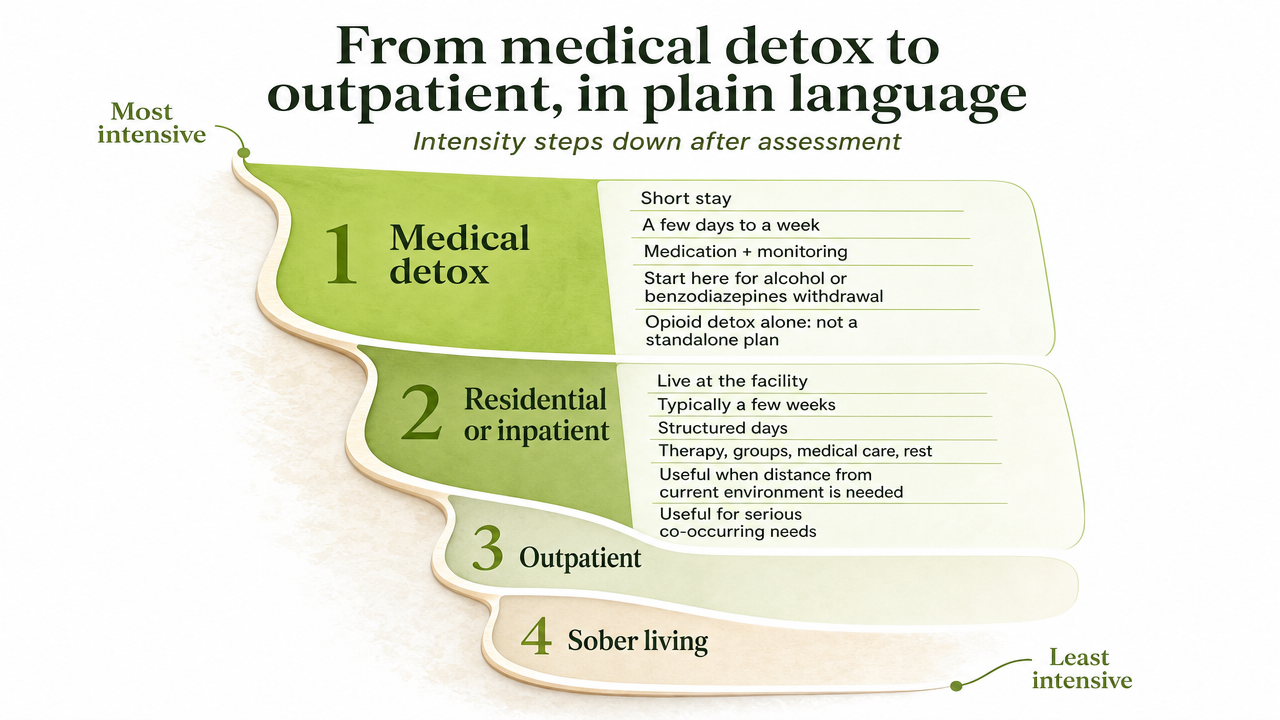
After the assessment, someone will suggest a level of care. The words can sound clinical. Here is what they actually mean, from most intensive to least.
- Medical detox.
- A short stay, usually a few days to a week, where clinicians manage withdrawal with medication and monitoring. This is where you start if alcohol or benzodiazepines are involved, since those withdrawals can be dangerous without supervision 15. For opioids, detox alone is not recommended as a standalone plan — CDC guidance warns it raises the risk of resumed use and overdose if medication treatment does not continue after 9.
- Residential or inpatient.
- You live at the facility, typically for a few weeks. Days are structured around therapy, groups, medical care, and rest. Good for people who need distance from their current environment or who have serious co-occurring symptoms.
- Partial hospitalization (PHP).
- You go to the program most of the day, five days a week, and sleep at home or in sober living. A step down from residential, or a step up from outpatient when more support is needed.
- Intensive outpatient (IOP).
- Several hours a few days a week. People often keep working or caring for family while attending.
- Standard outpatient.
- Weekly or twice-weekly therapy and medication appointments.
- Sober living.
- A substance-free home environment, usually paired with outpatient treatment, so recovery has a steady place to land.
You are not locked into one level forever. Most people move through two or three as they go. If the first recommendation feels wrong, say so during the assessment. The plan is supposed to fit you.
What treatment can actually include
Treatment is rarely one thing. It is usually a mix of therapy, medication when appropriate, and support that keeps the work going between appointments. Knowing what is possible helps you ask for it.
Medications, by condition. This is where a lot of people get surprised. For opioid use disorder, the FDA has approved three medications: buprenorphine, methadone, and naltrexone. All three have shown safety and effectiveness, and the right choice depends on your history, current use, and access 8. CDC guidance supports starting one of these rather than relying on detox alone 9. For alcohol use disorder, NIAAA identifies naltrexone, acamprosate, and disulfiram as evidence-based medication options that can be combined with counseling and tailored to the person 16.
Ask whether a program can start medication during your stay and keep it going after discharge. If the prescriber is only available during the first phase, you want to know that now.
Therapies. Expect some combination of individual therapy, group therapy, and family work. For co-occurring conditions, you want approaches that address both at the same time rather than treating one and parking the other 3, 7.
Support that outlasts the program. Case management, peer support, recovery housing, and follow-up appointments all count. The weeks after discharge are when a good plan either holds or quietly comes apart. Ask what that handoff looks like before you commit.
Step four: handle insurance, cost, and parity
What to verify before your first appointment
Insurance is the step where a lot of people stall. You can shrink it to a short phone call. Before your first appointment, call the member services number on the back of your insurance card and ask five things:
- Is this program in-network? Give the exact facility name and address. In-network means lower out-of-pocket cost.
- Does the plan cover the level of care being recommended? Detox, residential, PHP, IOP, and outpatient are billed differently.
- Is prior authorization required? If yes, who starts it, and how long does it take? Most programs will handle this for you.
- What are my out-of-pocket costs? Ask about the deductible, copay, coinsurance, and any annual limit.
- What are the medical-necessity criteria? These are the clinical reasons the plan will or won't approve a level of care.
Write down the name of the person you spoke with, the date, and a reference number for the call. If something changes later, that record matters.
If the plan says no: your rights under parity
A denial is not the end of the road. The Mental Health Parity and Addiction Equity Act requires most health plans that cover mental-health and substance-use benefits to apply limits no more restrictive than those used for medical and surgical care 12. That means prior authorization, step therapy, and network rules for addiction care cannot be tougher than what the plan uses for a knee surgery or a cardiac workup.
In 2024, the Departments of Labor, Health and Human Services, and the Treasury issued final rules strengthening those protections. The rules specifically target nonquantitative treatment limitations — things like prior authorization, step therapy, and provider-network standards — and require plans to evaluate whether those limits disproportionately restrict access to mental-health and substance-use care. Most provisions apply to group plans for plan years beginning on or after January 1, 2025, with additional pieces taking effect in 2026 11.
If a plan denies care, ask for the denial in writing, request the medical-necessity criteria they used, and file an appeal. Say the words "parity compliance" and ask for the plan's comparative analysis of its nonquantitative treatment limitations. Your state insurance commissioner and the U.S. Department of Labor also take complaints. You do not have to fight this alone — most treatment programs have staff who do appeals every week.
Step five: handle the logistics that stop most people
Most people don't stall on treatment because they can't find a program. They stall because they can't figure out what to do about the dog, the second shift, or the kids' school pickup. These are not small problems. They are the real reason good plans fall apart on a Tuesday.
Here is the quiet checklist worth running before you commit to a start date:
- Work. You usually don't have to disclose a diagnosis to take leave. Ask the intake coordinator about FMLA paperwork and short-term disability. Most programs have someone who completes these forms every week.
- Kids and dependents. Line up two people, not one. The backup matters more than the primary. Many programs can help coordinate family support during residential or PHP stays.
- Transportation. If driving yourself is a barrier, ask whether the program partners with a rideshare service or offers transportation. For outpatient levels, this is often the quiet difference between showing up and not.
- Privacy. Federal rules protect your treatment records tightly. Ask who the program can and cannot speak to, and sign releases only for people you choose.
- Pets, bills, pending appointments. Write them down. Hand the list to one trusted person. You are not abandoning your life — you are putting it on pause so you can come back to it.
You do not need to solve all of this before you say yes. You only need to name it out loud so someone can help you solve it with you.
State-specific entry points: Kansas and Ohio
FindTreatment.gov and the SAMHSA Helpline are the broad front doors, but your state has its own. If you live in Kansas or Ohio, two more resources can save you a round of phone tag.
Kansas. The Kansas Department for Aging and Disability Services (KDADS) publishes downloadable lists of licensed substance use disorder providers and methadone treatment programs, organized by location and facility, with contact information you can call directly 13. If methadone is part of what you need, the methadone-specific list spares you from guessing which programs are actually certified to offer it.
Ohio. The Ohio Department of Mental Health and Addiction Services (OhioMHAS) maintains licensure and certification resources you can use to confirm a program is credentialed before you book an assessment. Chemical-dependency professionals in Ohio are licensed through the Chemical Dependency Professionals Board, which OhioMHAS links to directly 14.
Licensure is one check, not the whole picture. Confirm a program is credentialed, then still ask the five questions from step two — especially whether they treat substance use and mental health together.
If you are the family member making the call
You are not overstepping. You are not being dramatic. If you are the one searching tonight, you are often the one who can actually make the first call happen, and that is a real contribution — not a stand-in for the person you love.
A few things to keep in mind as you dial:
- You can call the SAMHSA Helpline for information even if the person isn't ready. 1-800-662-HELP (4357) is open 24 hours and takes calls from family members, not just the person who uses substances 1, 2. You can ask what options exist in your area and what to say when the moment comes.
- Describe what you see, not what you think it means. "He's been drinking most days for about a year, and he's barely sleeping" is more useful than a diagnosis.
- Ask whether the program works with families — intake coordination, education, and family sessions can make a real difference in whether treatment holds.
Caring for someone in this is heavy. Call for yourself too.
Frequently Asked Questions
What number should I call first for addiction help near me?
Call SAMHSA's National Helpline at 1-800-662-HELP (4357). It is free, confidential, and open 24 hours a day, 365 days a year, in English and Spanish. TTY is 1-800-487-4889. If you'd rather text, send your ZIP code to 435748 (HELP4U) 1, 2. If someone is in a mental-health crisis, call or text 988 instead.
What happens when I call a treatment program for the first time?
A trained intake coordinator asks a few questions: your location, what substance is involved, whether anyone is in immediate danger, and whether you have insurance. You can say "I don't know" to anything. They'll schedule an assessment that screens for both substance use and mental health 3. The call is confidential, and you aren't committing to treatment just by making it.
How do I know if a local program can treat both substance use and mental health?
Ask directly: "Do you treat substance use and mental health at the same time, with the same team?" You want integrated care, where both conditions are addressed concurrently in one place by clinicians trained in both 3, 7. If the program refers you elsewhere for the mental-health side, or the answer is vague, call the next program on your list. The question matters because the conditions commonly travel together 5.
Will my insurance cover addiction treatment, and what if the plan says no?
Most plans that cover mental-health and substance-use benefits cannot apply tougher limits than they apply to medical or surgical care 12. 2024 final rules strengthened those protections around prior authorization, step therapy, and network standards, with most provisions applying to group plans for plan years beginning on or after January 1, 2025 11. If you're denied, request the denial in writing, ask for the medical-necessity criteria, and appeal.
Is it safe to stop drinking or stop taking benzodiazepines on my own?
No. The FDA warns that abruptly stopping benzodiazepines, or reducing the dose too quickly, can cause serious withdrawal reactions including seizures. There is no single taper schedule that works for everyone 15. Heavy daily alcohol use carries similar risks, including seizures and delirium tremens. A medically supervised detox or a clinician-guided taper is the safer path. Tell the intake team exactly what you're taking, how much, and for how long.
What should I do if a family member refuses to call for help?
You can call for information yourself. SAMHSA's National Helpline at 1-800-662-HELP (4357) takes calls from family members, not only the person using substances 1, 2. Describe what you see — sleep, use patterns, mood — rather than offering a diagnosis. Ask what options exist locally and what to say when the moment opens up. Keep naloxone on hand if opioids are involved 10. Taking care of yourself counts too.
References
- National Helpline for Mental Health, Drug, Alcohol Issues. https://www.samhsa.gov/find-help/helplines/national-helpline
- Managing Life with Co-Occurring Disorders. https://www.samhsa.gov/mental-health/serious-mental-illness/co-occurring-disorders
- Finding Help for Co-Occurring Substance Use and Mental Disorders. https://www.nimh.nih.gov/health/topics/substance-use-and-mental-health
- 2023 NSDUH Annual National Report. https://www.samhsa.gov/data/report/2023-nsduh-annual-national-report
- Co-Occurring Disorders and Health Conditions. https://nida.nih.gov/research-topics/co-occurring-disorders-health-conditions
- Substance Use Disorder Treatment for People With Co-Occurring Disorders. https://library.samhsa.gov/sites/default/files/SAMHSA_Digital_Download/PEP20-02-01-004.pdf
- Substance Use Disorder Treatment for People with Co-Occurring Disorders: An Advisory Based on TIP 42. https://library.samhsa.gov/sites/default/files/pep20-06-04-006.pdf
- Information about Medications for Opioid Use Disorder (MOUD). https://www.fda.gov/drugs/food-and-drug-administration-overdose-prevention-framework/information-about-medications-opioid-use-disorder-moud
- Opioid Use Disorder: Treating | Overdose Prevention. https://www.cdc.gov/overdose-prevention/hcp/clinical-care/opioid-use-disorder-treating.html
- What to Do If You Think Someone Is Overdosing. https://www.cdc.gov/stop-overdose/response/index.html
- Departments of Labor, Health and Human Services, and Treasury Issue Final Rules Strengthening Access to Mental Health and Substance Use Disorder Benefits. https://www.cms.gov/newsroom/press-releases/departments-labor-health-and-human-services-treasury-issue-final-rules-strengthening-access-mental
- The Mental Health Parity and Addiction Equity Act (MHPAEA). https://www.cms.gov/marketplace/private-health-insurance/mental-health-parity-addiction-equity
- Services and Programs. https://www.kdads.ks.gov/services-programs/behavioral-health/services-and-programs
- Licensure and Certification. https://mha.ohio.gov/supporting-providers/licensure-and-certification
- Benzodiazepine Drug Class: Drug Safety Communication. https://www.fda.gov/safety/medical-product-safety-information/benzodiazepine-drug-class-drug-safety-communication-boxed-warning-updated-improve-safe-use
- Recommend Evidence-Based Treatment: Know the Options. https://www.niaaa.nih.gov/health-professionals-communities/core-resource-on-alcohol/recommend-evidence-based-treatment-know-options