.webp)


Key Takeaways
- Addiction therapy works as a coordinated clinical plan combining assessment, stabilization, behavioral therapy, medication when indicated, and continuing care that shifts as the person progresses 1, 2.
- The right treatment matches the substance: buprenorphine, methadone, or naltrexone lead for opioid use disorder 6, while contingency management is the standard of care for stimulant use disorder 7, 8.
- Co-occurring depression, anxiety, or PTSD call for integrated care under one team with shared records and one plan, not parallel services in separate buildings 1, 3, 4, 9.
- A return to use signals the plan needs adjustment, not failure; strong programs reassess medication, therapy frequency, and continuing care rather than respond with shame or discharge 2.
Therapy Is a Coordinated Plan, Not a Single Room
When you hear "addiction therapy," you probably picture a quiet office, two chairs, and a counselor with a notebook. That picture is part of it. But it's a small part, and treating it as the whole thing is one reason so many people cycle through care that doesn't quite fit.
Therapy for a substance use disorder is a coordinated clinical plan. It usually combines behavioral therapy, medication when it's indicated, and recovery planning that extends well past the last session 2. The specific mix depends on what is used, how the body and brain respond, what else is going on in mental health, and what life actually looks like outside the treatment room. No single protocol fits everyone, and the plan should shift as the individual does 1.
If a person also lives with depression, anxiety, or PTSD alongside a substance use disorder, that changes the plan too. NIDA is direct about this: co-occurring conditions are generally better treated at the same time, by a team that communicates, than in separate buildings with separate charts 1, 3. SAMHSA's integrated-care framework says the same thing in operational terms, with screening, assessment, level-of-care decisions, and coordination all treated as part of the therapy, not as paperwork around it 4.
Here's what that means for you. The sections below walk through what a real treatment episode includes, which therapies have the strongest evidence for which substances, and what you have every right to expect from a program. You'll finish with a checklist you can bring to any provider. Not a sales pitch. A map.
The Full Arc of Care: What a Real Treatment Episode Includes
Screening and Clinical Assessment
Good care starts with a long conversation, not a quick intake form. Before anyone writes a treatment plan, a clinician needs to understand what is used, how much, how often, how one feels when stopping, and what else is happening in the body and mind. That's screening. Then comes the deeper assessment: medical history, any mental health conditions, past treatment, family dynamics, work and housing, legal pressures, and what is actually wanted out of this.
SAMHSA's integrated-care framework is specific about what a strong assessment captures: strengths, supports, cultural and language needs, how much symptoms affect daily life, and where one is in terms of readiness to change 4. Those aren't soft categories. They determine whether a 9 a.m. outpatient group will work or whether something more intensive is needed, whether medication belongs in the plan from day one, and whether a mental health condition has been quietly driving the use for years.
Stabilization and Withdrawal Management
If the body has adapted to a substance, stopping suddenly can be uncomfortable at best and dangerous at worst. Alcohol and sedative-hypnotic withdrawal can trigger seizures. Opioid withdrawal is rarely life-threatening but can be severe enough to drive people right back to use. Stimulant withdrawal looks more like a crash: deep fatigue, low mood, intense cravings.
This is where stabilization and withdrawal management come in. The VA/DoD guideline treats this as its own module, with structured algorithms for managing withdrawal across alcohol, opioid, sedative-hypnotic, stimulant, and cannabis use disorders 5. The goal isn't just to get through the first few days. It's to get medically stable, physically safer, and clear-headed enough to actually engage with the therapy that comes next.
Medically supervised detox can happen in an inpatient setting, a hospital, or sometimes an ambulatory program with close monitoring, depending on the substance, health history, and risk level. What should never happen is being handed a packet and told to "get through it" alone. If you're frightened about this part, that fear is reasonable. Supervised withdrawal exists precisely because this stage is hard 5.
Matching the Setting to the Need: Outpatient, PHP, Residential, Medically Managed
There isn't one right level of care. There's the one that matches what is needed right now, and the one to step down to as stabilization occurs. NIDA is clear that treatment happens in both residential and outpatient settings, and that the plan should be tailored to the substance-use pattern and related medical, mental, and social needs 1. The VA/DoD guideline builds the full architecture around that principle: screen, assess, stabilize, manage withdrawal, treat, and follow up, with the setting adjusted at each step 5.
In rough terms, the ladder looks like this.
- Standard outpatient therapy fits when medically stable, with a safe place to live, and able to hold a job or school around a few sessions a week.
- Intensive outpatient and partial hospitalization step up the hours and the clinical structure without taking one out of their home.
- Residential care gives a 24-hour therapeutic environment when the home situation isn't safe or symptoms need around-the-clock support.
- Medically managed inpatient care is for acute withdrawal, severe co-occurring psychiatric symptoms, or medical complications that need a hospital-level team.
SAMHSA's integrated framework ties level-of-care selection directly into treatment planning and coordination, not as a separate billing decision but as part of the therapy itself 4. If one starts in residential and moves to PHP, then outpatient, then continuing care, that's not a demotion. That's the plan working.
Medication, When It Belongs in the Plan
Opioid Use Disorder: Buprenorphine, Methadone, Naltrexone
If opioids are what brought you here, medication isn't an optional nice-to-have. For opioid use disorder, treatment generally starts with medication, usually combined with behavioral therapy or counseling 2. That's the standard, not the exception.
The FDA has approved three medications for opioid use disorder: buprenorphine, methadone, and naltrexone 6. They do different things. Buprenorphine (including extended-release injectable formulations) and methadone work on the same opioid receptors the drug of use acted on, which quiets withdrawal and cravings without producing the same high. Naltrexone works the opposite way, by blocking those receptors entirely. Each one has formulations, risks, and access considerations worth a real conversation with a prescriber.
Which one fits you isn't a moral question. It depends on treatment goals, whether one is still in active withdrawal, how long they've been using, pregnancy status, co-occurring conditions, what's accessible where they live, and what they'll realistically take. A clinician who hands you one option without walking through the others isn't doing a full assessment.
Here's the piece worth sitting with: medication is not a shortcut around therapy. It's what makes therapy possible when cravings and withdrawal would otherwise pull you out of the room 2.
Alcohol, Stimulants, and Where Medication Does and Doesn't Help
Outside of opioid use disorder, the medication picture gets more honest and more uneven. That's worth knowing before walking into an intake.
For alcohol use disorder, medications are part of the toolkit alongside behavioral treatment, and the VA/DoD guideline treats pharmacotherapy as a real option within its screening-and-treatment module 5. Integrated behavioral interventions on their own reduce alcohol consumption, cut heavy drinking, and support abstinence, though the evidence that they beat usual care outright is still limited 10. Translation: behavioral work moves the needle, medication can add to it, and the mix should be decided with a prescriber who knows your medical history.
For stimulant use disorder, no medication is FDA-approved. The ASAM/AAAP guideline is explicit that contingency management is the current standard of care, with pharmacotherapies only used off-label and with weaker evidence 7, 8. If someone promises a pill that treats cocaine or methamphetamine use disorder the way buprenorphine treats opioid use disorder, that pill doesn't exist yet.
None of this means medication is a mystery. It means the honest answer is substance-specific, and a good team will tell you where the evidence is strong, where it's thin, and what that means for your plan.
Psychotherapy: What Actually Happens in the Room
CBT, Contingency Management, Motivational Interviewing, Family Therapy
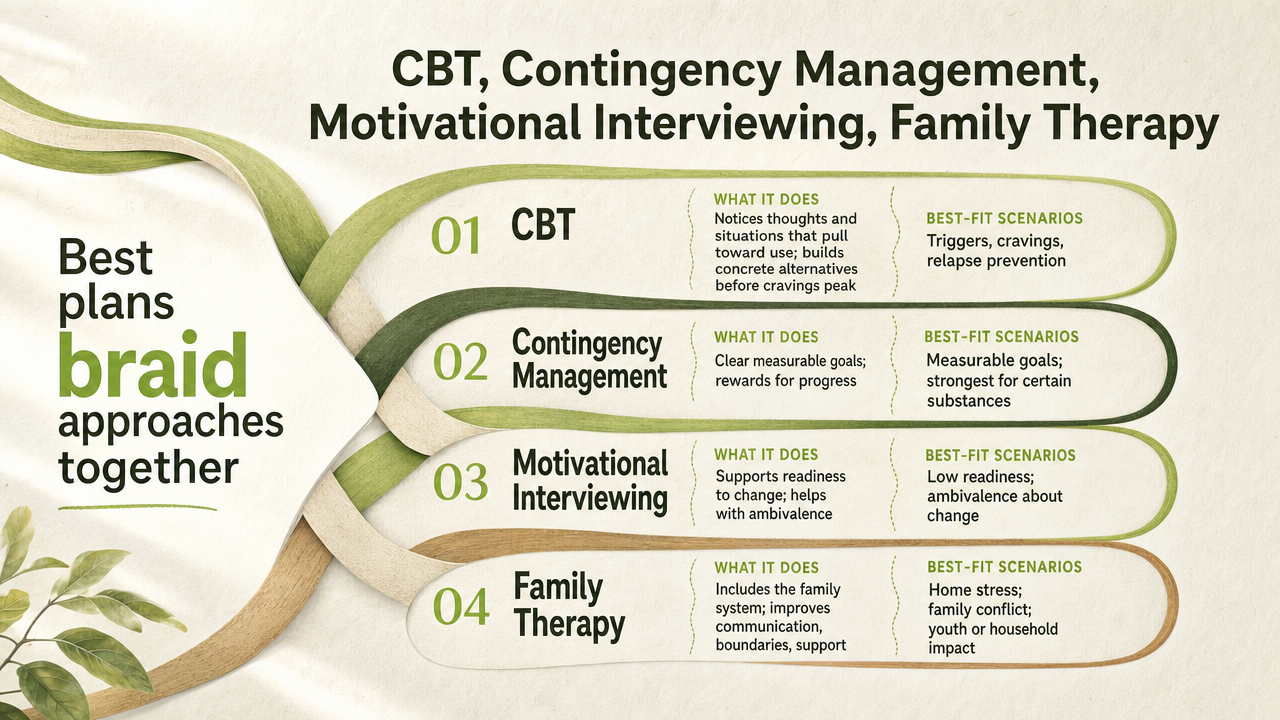
Psychotherapy for a substance use disorder isn't one conversation style on repeat. It's a small set of distinct approaches, each with its own job, and the best plans braid them together. NIDA names four as the behavioral core: cognitive behavioral therapy, contingency management, motivational enhancement therapy, and family therapy 2.
Cognitive behavioral therapy (CBT) teaches you to notice the thoughts and situations that pull you toward use, and to build concrete alternatives before cravings peak. It's practical and skill-based. You leave sessions with something to try, not just something to think about.
Contingency management is the one most people haven't heard of and the one with some of the strongest evidence for certain substances. You set clear, measurable goals (negative tests, session attendance, medication adherence) and earn tangible rewards for meeting them 8.
Motivational interviewing (and motivational enhancement therapy) is a conversational style designed to resolve ambivalence. A Cochrane review found it outperformed no treatment by a standardized mean difference of 0.48 (95% CI 0.07 to 0.89, low-certainty evidence) but showed no clear advantage over other active therapies 13. Translation: it's a strong engagement tool, especially early on, but it isn't a magic upgrade over other credible care.
Family therapy pulls the people around you into the plan. Substance use disorder rarely lives in one person alone, and the people at home often hold leverage that no clinician has. The right modality for you depends on your substance, your goals, and your mental health, and the chart below pairs the strongest evidence to each major scenario 6, 2, 7, 10, 11, 12.
Why Contingency Management Is First-Line for Stimulant Use Disorder
If stimulants are the substance you're working to stop, you need to hear this clearly: there is no FDA-approved medication for stimulant use disorder. That's not a failure of your treatment team. It's where the science is right now.
What does work, and works better than any other studied intervention, is contingency management. The ASAM/AAAP clinical practice guideline names it the current standard of care for stimulant use disorder and reports it has shown the best effectiveness of any treatment studied for this condition 7, 8. The structure is straightforward. You and your clinician agree on specific behaviors (negative urine screens, group attendance, medication adherence if you're on something off-label), and you earn tangible incentives like gift cards or vouchers each time you meet them.
If that sounds too simple, consider what it's actually doing. Stimulants hijack the brain's reward system. Contingency management puts a different, immediate, reliable reward on the other side of the behavior you want to grow. Pairing it with CBT or community reinforcement makes the gains more durable 8.
If a program treating your stimulant use doesn't offer contingency management, ask why. The guideline is explicit.
Co-Occurring Mental Health Conditions Change the Plan
Why Integrated Care Beats Parallel Services
If you've been through treatment before and felt like your therapist and your psychiatrist were working from different scripts, you weren't imagining it. Parallel care, where your substance use disorder is handled in one building and your mental health condition in another, is still common. It's also, by the current evidence, usually the weaker option.
A 2026 umbrella review pulled together 28 systematic reviews (drawn from 5,420 unique records) looking at psychosocial interventions for adults with a substance use disorder and a co-occurring common mental health condition like depression or anxiety. The headline finding: coordinated integrated care generally outperformed treating one condition alone or running services in parallel without coordination 9. The authors were careful. They couldn't crown one specific psychosocial intervention as the winner, and they flagged that longer follow-up studies are still needed. But the integration piece held up across reviews.
NIDA says the same thing in plainer language: when you have both a substance use disorder and a co-occurring condition, it's usually better to treat them at the same time 1, 3. SAMHSA's TIP 42 operationalizes that principle, defining integrated care as concurrently addressing the full range of symptoms rather than passing you between unconnected teams 4.
What should this look like in practice? One treatment plan. One team that meets about your case. Shared records. Medication and therapy decisions made with both conditions in view.
PTSD and Substance Use: Trauma-Focused Therapy, Honest Limits on Medication
If PTSD is part of what you're carrying, you deserve a straight answer about what the research actually supports. Here it is.
Psychosocial therapies are currently the specifically recommended treatments for people with co-occurring PTSD and a substance use disorder 12. That includes approaches like Seeking Safety, exposure-based trauma therapy, the Trauma Recovery and Empowerment Model, and integrated CBT. A systematic review of 13 studies (nine of them randomized trials) in adults with PTSD, SUD, and a history of adverse childhood experiences found small-to-medium positive effects on PTSD symptoms in several studies, with inconsistent effects on substance use and high dropout across most trials 11. Translation: this work can genuinely help, and it needs to be individualized and closely monitored. It isn't a one-size protocol.
On the medication side, be careful of anyone who promises certainty. A 2025 systematic review identified 29 studies covering 16 different pharmacotherapies for co-occurring PTSD and SUD and concluded the evidence base is too limited and heterogeneous for firm recommendations 12. Most of those studies focused on alcohol use disorder and on male or veteran populations, so what works for one group may not translate cleanly to another.
What that means for your plan: expect trauma-focused therapy to lead. Medication, if used, is adjunctive and personal.
Depression, Anxiety, and the Case for One Treatment Team
Depression and anxiety are the two mental health conditions most likely to show up alongside a substance use disorder. If either of those is part of your story, the integration case gets even more concrete.
NIDA reports that integrated treatment, meaning medication, psychosocial interventions, or both delivered with both conditions in view, leads to better health outcomes than treating the conditions separately 3. The umbrella review above included depression and anxiety as the most common co-occurring conditions studied, and integrated approaches generally came out ahead of parallel services 9.
What this looks like day to day: your therapist is working on depression skills and relapse prevention in the same session, not punting one topic to a different provider. Your prescriber is weighing an antidepressant against your SUD medication and your sobriety goals, together. If your anxiety spikes, that gets addressed inside your plan, not scheduled three weeks out with a stranger.
Ask any program you're considering: who makes the call when my depression and my substance use point in different directions? If the answer is "two different people who don't talk," keep looking.
Recurrence of Use Is a Clinical Signal, Not a Verdict
If you used again after a stretch of not using, you probably heard a voice in your head call it a failure. Push back on that voice. In the chronic-care framing NIDA uses, recurrence of substance use is information. It tells your team that something in the plan needs to shift, not that you or the treatment are broken 2.
Think about what that shift might look like.
- Maybe the medication dose is too low, or the formulation isn't holding you between appointments.
- Maybe your therapy is working on the right skills but not often enough.
- Maybe a co-occurring depression flared and nobody adjusted for it.
- Maybe your living situation changed and the plan hasn't caught up.
Each of those is addressable, and each one calls for a different move 1.
Continuing Care: What Keeps Progress From Slipping
The hardest part of therapy isn't always the first thirty days. It's month four, when the structure thins out, the group schedule drops, and real life floods back in. Continuing care is the part of the plan designed for exactly that stretch.
NIDA frames a substance use disorder as a treatable chronic medical condition that may require long-term support or multiple treatment episodes 1. That framing matters because it changes what "finishing treatment" means. You aren't finishing. You're stepping down to a lighter version of the same plan: continued therapy, medication if you're on it, mental health follow-up, peer or mutual-help support, and a check-in cadence that catches drift early 2.
Good continuing care has a few moving parts.
- Scheduled sessions that taper rather than stop.
- A medication plan with a prescriber who knows your history.
- A written response for what happens if cravings spike or you use again, so nobody is improvising at 2 a.m.
- Family or peer supports that stay in the picture 4.
If your discharge paperwork is a phone number and good luck, that isn't continuing care. Ask for the real version.
What Good Care Looks Like: A Checklist You Can Take to Any Provider
You've read a lot. Here's the short version you can carry into any intake call, any tour, any conversation with a loved one's treatment team. If a program can't answer these, keep looking.
- A real assessment, not a form. Someone asks about your substance use, mental health, medical history, trauma, supports, culture, and stage of change before writing a plan 4.
- Integrated care under one roof. If you have depression, anxiety, PTSD, or another co-occurring condition, the same team treats both at the same time, with one plan and shared records 1, 3, 4.
- Substance-matched evidence. Opioid use disorder treatment includes an honest conversation about buprenorphine, methadone, and naltrexone 6. Stimulant use disorder treatment includes contingency management 7, 8. Alcohol use disorder treatment pairs behavioral work with medication where it fits 5, 10.
- Measurable goals you helped set. You know what you're working on this month and how you'll know it's working 2.
- A plan for recurrence. If you use again, the response is reassessment, not discharge or shame 2.
- Family and peer involvement, if you want it. The people around you are offered a role in the plan 2.
- Continuing care written down. Step-down sessions, prescriber follow-up, mutual-help options, and a 2 a.m. plan before you leave 4.
You deserve care that matches this list. Programs like Arista Recovery are built around it, and so are many others. The checklist is yours either way.
Frequently Asked Questions
How long does addiction therapy usually last?
There's no fixed length, and anyone promising one is oversimplifying. A substance use disorder is a treatable chronic medical condition that may need long-term support or multiple treatment episodes 1. Expect an initial, more intensive stretch followed by step-down continuing care that tapers rather than stops. The right duration is the one that matches your progress and your plan, adjusted as you go.
Do I need medication, or is talk therapy enough?
It depends on the substance. For opioid use disorder, treatment generally starts with medication, usually paired with behavioral therapy 2, and three FDA-approved options exist: buprenorphine, methadone, and naltrexone 6. For stimulant use disorder, no medication is FDA-approved, so contingency management leads 7. For alcohol use disorder, behavioral and medication options work together 5. A good prescriber walks you through what fits.
What's the difference between outpatient, PHP, and residential treatment?
They're rungs on the same ladder, matched to how much structure and medical support you need 1, 5. Standard outpatient fits a few sessions a week around work or school. Partial hospitalization (PHP) steps up the clinical hours while you sleep at home. Residential puts you in a 24-hour therapeutic setting when home isn't safe or symptoms need constant support. You step down as you stabilize.
If I've used again after treatment, does that mean therapy didn't work?
No. In NIDA's chronic-care framing, a return to use is a signal that the plan needs adjustment, not evidence that you or the treatment failed 2. Something may need to change: the medication dose, the therapy frequency, an untreated depression flare, a shift in your living situation. A good team reassesses and adjusts. If yours responds with shame or discharge, find a team that doesn't.
I have depression, anxiety, or PTSD along with a substance use disorder. Should I treat them separately?
Generally, no. NIDA states that when you have both a substance use disorder and a co-occurring mental health condition, it's usually better to treat them at the same time 1, 3. SAMHSA's TIP 42 defines that as integrated care: one team, one plan, both conditions in view 4. For PTSD specifically, psychosocial trauma-focused therapy currently leads the recommendations, with medication playing an adjunctive role 12.
How do I know if a treatment program is actually offering good care?
Ask specific questions. Does the assessment cover substance use, mental health, trauma, medical history, and supports 4? Are both conditions treated by one coordinated team 1, 3? Does the plan match the evidence for your substance, including medication for opioid use disorder 6 and contingency management for stimulant use disorder 7? Is there a written continuing-care plan and a response for recurrence 2? Clear answers matter.
References
- Treatment - National Institute on Drug Abuse (NIDA) - NIH. https://nida.nih.gov/research-topics/treatment
- Treatment and Recovery. https://nida.nih.gov/publications/drugs-brains-behavior-science-addiction/treatment-recovery
- Co-Occurring Disorders and Health Conditions. https://nida.nih.gov/research-topics/co-occurring-disorders-health-conditions
- Substance Use Disorder Treatment for People with Co-Occurring Disorders. https://library.samhsa.gov/sites/default/files/pep20-06-04-006.pdf
- Management of Substance Use Disorder (SUD) (2021) - VA/DoD Clinical Practice Guidelines. https://healthquality.va.gov/HEALTHQUALITY/guidelines/mh/sud/
- Information about Medications for Opioid Use Disorder (MOUD) - FDA. https://www.fda.gov/drugs/food-and-drug-administration-overdose-prevention-framework/information-about-medications-opioid-use-disorder-moud
- The ASAM/AAAP Clinical Practice Guideline on the Management of Stimulant Use Disorder. https://pubmed.ncbi.nlm.nih.gov/38669101/
- The ASAM/AAAP Clinical Practice Guideline on the Management of Stimulant Use Disorder. https://pmc.ncbi.nlm.nih.gov/articles/PMC11105801/
- Effectiveness of Psychosocial Interventions for Adults With Substance Use Disorder That Have a Co-Occurring Common Mental Health Disorder: An Umbrella Review. https://pubmed.ncbi.nlm.nih.gov/41192364/
- Integrated behavioral interventions for adults with alcohol use disorder. https://pubmed.ncbi.nlm.nih.gov/39163680/
- Treatment of post-traumatic stress disorder and substance use disorder in adults with a history of adverse childhood experiences: A systematic review of psychological interventions. https://pubmed.ncbi.nlm.nih.gov/36845903/
- Pharmacological treatments for co-occurring PTSD and substance use disorders: A systematic review. https://pubmed.ncbi.nlm.nih.gov/39672336/
- Motivational interviewing for substance use reduction. https://pubmed.ncbi.nlm.nih.gov/38084817/