.webp)


Key Takeaways
- Federal guidance rejects the sequence of treating substance use before mental health; SAMHSA endorses concurrent screening and treatment under one coordinated plan 1, 2.
- Coordinated, co-located, and fully integrated care are not interchangeable—only fully integrated care shares one team, one chart, and one treatment plan naming both diagnoses.
- Evidence varies by diagnosis: trauma-focused therapies hold up strongly for PTSD with SUD 23, while effects for psychosis paired with substance use remain small and low-confidence 24.
- Judge your program by what happens in practice—cross-screening at intake, a unified plan, direct provider communication, trauma-informed delivery, and a continuing-care plan built before discharge 1, 5.
The Integration Question Most Treatment Programs Skip
If you are living with both a mental health condition and a substance use disorder, you have probably heard some version of this: "Get clean first, then we can work on the depression." Or the reverse — "Let's stabilize your anxiety, then we can talk about the drinking." That sequencing feels orderly, but research does not support it.
Federal guidance from SAMHSA has long advocated for a different approach: mental health and substance use conditions should be screened for together, treated together, and planned for within one coordinated care plan, rather than being handled by separate systems 1. The TIP 42 advisory identifies concurrent treatment as the preferred principle 2. A 2026 umbrella review of 28 systematic reviews found that coordinated treatment generally outperforms treating only one condition and sometimes surpasses parallel, uncoordinated care 20.
So why do many programs still treat therapy as something you earn after detox, or consider your mental health diagnosis a separate problem for another provider you must find on your own?
Partly, it is historical. Partly, it is due to how insurance and licensure divide the two fields. And partly, "integrated care" is a label almost every program now uses, regardless of whether the actual care is coordinated, co-located, or simply involves two different clinicians who occasionally communicate. The distinction lies in what you experience as a patient, which depends less on the brochure and more on who is involved in writing your treatment plan.
Coordinated, Co-located, or Fully Integrated: Why the Label Matters
What Each Model Actually Looks Like in Practice
Three programs can all claim to offer "integrated care" and provide three very different experiences. SAMHSA clarifies these differences, which can help you understand what to expect 1.
- Coordinated care
- The lightest version. Your therapist works at one agency, and your prescriber at another. They communicate, sometimes by phone, fax, or through you. There are plans on both sides, but they may not align perfectly. If your anxiety medication is adjusted, your therapist might learn about it in your next session, or later, or when you mention it.
- Co-located care
- Places providers in the same building. You might see your counselor and psychiatric prescriber on the same hallway, possibly even on the same day. This saves travel time but does not guarantee that the two providers share a chart, a treatment plan, or regular conversations about your case. Co-location describes a physical arrangement, not a unified workflow.
- Fully integrated care
- Involves one team, one chart, and one treatment plan that addresses both your mental health condition and your substance use disorder. Screening at intake covers both aspects. The therapist and prescriber meet to discuss your case. If your family is involved, they communicate with the entire team, not separate providers.
SAMHSA pairs these models with the "no wrong door" principle: regardless of where you seek help—a mental health clinic, an addiction program, or a primary care office—you should be screened for both conditions and connected to appropriate support, rather than being told to resolve one issue before addressing the other 1.
The Treatment Gap Behind the Push for Integration
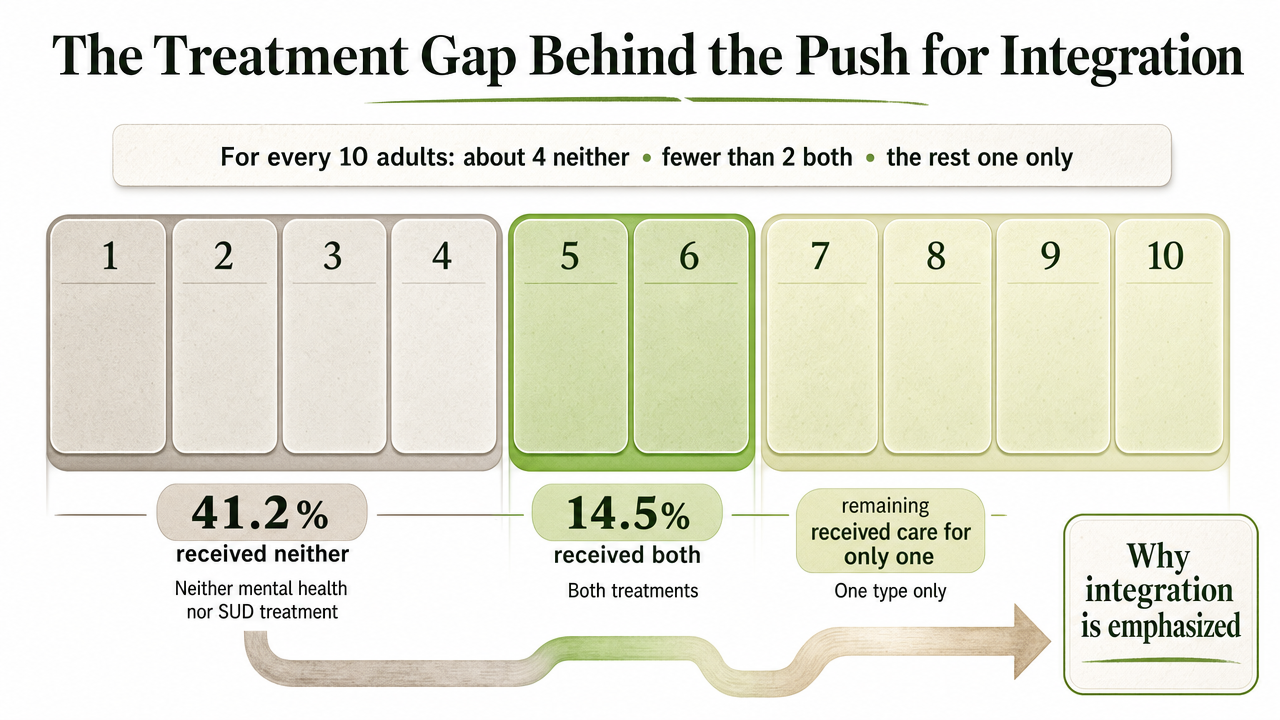
While integrated care is the ideal, current reality often falls short. The 2024 National Survey on Drug Use and Health estimates that among U.S. adults with co-occurring mental illness and a substance use disorder, 41.2% received neither mental health nor substance use treatment that year. Only 14.5% received both 7.
Consider this: for every ten adults experiencing both conditions, roughly four received no help for either, and fewer than two received help for both. The remaining individuals received care for only one aspect of their condition.
This significant gap is a primary reason federal guidance continues to emphasize integration. When someone with depression and alcohol use disorder visits a mental health clinic and leaves without discussing their drinking, or enters an addiction program without a plan for the depression that may contribute to their drinking, the system implicitly asks them to compartmentalize their struggles. Many individuals do not return for separate treatments.
The NSDUH figures are based on self-reported treatment receipt and do not explain why individuals did or did not receive care 7. However, they highlight the critical importance of the treatment model you receive, as statistically, obtaining any coordinated help is already a challenge.
What the Evidence Actually Says, by Diagnosis Pairing
PTSD and Substance Use: The Strongest Case for Doing Both at Once
For individuals with PTSD and a substance use disorder, the outdated approach of "get sober first, then deal with the trauma" is no longer supported by evidence. These two conditions are often deeply intertwined, with substance use frequently serving as a coping mechanism for flashbacks, hyperarousal, or a dysregulated nervous system. Separating their treatment tends to leave both unaddressed.
The VA National Center for PTSD explicitly states that having either PTSD or a substance use disorder should not prevent someone from receiving evidence-based treatment for the other. Trauma-focused therapies—such as prolonged exposure, cognitive processing therapy, and EMDR—are supported for use alongside substance use treatment, not after it 21.
A systematic review and meta-analysis of 14 studies found that trauma-focused psychological interventions improved PTSD severity both at the end of treatment and at follow-up, with evidence of an effect on drug or alcohol use observed at five to seven months. A caveat was that fewer participants completed the trauma-focused arm compared to usual care, indicating the demanding nature of the work rather than its ineffectiveness 23.
A 2025 randomized trial of COPE in women with PTSD and alcohol use disorder yielded similar results. Twelve sessions of integrated trauma-focused treatment led to a greater reduction in PTSD symptoms than relapse prevention, with no detectable difference in alcohol use between groups 22. This suggests that while trauma work progressed, changes in drinking were comparable across both approaches, reflecting an honest assessment of the evidence.
Depression, Anxiety, and Alcohol or Other Substances
This is a common pairing in therapy, and it is also where marketing claims can be most pronounced. The actual research is more nuanced.
A clinical review of integrated care for alcohol use disorder and co-occurring mental health conditions reported small but clinically meaningful improvements in depressive symptoms and alcohol use when CBT and motivational interviewing were delivered together, compared with usual care. However, the same review noted that some long-term trials of integrated psychosocial treatment found no significant differences from usual care in substance use, functioning, or life satisfaction 3. Small gains are real, but they do not always represent a complete transformation.
The 2026 umbrella review of 28 systematic reviews reached a similar conclusion: most psychosocial interventions improved mental health and substance use outcomes, and coordinated treatment generally outperformed treating one condition alone. However, it was only sometimes better than well-managed parallel care 20. A separate umbrella review from the same body of work also supported this finding 4.
Specifically for alcohol use disorder, a 2024 systematic review of integrated behavioral interventions found consistent reductions in consumption, heavy drinking, and progress toward abstinence. However, there was insufficient evidence to conclude that these integrated models definitively outperformed usual care in head-to-head comparisons 18. Practically, this suggests that effective therapy, whether integrated or well-coordinated, tends to help with depression, anxiety, and drinking. No single configuration guarantees a specific outcome.
Psychosis, Schizophrenia, and Substance Use: Where Claims Outrun Data
A meta-analysis of motivational interviewing for co-occurring psychosis and substance use disorder found that pure MI interventions did not significantly reduce either substance-use severity or psychotic symptoms. Mixed MI interventions produced a small, statistically significant effect on substance use (g = 0.15) but no significant improvement in psychotic symptoms 17. These effects are modest and not a cure.
A 2026 systematic review and meta-analysis of psychological and psychosocial interventions for people with schizophrenia and co-occurring substance use disorders told a similar story. The review found a very small, low-confidence effect on overall symptoms and no difference in reducing all substance use compared with control conditions, except for nicotine-related outcomes 24. This is a sobering finding. Therapy remains important in these cases for engagement, safety planning, daily functioning, and supporting the relationship with a prescriber who manages antipsychotic medication. However, the specific claim that integrated therapy packages reliably reduce psychotic symptoms or non-nicotine substance use is not supported by current data.
Keep this gradient in mind as you read about which therapies are most effective in the next section.
The Therapies That Carry the Weight, Honestly Rated
Trauma-Focused CBT, Prolonged Exposure, Cognitive Processing Therapy, and EMDR
These therapies have earned the most trust in research when PTSD and a substance use disorder are present. They are intensive but offer structured approaches to address memories, beliefs, and body responses that perpetuate trauma, while substance use treatment proceeds concurrently.
- Prolonged exposure involves revisiting trauma memories in a controlled manner with a therapist until the associated distress diminishes.
- Cognitive processing therapy focuses on challenging and restructuring beliefs about safety, trust, control, and self-worth that stem from trauma.
- EMDR uses bilateral stimulation while you focus on a traumatic memory.
The VA National Center for PTSD supports all three alongside substance use treatment 21.
A systematic review and meta-analysis of 14 studies found that trauma-focused intervention improved PTSD severity at the end of treatment and at follow-up, with little evidence that non-trauma-focused individual or group work achieved similar results 23. Attrition rates were higher in the trauma-focused arms, indicating the demanding nature of the work. This highlights the need for thorough preparation, not a reason to avoid it.
CBT and Motivational Interviewing: Useful, Not a Cure
CBT and motivational interviewing are foundational in most dual diagnosis programs. They are valuable tools but have limitations.
CBT provides a framework for understanding the connections between thoughts, feelings, behaviors, and substance use, helping individuals identify and modify patterns that lead to cravings. Motivational interviewing focuses on resolving ambivalence about change, acknowledging that individuals often have conflicting desires regarding their substance use.
A 2025 review of CBT for dual diagnosis, synthesizing 23 studies, reported mixed results, with limited evidence that integrated CBT outperforms active control conditions for anxiety or depression outcomes 19. A clinical review of integrated care for alcohol use disorder found small but clinically meaningful improvements in depressive symptoms and alcohol use when CBT and motivational interviewing were delivered together, compared with usual care 3.
These therapies are helpful but do not guarantee complete transformation. If a program markets CBT as a universal solution, it is important to recognize this as marketing rather than evidence-based fact. When used effectively within a comprehensive plan that also addresses medication, trauma, family dynamics, and continuing care, they can be genuinely beneficial.
Trauma-Informed Care as a Stance, Not a Therapy
The term "trauma-informed" appears on many program websites. It is important to understand that this is not a specific therapy you receive, but rather an organizational approach to service delivery.
SAMHSA's TIP 57 describes trauma-informed care as a framework built around safety, preventing retraumatization, trauma psychoeducation, identifying triggers, building coping skills, peer support, resilience, trust, and empowerment—all delivered in culturally and gender-responsive ways 11. A trauma-informed program assumes that most individuals seeking services have a trauma history and designs its intake processes, group activities, physical environment, and staff interactions around this understanding.
However, "trauma-informed" is distinct from "trauma-focused." A program can be excellent at being trauma-informed yet still not offer specific trauma-focused therapies like prolonged exposure, cognitive processing therapy, or EMDR. If you have a PTSD diagnosis, you ideally want both—the trauma-informed approach and the specific trauma-focused therapy. It is important to ask directly about the availability of both.
The Ecosystem Around the Therapy Room
Family Involvement: Real Effects, Honest Limits
The people in your life—past or present—are already part of your recovery journey, whether or not they attend therapy sessions. The question is whether their involvement is guided by a clinician or left to chance.
A 2024 systematic review of 15 randomized controlled trials on family-based interventions for substance use disorders found that 11 reported significant positive effects, including reductions in substance use and improvements in family functioning 16. This is a meaningful indicator, though not a magical solution. The authors still called for more high-quality trials.
Family work is not suitable for every family. If there is active violence, ongoing coercion, or an unsafe dynamic, it is crucial to communicate this to your clinician. Participation should be voluntary, culturally appropriate, and respectful of confidentiality 16. When these conditions are met, involving a partner, parent, or adult child in even a few structured sessions can positively influence how those around you respond during challenging times.
Peer Support and Recovery Coaching
A peer is someone who has navigated similar challenges and is trained to support others on their journey. They are not a therapist or a sponsor, but rather a knowledgeable companion familiar with the recovery landscape.
A recent systematic review of peer recovery support services for substance use disorder, encompassing 28 quantitative studies and 12,601 participants, identified the strongest emerging signal in treatment engagement and retention. Evidence for direct improvements in substance use outcomes is still preliminary 14. In the broader context of mental illness, a meta-analysis of 30 randomized trials involving 4,152 participants found small effects on clinical recovery (g = 0.19) and personal recovery (g = 0.15), with no statistically significant effect on functional recovery 15.
Honestly, peer support helps individuals stay engaged in treatment and feel less isolated. It may offer a slight boost to clinical and personal recovery. However, it is not a substitute for therapy or medication; rather, it serves as a supportive layer that enhances access to other forms of care.
Contingency Management and Medication Coordination
Contingency management is a therapeutic adjunct that, while sometimes met with discomfort, has clear behavioral logic. It involves providing tangible reinforcement—typically a small voucher or incentive—for objectively verified behaviors, such as a negative drug test, attendance at a session, or taking medication. SAMHSA's advisory notes that authorized federal grant programs may offer incentives up to $750 per patient per year, requiring verification and prohibiting unrestricted cash 13. This approach is particularly relevant for stimulant-related disorders, where no FDA-approved medication currently exists.
Medication coordination is a quieter but more consequential aspect of care. Therapy does not replace medication when medication is indicated. The VA/DoD guideline for substance use disorder integrates psychosocial care within a broader plan that includes medical assessment, pharmacotherapy when appropriate, and follow-up 8, 9. The CDC's 2022 opioid prescribing guideline goes further, stating that a lack of available psychosocial treatment should not delay medications for opioid use disorder 10.
Telehealth and Continuing Care After You Leave the Building
Discharge is not the end of treatment; it is the point where treatment must adapt to your daily life—work, family, commutes, and social environments. HHS identifies telehealth as a legitimate tool for continuing substance use disorder care, including counseling, medication monitoring, and coordination with behavioral health and primary care. The guidance emphasizes that virtual care is most effective when integrated with in-person services, supported by reliable technology, privacy, and a local crisis plan 25.
In practice, this often involves weekly individual therapy via video, a monthly in-person medication visit, and peer check-ins. While not glamorous, this approach is workable and sustainable. The goal is a plan you can maintain on a Tuesday evening after a difficult day, not just during the week you leave a program.
How to Tell Whether Your Care Is Actually Integrated
You do not need a clinical degree to distinguish between a program that treats you as a whole person and one that treats you as two separate case files. You simply need a few key questions and the willingness to ask them.
- At intake, were you screened for both a mental health condition and substance use—not just one? SAMHSA's guidance on co-occurring disorders identifies cross-screening as a baseline practice 1. If the intake paperwork only asked about drinking or only about depression, that is a red flag.
- Is there one treatment plan that names both diagnoses in the same document? Or are there two separate plans that have never been reconciled? TIP 42 identifies concurrent treatment within a coordinated plan as the preferred principle 2.
- Do your therapist and prescriber actually communicate about your care, rather than through you? Ask how often. "We're in the same building" is not a sufficient answer. The Lancet Psychiatry realist synthesis found that true integration depends on team culture and coordination, not just physical proximity 5.
- Is the program trauma-informed in its approach—attentive to safety, triggers, and preventing retraumatization in how groups and intake are conducted 11? Were you offered a role for your family, if that is safe for you? Was a continuing-care plan developed before discharge, not after?
If most of your answers are yes, you are likely receiving integrated care. If most are no, you have valuable information to bring to your next appointment.
Frequently Asked Questions
Do I have to stop using substances before I can start mental health therapy?
No. Federal guidance explicitly rejects that sequence. SAMHSA recommends screening and treating mental health and substance use conditions together, under the "no wrong door" principle, rather than requiring you to complete one before the other 1. TIP 42 names concurrent treatment as the preferred principle 2. If a program tells you to come back after you are sober, that is not current practice.
What is the difference between coordinated, co-located, and fully integrated care?
Coordinated care means separate providers at separate agencies who communicate about your plan. Co-located care puts them in the same building, but not necessarily on the same team or chart. Fully integrated care is one team, one chart, and one treatment plan that names both your mental health condition and your substance use disorder together, with shared screening at intake 1.
Which therapy has the strongest evidence for PTSD and a substance use disorder?
Individual trauma-focused cognitive behavioral treatment—prolonged exposure, cognitive processing therapy, or EMDR—delivered alongside substance use treatment 21. A meta-analysis of 14 studies found trauma-focused therapy improved PTSD severity at end of treatment and follow-up, with evidence of an effect on drug or alcohol use at five to seven months 23. The work is demanding, but delaying it rarely helps either condition.
Can therapy replace medication for depression, anxiety, or opioid use disorder?
Not when medication is clearly indicated. The VA/DoD guideline places therapy inside a broader plan that includes pharmacotherapy when appropriate 8, 9. The CDC's 2022 opioid guideline is more direct: lack of available psychosocial treatment should not delay medications for opioid use disorder 10. Buprenorphine or methadone belongs in the conversation from day one. Therapy helps that medication work—it does not replace it.
How do I know if my current program is actually integrated or just co-located?
Ask three questions. Were you screened for both conditions at intake, not one 1? Is there one treatment plan naming both diagnoses, or two separate plans 2? Do your therapist and prescriber actually talk about you, and how often? Lancet Psychiatry's realist synthesis found integration depends on team culture and coordination, not floor plans 5. If most answers are vague, you have co-location.
Is telehealth therapy a reasonable option for continuing care after I leave treatment?
Yes, when used thoughtfully. HHS identifies telehealth as a legitimate tool for counseling, medication-related monitoring, and coordination with behavioral health and primary care, especially where access is limited 25. It works best integrated with in-person services, with reliable technology, privacy, and a local crisis plan. For many people, a video session on a Tuesday evening is the difference between keeping care and losing it.
References
- Managing Life with Co-Occurring Disorders - SAMHSA. https://www.samhsa.gov/mental-health/serious-mental-illness/co-occurring-disorders
- Substance Use Disorder Treatment for People with Co-Occurring Disorders. https://library.samhsa.gov/sites/default/files/pep20-06-04-006.pdf
- Integrating Treatment for Co-Occurring Mental Health Conditions. https://pmc.ncbi.nlm.nih.gov/articles/PMC6799972/
- Effectiveness of psychosocial interventions for adults with substance use disorder that have a co-occurring common mental health disorder: an umbrella review. https://pubmed.ncbi.nlm.nih.gov/42381425/
- Achieving integrated treatment: a realist synthesis of service models and systems for co-existing serious mental health and substance use conditions. https://pubmed.ncbi.nlm.nih.gov/37327804/
- Interventions targeting patients with co-occuring severe mental illness and substance use (dual diagnosis) in general practice settings - a scoping review of the literature. https://pubmed.ncbi.nlm.nih.gov/39097682/
- Results from the 2024 National Survey on Drug Use and Health. https://www.samhsa.gov/data/sites/default/files/reports/rpt56287/2024-nsduh-annual-national/2024-nsduh-annual-national-html-071425-edited/2024-nsduh-annual-national.htm
- Management of Substance Use Disorder (SUD) (2021) - VA/DoD Clinical Practice Guidelines. https://healthquality.va.gov/HEALTHQUALITY/guidelines/mh/sud/
- VA/DoD Clinical Practice Guideline for the Management of Substance Use Disorders: Provider Summary. https://www.healthquality.va.gov/guidelines/MH/sud/VADoDSUDCPGProviderSummary.pdf
- CDC Clinical Practice Guideline for Prescribing Opioids for Pain — United States, 2022. https://www.cdc.gov/mmwr/volumes/71/rr/rr7103a1.htm
- TIP 57 Trauma-Informed Care in Behavioral Health Services. https://library.samhsa.gov/sites/default/files/sma14-4816.pdf
- Behavioral Health and Substance Use Disorders. https://www.ahrq.gov/ncepcr/reports/2025-annual-report/behavioral-health.html
- Contingency Management: Incentives for Treatment of Substance Use Disorders. https://library.samhsa.gov/sites/default/files/contingency-management-advisory-pep24-06-001.pdf
- Peer Recovery Support Services and Recovery Coaching for Substance Use Disorder: A Systematic Review. https://pubmed.ncbi.nlm.nih.gov/41551498/
- The effectiveness of peer support for individuals with mental illness: systematic review and meta-analysis. https://pubmed.ncbi.nlm.nih.gov/36066104/
- Efficacy of Family-based Interventions in Addressing Substance Use Disorders: A Systematic Review on Randomized Controlled Trials. https://pubmed.ncbi.nlm.nih.gov/41970367/
- Efficacy of Motivational Interviewing in Treating Co-occurring Psychosis and Substance Use Disorder: A Systematic Review and Meta-Analysis. https://pubmed.ncbi.nlm.nih.gov/34963202/
- Integrated behavioral interventions for adults with alcohol use disorder. https://pubmed.ncbi.nlm.nih.gov/39163680/
- Cognitive Behavioural Therapy and Dual Diagnosis. https://pmc.ncbi.nlm.nih.gov/articles/PMC12535280/
- Effectiveness of Psychosocial Interventions for Adults With Substance Use Disorder That Have a Co-Occurring Common Mental Health Disorder: An Umbrella Review. https://pubmed.ncbi.nlm.nih.gov/41192364/
- Treatment of Co-Occurring PTSD and Substance Use Disorder in Veterans. https://www.ptsd.va.gov/professional/treat/cooccurring/tx_sud_va.asp
- Concurrent Treatment of Posttraumatic Stress Disorder and Alcohol Use Disorder in Women: A Randomized Clinical Trial. https://pubmed.ncbi.nlm.nih.gov/40663349/
- Psychological interventions for post-traumatic stress disorder and comorbid substance use disorder: A systematic review and meta-analysis. https://pubmed.ncbi.nlm.nih.gov/25792193/?dopt=Abstract
- Psychological and Psychosocial Interventions for People With Schizophrenia and Co-Occurring Substance Use Disorders. https://pubmed.ncbi.nlm.nih.gov/41637064/
- Telehealth for Substance Use Disorder. https://telehealth.hhs.gov/providers/best-practice-guides/telehealth-substance-use-disorder