.webp)


How to Choose the Right Drug Addiction Treatment Near Me
Key Takeaways
- Prioritize clinical fit over proximity: the right program treats your child's specific substance, offers proven medications, and addresses co-occurring mental health conditions 1, 6.
- Detox is only the first step, not treatment itself; ask what happens on day eight and confirm a clear handoff to ongoing care 7, 12.
- Match the program to the substance involved by asking about buprenorphine, methadone, or naltrexone for opioids, FDA-approved medications for alcohol, and contingency management for stimulants 7, 8, 12.
- Confirm accreditation, state licensing, and on-staff physicians, psychiatrists, and licensed therapists before discussing amenities or therapy models 6.
- Ask which evidence-based therapies are used by name, how often they are delivered, and how the plan changes if your child is not responding 1, 11.
- Insist that discharge planning start on day one, with named providers, appointment times, and continuity for any medications already prescribed 6, 12.
- Have your adult child sign a specific 42 CFR Part 2 release before admission so the program can legally communicate with you 2, 13.
- Verify insurance coverage, prior authorization timelines, continued-stay criteria, and appeals rights under strengthened federal parity rules taking effect for many plans in 2025 3.
Start With Fit, Not Distance
If you are reading this at 11 p.m. after a phone call that scared you, take a breath. You are already doing the hard thing, which is looking for help instead of hoping the problem will fix itself.
Here is the shift that will save you time and heartbreak in the next few weeks: the closest program is not automatically the right program. A treatment center five minutes from your house can still be a poor match for your adult child if it does not treat the substance they are using, does not offer the medications proven to work, or cannot handle the depression or anxiety sitting underneath everything.
Fit is what matters. Fit means the program's level of care, its medications, its therapies, and its ability to treat a mental health condition alongside a substance use disorder all line up with what your child is actually dealing with 16. Distance matters too, because a program that is drivable makes family visits and continuing care easier. But distance is a tiebreaker, not the first filter.
The rest of this guide gives you a working script. You will get direct questions to ask programs, insurers, and clinical staff before anyone signs an admission form. You do not need to become an expert overnight. You need to know what to ask, and you need to trust yourself when an answer feels vague.
What Your Adult Child's Clinical Picture Actually Requires
Detox Is Not Treatment: Knowing What Comes After
Detox and treatment are not the same thing. That distinction matters more than almost any other clinical fact you will learn in the next few weeks.
Medical detox is the short window when a person's body clears the substance under medical supervision. For alcohol, benzodiazepines, and opioids, detox can be medically necessary and, in some cases, life-saving. What it is not, however, is a cure. Federal guidance is direct on this point: detoxification alone is not sufficient treatment for recovery, and for opioid use disorder, detox without follow-up medication is actively not recommended 712.
So when you call a program, ask what happens on day eight. Ask whether they provide the next level of care in-house or coordinate the handoff to residential, partial hospitalization, or intensive outpatient. If the answer is vague, that is your answer. You are looking for a program that treats detox as a doorway, not a destination.
Matching the Program to the Substance Involved
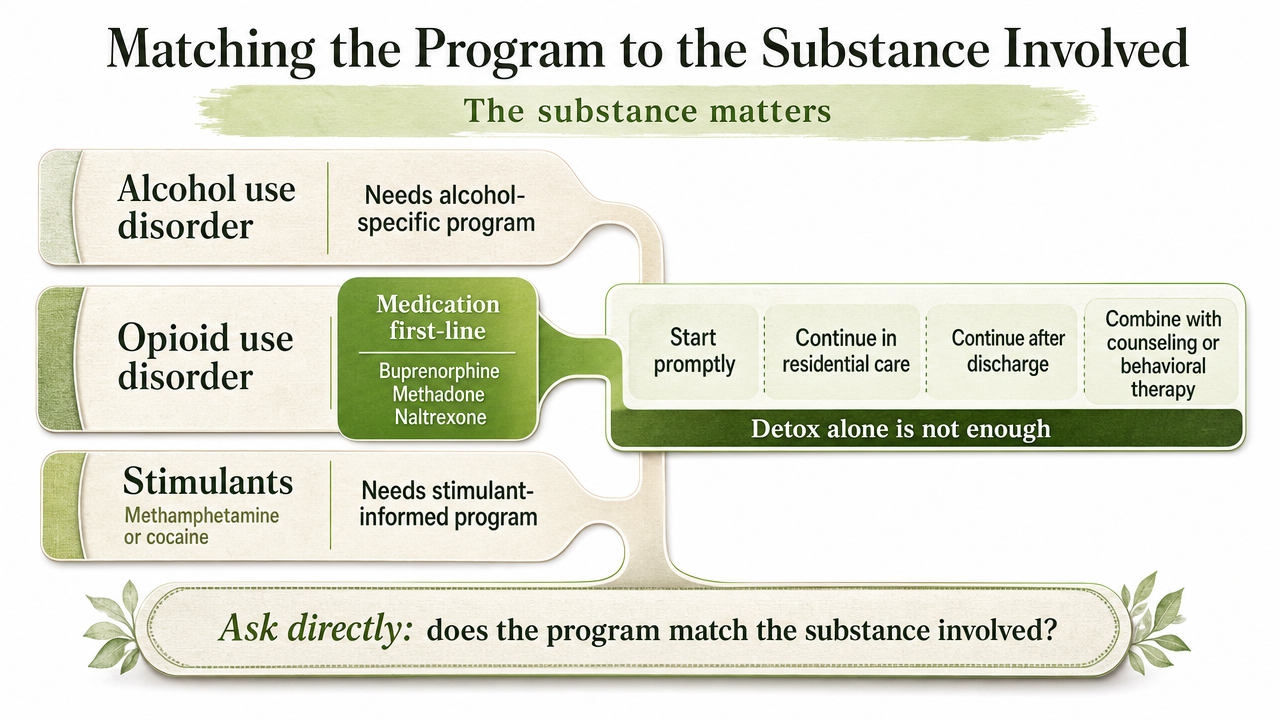
The substance matters. A program that is excellent at treating alcohol use disorder is not automatically equipped to treat someone experiencing opioid use disorder, and neither one may know what to do with stimulants like methamphetamine or cocaine. This is one of the questions parents most often skip, and it is one of the most important ones to ask directly.
If opioids are involved, medication should be the first line of treatment, usually combined with counseling or behavioral therapy 7. That means asking specifically: does the program offer buprenorphine, methadone, or naltrexone, and can they start medication promptly and continue it during residential care and after discharge? CDC guidance is clear that medication treatment is associated with lower overdose and mortality risk, and that detoxification without these medications is not recommended 12.
The access gap here is real. In 2022, an estimated 9,367,000 U.S. adults needed opioid use disorder treatment; 55.2% received any treatment, and only 25.1% received medications for opioid use disorder 9. Even among adults who need this care, most did not receive the specific medications proven to reduce overdose death. So when a nearby program tells you they treat opioid use disorder, ask exactly how. If the answer is "counseling and support groups" without a clear pathway to medication, keep looking.
If alcohol is the primary concern, three FDA-approved medications can help prevent a return to heavy drinking and support abstinence 8. Ask whether the program prescribes them, which ones, and how they decide. Medication is not right for everyone, but the program should be able to explain the options rather than dismiss them.
If stimulants are involved—methamphetamine, cocaine, prescription stimulants used non-medically—there is no FDA-approved medication that currently treats stimulant use disorder 7. That does not mean nothing works. Behavioral interventions carry real weight here, and one in particular has a strong evidence base. Ask specifically whether the program offers contingency management, a structured approach that reinforces treatment goals with tangible rewards.
The follow-up question worth asking every program, regardless of substance: "How does your treatment plan change based on what my child is using?" A thoughtful clinical team will answer specifically. A generic program will describe the same schedule for everyone.
When a Mental Health Condition Is Also in the Picture
If you suspect your adult child is dealing with depression, anxiety, trauma, bipolar disorder, or something else alongside the substance use, you are not overreacting. You are noticing something clinically important, and it should change how you evaluate programs.
The research points in one direction here. A 2026 umbrella review of 28 systematic reviews on psychosocial interventions for adults with substance use disorders and co-occurring common mental health disorders found that integrated treatment was generally better than treating one condition alone and generally better than parallel, uncoordinated services 10. Integrated care means the mental health condition and the substance use disorder are treated together, by a coordinated team, in the same program 1.
Now for the caution. Many programs will tell you they treat co-occurring conditions. Fewer actually deliver integrated care. An HHS Office of Inspector General report published in 2025 found that while most federally funded health centers provide some behavioral health services to patients with substance use disorder, operational challenges limit truly comprehensive treatment—and the report specifically distinguishes behavioral health services for substance use disorder from mental health treatment for co-occurring conditions 5. Those are not the same thing.
So ask concrete questions:
- Is there a psychiatrist on staff who can evaluate and prescribe?
- Are therapists trained to treat both conditions, or do they refer the mental health piece out?
- Does the treatment plan address both diagnoses in one document, or are there two disconnected plans?
- If your child has a trauma history, is trauma-informed care part of how everyone on the team works, or is it one optional group on Tuesdays?
The label "dual diagnosis" on a website is not proof. The staffing, the coordination, and the actual plan are.
When mental health challenges and addiction intersect, it can feel isolating. At Arista, we offer compassionate, evidence-based, and trauma-informed care to help you heal, grow, and move forward.
The Questions to Ask Before You Say Yes to Admission
Accreditation, Licensing, and Who Is Actually on Staff
Before you talk about therapy models or amenities, ask two boring-sounding questions that tell you a lot: Is the program licensed by the state, and is it accredited by a recognized body like The Joint Commission or CARF? SAMHSA lists accreditation among its five core signs of quality treatment for a reason—it means an outside organization has reviewed how the program actually operates, not just how it markets itself 6.
Then ask who works there. You are looking for names and credentials, not job titles on a webpage.
Some direct questions worth writing down before you call:
- Is there a physician on staff who can manage detox and prescribe medications for opioid or alcohol use disorder?
- Is there a psychiatrist or psychiatric nurse practitioner who can evaluate and treat mental health conditions on-site?
- Are the therapists licensed in your state, and what is the typical caseload per clinician?
- Who is available overnight and on weekends if your adult child has a medical or psychiatric crisis?
If the person on the phone cannot answer these without transferring you three times, that is information too. A quality program expects these questions and has clear answers ready.
Which Evidence-Based Therapies the Program Uses
"Evidence-based" gets used a lot in treatment marketing. Your job is to ask what that phrase actually means at this specific program.
The therapies with the strongest research support across substance use disorders include cognitive behavioral therapy (CBT), motivational interviewing, contingency management, and, for co-occurring mental health conditions, integrated behavioral treatment delivered by a coordinated team 111. When a program says they use evidence-based practices, ask which ones by name, how often your child would receive them each week, and who delivers them.
Contingency management deserves a specific ask, especially if stimulants like methamphetamine or cocaine are part of the picture. Because there is no FDA-approved medication for stimulant use disorder 7, behavioral interventions carry the clinical weight here—and contingency management has some of the strongest data of any behavioral treatment in this space. In a 2025 observational study of people receiving care for stimulant use disorder, those who received contingency management were 41% less likely to die during one year of follow-up than matched controls 4. That is an an association, not proof that contingency management alone caused the difference, and it comes from an observational study rather than a randomized trial. But it is a striking signal, and it is a fair reason to ask any nearby program directly: "Do you offer contingency management for stimulant use disorder, and if not, what do you use instead?"
A few more questions that separate a real evidence-based program from a marketing one:
- How is the treatment plan built, and how often is it updated based on how my child is doing?
- If my child is not responding to a therapy after a few weeks, what changes?
- Are group therapies structured around a specific curriculum, or are they open-ended discussions?
- What role does trauma-informed care play in daily programming, not just in a specialty group?
You are not trying to catch anyone. You are trying to hear whether the clinical thinking is specific or generic. Specific answers are what you want.

Continuing Care and What Happens After Discharge
Ask what happens after your adult child leaves. Then ask again, because this is where many programs get quiet.
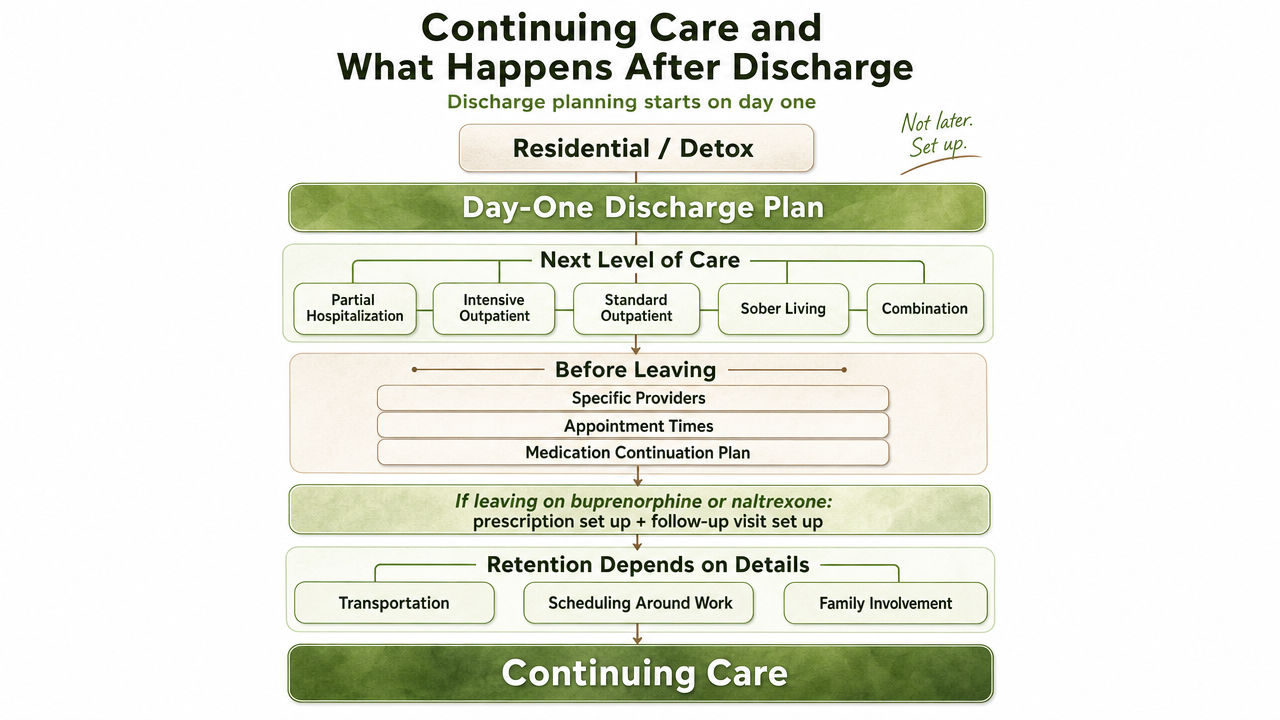
A quality program builds the discharge plan on day one, not day thirty. That plan should name the next level of care—partial hospitalization, intensive outpatient, standard outpatient, sober living, or a combination—and it should include specific providers, appointment times, and a plan for continuing any medications started during treatment 612. If your child is on buprenorphine or naltrexone when they leave residential, the prescription and the follow-up visit should already be set up. Not "we'll help you find someone." Set up.
Retention matters, and the details you might think are logistical—transportation, scheduling around work, family involvement—are actually clinical. A 2024 systematic review of 98 studies of adolescents and young adults in psychosocial alcohol and other drug treatment estimated an overall completion rate of 59%, and found that family-based intervention and contingency management were associated with higher completion 14. That research is on younger populations, not adults, so read it as a signal rather than a rule. Still, the practical point holds: programs that make it easier to show up—flexible session times, help with transportation, meaningful family participation—tend to keep people engaged longer.
Ask specifically: How do you handle a missed appointment? What is your relapse protocol—does my child get kicked out, or does the plan adjust? Who calls whom if something goes sideways in month two?
Privacy, Consent, and What You Are Allowed to Know
This part is hard, and it catches a lot of parents off guard. Once your child is 18, they are the patient. You may be paying the bill, driving them to admission, and lying awake every night worrying about them, and the treatment team still cannot tell you much of anything without your child's written permission.
The rules here are stricter than standard medical privacy. Records from federally assisted substance use disorder programs are covered by 42 CFR Part 2, a federal regulation that generally prohibits a program from disclosing information that identifies someone as having a substance use disorder unless the patient has signed a specific consent 2. That protection sits on top of HIPAA. A 2024 final rule updated Part 2 to align more closely with HIPAA while keeping its specialized safeguards, and it allows patients to sign a single consent covering future disclosures for treatment, payment, and health care operations 13.
What that means in practice: ask your adult child, before admission if possible, to sign a release naming you (and anyone else they trust) as someone the program can talk to. Be specific about what they are comfortable sharing—clinical progress, medication changes, discharge planning, billing—and what stays private. A good program will walk your child through this consent form carefully, not rush it or bury it in a stack of paperwork.
If your child says no, or says yes to only a narrow slice, honor it. That is their right, and pushing against it usually damages the trust you will need later. What you can still do is give the program your contact information, tell them what you have observed, and ask how family participation works within whatever consent your child has signed. Family therapy sessions, education groups for loved ones, and scheduled updates are often built into programming and do not require your child to hand over their full chart.
Write down one question for the admissions call: "What does family communication look like here, and what does my child need to sign for that to happen?" A clear answer tells you the program takes both privacy and family involvement seriously.
Insurance, Parity, and the Questions to Ask Your Plan
Money is not the reason to pick a program, but it will shape which programs are realistic. Before you commit to anything, call the number on the back of your child's insurance card and ask specific questions. Vague answers from an insurer are as much of a red flag as vague answers from a treatment center.
Federal law is on your side here more than it used to be. The 2024 final rules under the Mental Health Parity and Addiction Equity Act (MHPAEA) strengthened protections against health plans imposing tougher limits on mental health and substance use disorder care than they do on medical or surgical care. For many group health plans, the final rules generally apply to plan years beginning on or after January 1, 2025, with certain requirements applying beginning on or after January 1, 2026, and individual-market rules generally applying for policy years beginning in 2026 3. That means the plan you have right now likely operates under stricter parity requirements than it did a couple of years ago.
Turn that into four direct questions:
- Is this specific treatment center in-network, and what are my out-of-pocket costs for detox, residential, partial hospitalization, and intensive outpatient?
- Do you require prior authorization at each level of care, and how long does that decision take?
- What are your criteria for approving continued stay, and how do those compare to how you approve inpatient medical care?
- If a request is denied, what is the appeals process and how quickly can it move?
Get the answers in writing when you can. Ask the treatment center's admissions team to verify benefits independently and share what they find. When the two accounts do not match, that gap is worth resolving before day one, not after a bill arrives.
Red Flags and Green Flags When You Tour or Call
You will feel the difference between a good program and a shaky one within about ten minutes of the first phone call. Trust that instinct, and then check it against a few specifics.
Green flags: The person on the phone asks about your child before pitching the program. They can name the medications they prescribe for opioid or alcohol use disorder, describe how detox connects to what comes next, and explain how mental health conditions are treated inside the same program rather than referred out 16. They welcome your questions about accreditation, staffing, and consent, and they walk you through what family communication looks like once your adult child signs a release 13.
Red flags: Guaranteed outcomes. A one-size schedule regardless of substance. Vague answers about medications for opioid use disorder, or pressure to avoid them entirely 12. "We offer behavioral health" used as a stand-in for integrated dual diagnosis care, which the HHS Office of Inspector General flagged in 2025 as a real gap even at well-funded centers 5. Aggressive travel offers before anyone has assessed your child. Reluctance to put insurance details or discharge planning in writing.
Your Role as a Parent Without Overstepping
You are not the clinician. You are also not a bystander. Somewhere between those two roles is where you belong, and finding that spot is one of the harder emotional pieces of this whole thing.
What you can do well: notice patterns, ask questions, show up for family sessions, and hold steady when things get bumpy. Family involvement is one of SAMHSA's five signs of quality treatment for a reason, and family-based approaches have been associated with better engagement in the research on younger populations 614. When a program invites you into education groups or family therapy, say yes, even when it is inconvenient and uncomfortable.
What is not your job: running the treatment plan, second-guessing the clinical team in front of your child, or trying to fix what only your child can decide to work on. If you disagree with a decision, take it up with the team privately.
One more thing. Take care of yourself while this is happening. Your own therapist, an Al-Anon or Nar-Anon meeting, or a support group for families can carry weight that you should not try to carry alone. You are in this for the long run, and steady beats heroic every time.
Frequently Asked Questions
How do I know if a nearby program can actually treat both addiction and a mental health condition?
Ask concrete staffing and coordination questions. Is a psychiatrist on staff who can evaluate and prescribe? Do the same team members treat both conditions, and is there one unified treatment plan rather than two disconnected ones? The label "dual diagnosis" is not proof; integrated care means the mental health condition and substance use disorder are addressed together by a coordinated team 110.
My adult child is 22. Can the treatment program tell me anything about their care?
Not without your child's written consent. Records from federally assisted substance use disorder programs are protected under 42 CFR Part 2, which generally prohibits sharing information identifying someone as having a substance use disorder unless the patient signs a specific release 213. Ask your child, before admission if possible, to sign a release naming you and specifying what the program may discuss with you.
Is detox by itself enough, or does my child need more treatment after that?
Detox alone is not treatment. Federal guidance is direct: detoxification by itself is not sufficient for recovery, and for opioid use disorder, detox without follow-up medication is actively not recommended and can raise overdose risk as tolerance drops 712. Ask any program what happens on day eight, whether they provide the next level of care in-house, and how ongoing medication and therapy get arranged.
What should I ask our insurance plan before we commit to a program?
Ask four things: Is the treatment center in-network, and what are out-of-pocket costs at each level of care? Is prior authorization required, and how quickly is it decided? What are the criteria for continued stay? What is the appeals process if a request is denied? Strengthened federal parity rules apply to many group plans for plan years beginning on or after January 1, 2025 3.
What medications should a quality program offer for opioid or alcohol use disorder?
For opioid use disorder, ask specifically about buprenorphine, methadone, and naltrexone; medication is the first line of treatment and is associated with reduced overdose and mortality risk 712. For alcohol use disorder, ask which of the three FDA-approved medications the program prescribes and how they decide 8. A quality program can start medication promptly, continue it during residential care, and arrange continued prescribing after discharge.
What are the biggest red flags when I tour or call a treatment center?
Watch for guaranteed outcomes, a one-size schedule regardless of substance, vague answers about medications for opioid use disorder, and pressure to skip them entirely 12. "We offer behavioral health" used as a stand-in for integrated dual diagnosis care is another warning; the HHS Office of Inspector General flagged this gap in 2025 5. Reluctance to put insurance details or a written discharge plan in writing is also telling.
References
- Finding Help for Co-Occurring Substance Use and Mental Disorders. https://www.nimh.nih.gov/health/topics/substance-use-and-mental-health
- Understanding Confidentiality of Substance Use Disorder (SUD) Patient Records. https://www.hhs.gov/hipaa/part-2/index.html
- New Mental Health and Substance Use Disorder Parity Rules. https://www.dol.gov/agencies/ebsa/laws-and-regulations/laws/mental-health-parity/new-mhpaea-rules-what-they-mean-for-plans-and-issuers
- Contingency Management for Stimulant Use Disorder and Association With Mortality. https://pubmed.ncbi.nlm.nih.gov/40926572/
- Most Health Centers Provide Some Behavioral Health Services to Patients with Substance Use Disorder Despite Facing Challenges That Limit Comprehensive Treatment. https://oig.hhs.gov/reports/all/2025/most-health-centers-provide-some-behavioral-health-services-to-patients-with-substance-use-disorder-despite-facing-challenges-that-limit-comprehensive-treatment/
- Finding Quality Treatment for Substance Use Disorders. https://library.samhsa.gov/product/finding-quality-treatment-substance-use-disorders/pep18-treatment-loc
- Treatment and Recovery. https://nida.nih.gov/publications/drugs-brains-behavior-science-addiction/treatment-recovery
- Recommend Evidence-Based Treatment: Know the Options. https://www.niaaa.nih.gov/health-professionals-communities/core-resource-on-alcohol/recommend-evidence-based-treatment-know-options
- Treatment for Opioid Use Disorder: Population Estimates — United States, 2022. https://www.cdc.gov/mmwr/volumes/73/wr/mm7325a1.htm
- Effectiveness of Psychosocial Interventions for Adults With Substance Use Disorder That Have a Co-Occurring Common Mental Health Disorder: An Umbrella Review. https://pubmed.ncbi.nlm.nih.gov/41192364/
- Integrated behavioral interventions for adults with alcohol use disorder. https://pubmed.ncbi.nlm.nih.gov/39163680/
- Opioid Use Disorder: Treating. https://www.cdc.gov/overdose-prevention/hcp/clinical-care/opioid-use-disorder-treating.html
- Fact Sheet 42 CFR Part 2 Final Rule. https://www.hhs.gov/hipaa/for-professionals/regulatory-initiatives/fact-sheet-42-cfr-part-2-final-rule/index.html
- Systematic review of treatment completion rates and correlates among young people accessing alcohol and other drug treatment. https://pubmed.ncbi.nlm.nih.gov/38971027/
You’re not alone in this.
When mental health challenges and addiction intersect, it can feel isolating. At Arista, we offer compassionate, evidence-based, and trauma-informed care to help you heal, grow, and move forward.
Support that moves with you.
You’ve taken a brave first step. At Arista Recovery, we’re here to help you continue with best-in-class care designed for long-term healing and support.