.webp)


How to Start Alcohol Abuse Treatment Near Me
Key Takeaways
- Assess withdrawal risk before choosing a location, since heavy daily drinking can trigger dangerous symptoms like seizures that require medical detox rather than a nearby outpatient clinic 7.
- Match care to your situation across the ladder from detox to sober living, and consider primary care or integrated treatment when mental health conditions are part of the picture 6, 8.
- Vet programs by asking about naltrexone, acamprosate, and disulfiram by name, specific therapies delivered, and whether psychiatric providers are on staff for co-occurring conditions 7, 8.
- Use a prepared script for the first call with your drinking history, medications, and insurance ready, and move on if answers about medication or follow-up are vague.
- Gather insurance details before verifying benefits, and know that 42 CFR Part 2 protects your treatment records from disclosure without written consent outside narrow exceptions 11.
- Expect admission day to focus on medical and psychiatric intake, with therapy and medication decisions typically starting by day three or four once withdrawal settles 6, 7.
- Leave discharge with therapy, prescriber, and mental health appointments already scheduled, because continued medication and integrated follow-up drive results more than the residential stay alone 4, 5, 10.
Before You Pick a Place, Answer One Question About Withdrawal
Before you compare programs, drive times, or star ratings, sit with one question: what happens to your body if you stop drinking in the next 24 hours? The answer changes everything about where you should start.
Here's why it matters. If you've been drinking heavily for weeks, months, or years, stopping abruptly can trigger withdrawal that isn't just uncomfortable — it can be dangerous. NIAAA is direct about this: withdrawal after prolonged heavy drinking can be life-threatening and may include seizures 7. That's not fearmongering. That's the reason medical detox exists as its own level of care, and it's why the closest outpatient clinic isn't always the right first stop.
You don't need to diagnose yourself. You just need to notice a few honest signals from the last time you tried to cut back or went a day without a drink.
- Shaky hands, sweating, a racing heart, or nausea within hours of your last drink
- Trouble sleeping, restlessness, or feeling like your skin is buzzing
- Anxiety that spikes when you're not drinking and eases when you are
- A history of seizures, hallucinations, or DTs during past attempts to stop
- Drinking daily, drinking to steady yourself in the morning, or drinking to sleep
If none of that fits and your drinking is heavy-but-not-daily, you likely have more room to plan. Either way, the answer to the withdrawal question tells you whether your first call is to a medical detox intake line or to a scheduled assessment. Start there. The map comes second.
Match the Level of Care to Your Actual Situation
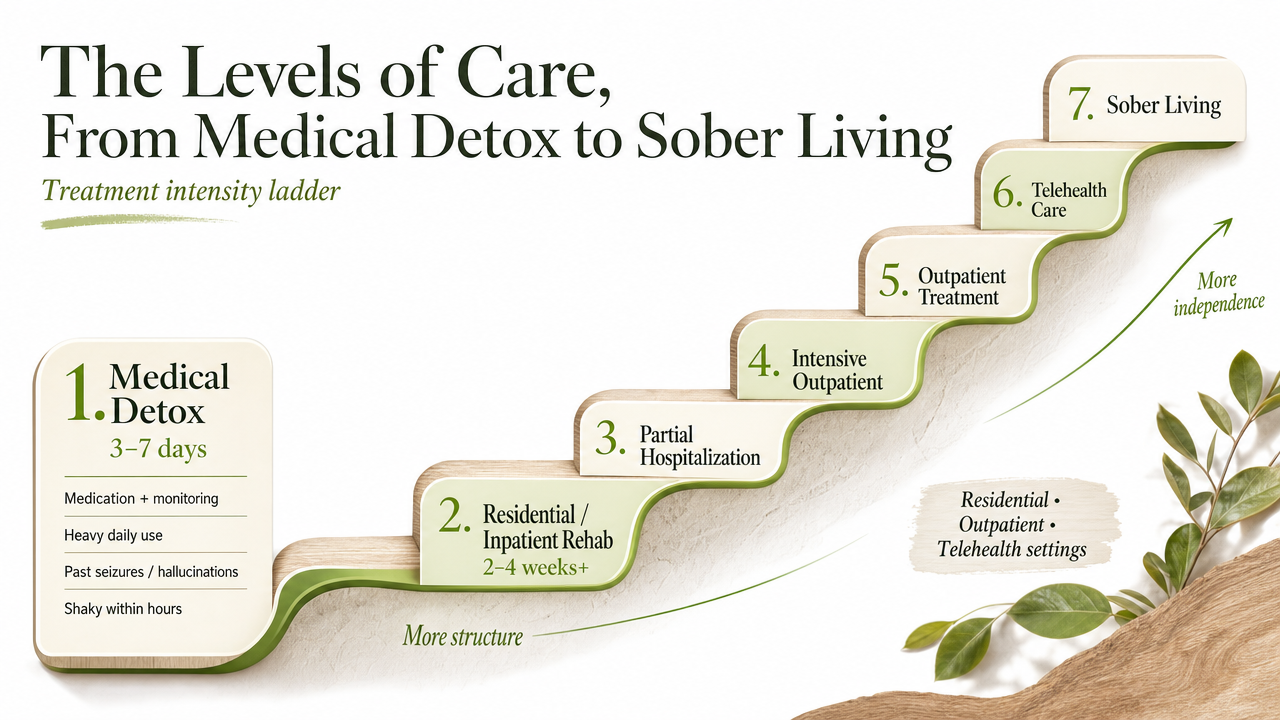
The Levels of Care, From Medical Detox to Sober Living
Alcohol treatment isn't one thing. It's a ladder, and the rung you start on depends on how your body handles stopping, how stable your daily life is, and how much structure you need to stay safe. NIAAA describes care as happening across residential, outpatient, and telehealth settings, with different intensities inside each 8. Here's what those rungs actually look like when you're the one climbing them.
- Medical detox. A short stay, usually 3–7 days, where a medical team manages withdrawal with medication and monitoring. This fits when you've been drinking heavily every day, when past attempts to stop caused seizures or hallucinations, or when you're already shaky within hours of your last drink 7.
- Residential or inpatient rehab. You live at the facility for roughly two to four weeks, sometimes longer. This fits when home isn't a safe place to get sober, when you need to step out of your daily triggers, or when co-occurring mental health issues need close attention.
- Partial hospitalization (PHP). Treatment most of the day, five days a week, but you sleep at home or in sober living. This fits when you need heavy structure but not 24-hour supervision.
- Intensive outpatient (IOP). Nine to fifteen hours a week of group and individual therapy. This fits when you can work or care for family and still commit to several evenings or mornings a week.
- Standard outpatient. Weekly or biweekly therapy, medication management, or both. This fits when you're stable and building long-term recovery skills.
- Telehealth. Video-based counseling and medication follow-up, delivered in the same evidence-based settings 8. This fits when travel, childcare, or rural distance would otherwise block care.
- Sober living. A structured, alcohol-free home you move into after residential or PHP. This fits when your housing situation would pull you back toward drinking.
You don't have to start at the top of the ladder. You just have to start at the rung that keeps you safe this week.
When Your Primary Care Doctor Is the Right First Call
If your drinking is heavy but you're not in daily withdrawal, and you don't have a history of seizures or DTs, your primary care doctor is a legitimate starting point. Not a backup plan — a real one.
The CDC's screening and brief intervention (SBI) approach is built for exactly this: a short set of validated questions, an honest conversation about what you're drinking, and a referral to treatment when it's warranted 1. Your doctor can also prescribe FDA-approved AUD medications, order labs to check your liver and other systems, and coordinate with a therapist. For a lot of people, that combination — a medication, a counselor, and a doctor who follows up — is the whole treatment plan.
What to say when you call: "I want to talk about my drinking. I'd like an alcohol screening at my next visit, and I want to know what medication and referral options you offer." That's it. You don't have to have a diagnosis ready. You just have to open the door. If your doctor decides your withdrawal risk is higher than outpatient care can handle, they'll route you to detox — which is a win, not a setback.
If Depression, Anxiety, or Trauma Are Part of the Picture
For a lot of people, drinking isn't the only thing happening. There's depression that started years before the drinking got heavy. Anxiety that a drink used to quiet. Trauma that never got treated. If any of that sounds like you, the level of care question changes shape: you don't just need a program that treats alcohol. You need one that treats both, at the same time, by the same team.
SAMHSA calls this integrated treatment, and the evidence-based approach combines mental health and substance use services through the same practitioner or team rather than sending you to two disconnected clinics 6. That matters practically. When your therapist knows about your PTSD and your prescriber knows about your naltrexone, nobody's guessing. When they're in separate systems, you become the messenger — and messengers relapse.
When you're vetting programs, ask directly: "Do you have psychiatric providers on staff? Can you treat depression, anxiety, PTSD, or bipolar alongside alcohol use disorder? Is that the same team or a referral out?" A program that says "we refer that out" isn't wrong — but it's a different kind of care than integrated treatment, and you deserve to know before admission, not after.
When mental health challenges and addiction intersect, it can feel isolating. At Arista, we offer compassionate, evidence-based, and trauma-informed care to help you heal, grow, and move forward.
Vetting a Local Program: What a Real One Sounds Like
Ask About the Three FDA-Approved Medications by Name
A lot of people don't know there are medications for alcohol use disorder. A lot of programs would rather you didn't ask. But asking is one of the fastest ways to tell a program that follows the evidence from one that doesn't.
Three medications are FDA-approved for AUD: naltrexone (as a daily pill or a monthly injection), acamprosate, and disulfiram 7, 8. They work in different ways and fit different goals. Naltrexone reduces the reward from drinking and can help with either abstinence or cutting back. Acamprosate is designed to support abstinence once you've stopped. Disulfiram creates a strong physical reaction if you drink, which is why it's typically started only after at least 12 hours of abstinence 8. None of them is a magic pill. All of them have real evidence behind them when combined with counseling — a 2024 systematic review and meta-analysis of 79 randomized trials and 11,737 participants found that AUD medications reduced alcohol-related outcomes compared with placebo 2, and AHRQ's outpatient review found moderate-strength evidence that acamprosate and oral naltrexone improve consumption outcomes 10.
Here's the ask, verbatim, for the phone call: "Do you offer naltrexone, acamprosate, and disulfiram? Who prescribes them, and how quickly can I be evaluated for one? If I start a medication in your program, who continues it after I discharge?" A program that treats medication as an add-on, or that only mentions it when you push, is telling you something. A program that has a psychiatric provider or medical director who evaluates every admission is telling you something else. You want the second one.
Ask What Therapy Actually Looks Like Day to Day
"We offer therapy" is not an answer. Every program says that. What you want to know is which therapies, how often, in what format, and who's running the room.
The behavioral interventions that show up in the evidence base for AUD have names. Cognitive behavioral therapy (CBT) helps you spot the thoughts and situations that lead to drinking and build different responses. Motivational interviewing (MI) works with your ambivalence instead of arguing you out of it. Dialectical behavioral therapy (DBT) adds skills for managing intense emotions, which matters if drinking has been your main coping tool. Integrated behavioral approaches for AUD are designed to reduce drinking and support the behavior change that keeps it reduced 5. Ask which of these the program actually delivers, and how often you'll get individual sessions versus group.
Then ask about the daily rhythm. In a residential program, what does a Tuesday look like? How many hours of clinical programming versus free time? Who's on staff overnight? In outpatient, how many hours a week, on what schedule, and what happens if you miss a session? A program that can walk you through a specific day, hour by hour, has thought about this. A program that hands you a brochure hasn't.
Ask How They Handle Co-Occurring Mental Health Care
This is the question that separates a real program from one that only treats drinking. If depression, anxiety, PTSD, or another mental health condition is part of your story — and for most people, it is — you need a program that can treat both together.
SAMHSA's evidence-based approach combines mental health and substance use services through the same practitioner or treatment team, not through two separate clinics passing you back and forth 6. Ask three specific things: Do you have a psychiatric provider on staff, and how quickly will I see them after admission? Can you evaluate and treat depression, anxiety, PTSD, or bipolar during my stay, not just refer out? If I'm already on a psychiatric medication, will you continue it, adjust it, or ask me to stop?
If the answers are vague — "we work with an outside psychiatrist," "we focus on the alcohol first" — that's real information. It might still be the right program for you. But you'll know what you're signing up for.
The First Phone Call: A Script You Can Actually Use
The hardest part of this whole process is usually the ten seconds before you hit call. So let's take the guesswork out of what happens after.
Before you dial, put three things in front of you: a rough timeline of your drinking (how much, how often, for how long), a list of any medications you take, and your insurance card if you have one. If you don't have insurance, that's okay — say so on the call and ask about self-pay rates, sliding scales, or state-funded options. You do not need a diagnosis, a plan, or a speech.
"Hi, I'm calling because I want to get help for my drinking. I'm not sure what level of care I need. Can you walk me through what a first assessment looks like?"
Then work through this short list of questions. Keep them on your screen or on paper so you don't have to remember them under pressure.
- How soon can I be assessed — today, tomorrow, this week?
- Do you offer medical detox on-site, or do you refer out if I need it?
- Do you prescribe naltrexone, acamprosate, and disulfiram, and who follows up on the medication after I leave? 7, 8
- Do you have psychiatric providers on staff for depression, anxiety, or PTSD? 6
- What insurance do you take, and can you verify my benefits while I'm on the phone?
- What does a typical day look like in your program?
- What happens after I discharge — do you help set up outpatient or medication follow-up? 5
If you get flustered or start crying in the middle of it, that's normal. The person on the other end has heard it before. Say, "I need a minute," or "Can you repeat that?" Nothing about this call disqualifies you from care.
One more thing. If the person answering can't give you clear answers to the medication and follow-up questions, thank them and call the next program on your list. Making the call was the win. Picking the right one is the next step, and you're allowed to shop.
Insurance, Cost, and Privacy Without the Jargon
What to Have in Front of You Before You Verify Benefits
Before the intake coordinator starts running your benefits, pull a few things together. It takes ten minutes and it saves you from a callback loop later.
- The front and back of your insurance card — snap photos on your phone so you can read the member ID and the phone number for behavioral health
- Your primary care doctor's name and clinic, in case the program wants to coordinate
- A rough list of current medications and doses
- Your ID and, if you have one, a rough sense of your deductible status for the year
Then ask the program to verify your benefits while you're on the line and to walk you through what your out-of-pocket cost looks like for detox, residential, PHP, or IOP — whichever levels of care are on the table. If you don't have insurance, say so early. Ask about self-pay rates, sliding-scale options, payment plans, and state-funded programs. Cost should not be the reason you don't call. It should be part of the conversation you have when you do.
Who Can See Your Records Under 42 CFR Part 2
Privacy is one of the top reasons people stall on making the call. You're worried your employer will find out. Your spouse. Your parents. Your license board. That worry is legitimate, and the answer is more protective than most people realize.
Substance use disorder records are covered by a federal rule called 42 CFR Part 2, which sits on top of the usual HIPAA protections. HHS updated the rule in 2024, with a compliance date of February 16, 2026, to make care coordination easier while keeping the heightened confidentiality that applies to SUD records 11. In plain terms: a program can't share the fact that you're a patient — let alone anything about your treatment — without your written consent, with narrow exceptions like a medical emergency or a court order. The updated rule also lets you sign a single consent for future uses and disclosures for treatment, payment, and health care operations, so you're not re-signing paperwork every visit 11.
When you call, ask three questions: Who at this program can access my chart? What consent form will I sign, and can I see it before admission? If I want my primary care doctor or therapist in the loop, how does that get set up — and can I revoke it later? Good answers sound specific. Vague answers are a signal to keep looking.
Admission Day and the First Two Weeks
Pack light. A few days of comfortable clothes, your ID and insurance card, your medication bottles in their original containers, and a phone charger. Most programs will give you a list; the list is usually shorter than you expect. Leave the laptop at home unless you've cleared it in advance.
Day one is mostly intake. You'll do a medical assessment, a psychiatric evaluation if the program has integrated care 6, and paperwork including the consent forms that govern who can be told you're there. If you're starting in detox, expect vitals every few hours, medication to manage withdrawal symptoms, and a lot of sleep. That's the point.
By day three or four, if withdrawal is behind you, therapy starts in earnest — individual sessions, group work, and a conversation about medication. This is when naltrexone, acamprosate, or disulfiram usually gets discussed and started if it fits 7. It's also when the fog begins to lift and the actual work becomes visible.
The first two weeks feel long. Homesickness is normal. Doubt is normal. Wanting to leave on day five is so common that staff have a name for it. Tell your counselor. Stay one more day. Then one more.
What Continues After Discharge
Discharge day is not the finish line. It's the handoff. What happens in the two weeks after you leave a residential or PHP program matters at least as much as what happened inside it, and the programs worth choosing know that going in.
Ask your program directly: "Who calls me in week one? Who prescribes my medication in month two? What happens if I miss an appointment?" Relapse-prevention planning is part of integrated behavioral treatment for a reason 5. A program that hands you a printout and wishes you luck is a different product than one that has a case manager checking in.
Recovery goals aren't one-size either. Some people aim for full abstinence. Others start with reduction and reassess. Both are legitimate paths worth discussing with your prescriber, and treatment duration varies with the goal 3. The point isn't the label. It's that you keep showing up — to the appointment, to the meeting, to the next honest conversation. That's the work.
Taking the Next Step
If you've read this far, you already know more than most people do when they start. You know withdrawal risk comes before geography. You know the three medications to ask about by name. You know what integrated care sounds like and what a real first call includes.
Now pick one thing to do in the next hour. Not the whole plan. One thing. Save two program numbers in your phone. Or text one person who won't panic and tell them you're looking into treatment. Or open your insurance app and find the member ID. Small moves count. They're how this actually starts.
If you're in Kansas, Ohio, Missouri, or Oklahoma and you want a same-day conversation with a team that offers medical detox, inpatient care, and integrated mental health support, Arista Recovery answers the phone 24/7. No script required on your end.
Frequently Asked Questions
How do I know if I need medical detox or if outpatient treatment is safe to start with?
The honest test is what happens when you stop. If you get shaky, sweaty, or nauseated within hours of your last drink, drink in the morning to steady yourself, or have ever had a seizure or hallucinations trying to quit, tell an intake line today — you likely need medical detox. Withdrawal after prolonged heavy drinking can be life-threatening 7.
What should I ask a local alcohol treatment program before I commit?
Ask five things. Do you prescribe naltrexone, acamprosate, and disulfiram, and who continues them after discharge 8? Which specific therapies do you run, and how often are individual sessions? Do you have psychiatric providers on staff for co-occurring conditions 6? Can you verify my insurance on this call? What follow-up appointments will be scheduled before I leave? Vague answers are useful information.
Will my employer or family find out I went to treatment?
Not without your written consent, with narrow exceptions like a medical emergency or a court order. Substance use disorder records get extra protection under 42 CFR Part 2, updated by HHS in 2024 with a February 16, 2026 compliance date 11. Ask the program who can access your chart, what consent form you'll sign, and how you can revoke any release later.
Can I start with my primary care doctor instead of a rehab facility?
Yes, if your drinking is risky but you're not in daily withdrawal and don't have a seizure history. The CDC's screening and brief intervention approach is built for this — a short set of validated questions, a real conversation, and a referral when needed 1. Your doctor can also prescribe AUD medication and coordinate with a therapist. If withdrawal risk is higher, they'll route you to detox.
What medications are approved for alcohol use disorder, and should I ask about them?
Three: naltrexone (daily pill or monthly injection), acamprosate, and disulfiram 7, 8. Ask by name. A 2024 meta-analysis of 79 randomized trials and 11,737 participants found AUD medications reduced alcohol-related outcomes versus placebo 2, and AHRQ found moderate-strength evidence for acamprosate and oral naltrexone 10. They work best alongside counseling. If a program treats medication as optional, keep calling.
What happens if I also struggle with depression, anxiety, or trauma?
You want integrated treatment — the same team handling both, not two clinics passing you back and forth. SAMHSA's evidence-based approach combines mental health and substance use services through the same practitioner or team 6. Ask if there's a psychiatric provider on staff, how quickly you'll see them, and whether they'll continue any medication you're already taking. Separate systems make you the messenger.
References
- Alcohol Screening and Brief Intervention (SBI). https://www.cdc.gov/alcohol-pregnancy/hcp/alcoholsbi/index.html
- Efficacy of medications for the treatment of alcohol use disorder (AUD): A systematic review and meta-analysis considering baseline AUD severity. https://pubmed.ncbi.nlm.nih.gov/39396764/
- Efficacy and safety of alcohol reduction pharmacotherapy according to treatment duration in patients with alcohol dependence or alcohol use disorder: A systematic review and network meta-analysis. https://pubmed.ncbi.nlm.nih.gov/38173342/
- Pharmacotherapy for Alcohol Use Disorder: A Systematic Review. https://pubmed.ncbi.nlm.nih.gov/37934220/
- Integrated behavioral interventions for adults with alcohol use disorder. https://pubmed.ncbi.nlm.nih.gov/39163680/
- Integrated Treatment for Co-Occurring Disorders Evidence-Based Practices KIT. https://library.samhsa.gov/product/integrated-treatment-co-occurring-disorders-evidence-based-practices-ebp-kit/sma08-4366
- Treatment for Alcohol Problems: Finding and Getting Help. https://www.niaaa.nih.gov/publications/brochures-and-fact-sheets/treatment-alcohol-problems-finding-and-getting-help
- Recommend Evidence-Based Treatment: Know the Options. https://www.niaaa.nih.gov/health-professionals-communities/core-resource-on-alcohol/recommend-evidence-based-treatment-know-options
- Alcohol Treatment in the United States. https://www.niaaa.nih.gov/alcohols-effects-health/alcohol-topics-z/alcohol-facts-and-statistics/alcohol-treatment-united-states
- Pharmacotherapy for Adults With Alcohol Use Disorder (AUD) in Outpatient Settings. https://effectivehealthcare.ahrq.gov/products/alcohol-misuse-drug-therapy/clinician
- Fact Sheet 42 CFR Part 2 Final Rule. https://www.hhs.gov/hipaa/for-professionals/regulatory-initiatives/fact-sheet-42-cfr-part-2-final-rule/index.html
You’re not alone in this.
When mental health challenges and addiction intersect, it can feel isolating. At Arista, we offer compassionate, evidence-based, and trauma-informed care to help you heal, grow, and move forward.
Support that moves with you.
You’ve taken a brave first step. At Arista Recovery, we’re here to help you continue with best-in-class care designed for long-term healing and support.