.webp)


Key Takeaways
- Franklin County carries a heavier mental health and substance use load than Ohio overall, with roughly one in five adults meeting SUD criteria in 2023 2.
- Ohio Medicaid requires ASAM criteria to match people to outpatient, IOP, PHP, residential, or detox care, and the framework specifically accounts for co-occurring conditions 3.
- Ask whether a Hilliard program is co-occurring capable or co-occurring enhanced, whether one team treats both conditions, and how ASAM assessments drive step-downs 3, 13.
- Compare programs on staffing, length of coordinated care, and outcome tracking — sustained integrated outpatient treatment of 18 months or longer shows the strongest gains 7.
What integrated care means when addiction and mental health show up together
If you're reading this at an odd hour, trying to figure out whether what's happening in your life or your loved one's life counts as "dual diagnosis," take a breath. The short answer is this: when a substance use disorder and a mental health condition like depression, anxiety, PTSD, or bipolar disorder show up in the same person, that's a co-occurring condition. And treating them at the same time, on the same team, with one plan, is what clinicians call integrated care.
That definition matters more than it sounds. Integrated treatment means the same clinicians, working in one coordinated setting, deliver both the mental health work and the substance use work together, rather than handing you off between two separate systems that rarely talk to each other 13. In practice, that can look like one team combining therapy and medication for both conditions in a single plan 8.
Federal guidance from NIDA is direct about why this matters: the high rate of overlap between substance use and other mental disorders points to a real need to identify and treat both at the same time, and integrated approaches tend to lead to better health outcomes 6. When only the addiction gets addressed, untreated anxiety or trauma often pulls you back toward substances. When only the mental health side gets treated, ongoing substance use can blunt the medication and stall the therapy.
You are not being asked to pick which struggle is "the real one." Both are real. Integrated care is built on that idea, and the rest of this guide walks you through what it looks like near Hilliard.
The Hilliard and Franklin County picture
What the local numbers say about co-occurring conditions
You are not imagining that this feels harder in Central Ohio than the national headlines suggest. The Alcohol, Drug and Mental Health Board of Franklin County reports that in 2023, 9.9% of Franklin County adults had a mental health impairment in the past month, compared with 7.5% of Ohioans overall 2. That gap is small on paper and huge in a living room. It means the county Hilliard sits in carries a heavier month-to-month mental health load than the state average, and the people around you are more likely than most Ohioans to be quietly struggling right now.
Layer in the substance use side. The same ADAMH data estimates that roughly one in five Franklin County residents had a substance use disorder in 2023, and 26.2% of adults reported binge drinking in the past month 2. Binge drinking isn't just a weekend habit label — it's often how untreated anxiety, grief, or trauma looks from the outside before anyone calls it a diagnosis.
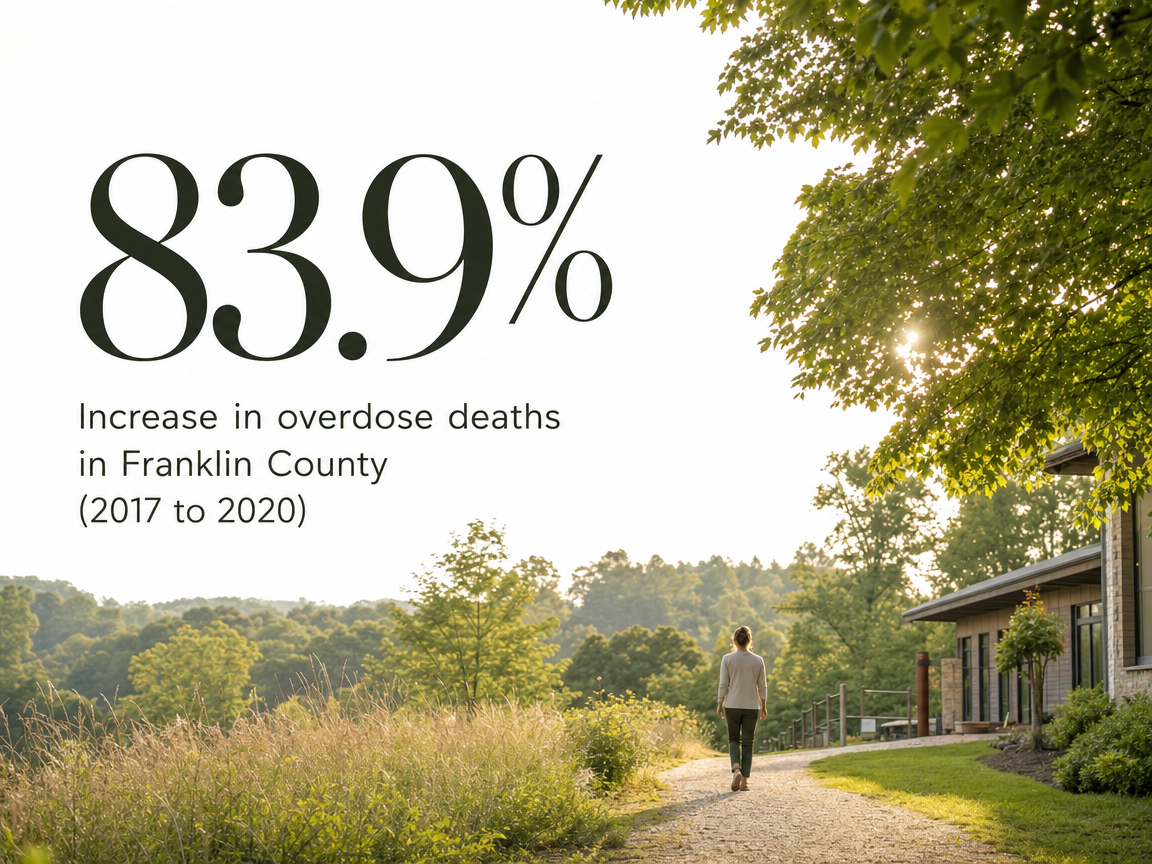
Columbus Public Health rounds out the picture. Thirteen percent of Franklin County adults report 15 or more poor mental health days in a typical month, 7% meet criteria for an alcohol use disorder, and 8% are classified as heavy drinkers 5. And Ohio State's Wexner Medical Center notes that overdose deaths in the county rose 45.6% from 2019 to 2020, a jarring single-year jump that has kept local providers focused on integrated care ever since 1.
If any of those numbers describe someone in your household, you are not an outlier here. You are one of many Hilliard neighbors trying to figure out the same thing at the same time — and that means the local infrastructure to help you exists, and it's been under real pressure to get better.
How common co-occurring conditions are across Ohio
Zoom out from Franklin County for a moment, because the statewide backdrop changes how you read the local numbers. SAMHSA's 2023 National Survey on Drug Use and Health estimates that about 1,828,000 Ohioans aged 12 and older met criteria for a past-year substance use disorder in 2022–2023. That total splits almost evenly: roughly 1,095,000 with an alcohol use disorder and 1,039,000 with a drug use disorder 4.
Why does that split matter to you? Because it changes what a Hilliard program's caseload looks like on any given Tuesday. If you or your loved one is struggling with alcohol, you are not walking into a room full of strangers whose experiences feel foreign. Half the state's SUD population is right there with you. If the primary struggle is opioids, stimulants, or benzodiazepines, the other half of that number reflects your reality — and it means local clinicians see this every day.
The other thing this scale tells you: when co-occurring depression, anxiety, PTSD, or bipolar disorder sits underneath either the alcohol or the drug use, that combination is the norm, not the exception. Federal guidance from NIDA frames it plainly: the overlap between substance use and other mental disorders is high enough that identifying and treating both at once should be the standard approach, not a specialty add-on 6.
So when you call a program near Hilliard and hear terms like "co-occurring" or "integrated," you are not being routed to a niche track. You are asking for what the data — state and local — says most people in your situation actually need.
Levels of care under Ohio's ASAM framework
Outpatient, IOP, PHP, residential, and detox in plain language
When you start calling programs near Hilliard, you'll hear a stack of terms that sound like acronym soup: ASAM, IOP, PHP, LOC 3. Here's the plain-language version, because you deserve to know what you're being sold before you commit to it.
Ohio Medicaid requires that substance use disorder treatment services be defined and delivered according to ASAM criteria — the American Society of Addiction Medicine's framework for matching a person to the right intensity of care. That standard applies to admission, to continued stay, and to discharge, and it explicitly includes co-occurring conditions 3. Translation: a program can't just say "you look like a residential case, come on in." There's a structured assessment behind the recommendation, and you can ask to see how you scored.
The levels, from lightest to most intensive:
Outpatient (Level 1). Typically one to a few hours a week. Individual therapy, group, and psychiatric medication management. You keep working, keep sleeping at home, keep parenting.
Intensive Outpatient (IOP) and Partial Hospitalization (PHP) (Level 2). IOP usually runs about 9–19 hours a week across three to five days. PHP is more like a day program — often 20+ hours a week, five days a week — where you go home at night. Both are common landing spots for co-occurring care because they combine real structure with real life.
Residential/Inpatient (Level 3). Twenty-four-hour treatment. Ohio's rule specifies that Level 3 services are "co-occurring capable, co-occurring enhanced, and complexity capable," delivered by addiction, mental health, and general medical staff together 3.
Medical detox (Level 3.7/4). Short-term, medically supervised withdrawal management for alcohol, opioids, or benzodiazepines when stopping on your own would be dangerous. It's a starting point, not a whole treatment plan.
You are allowed to step up or down between these levels as your needs change. That is how the framework is designed to work.
Co-occurring capable vs co-occurring enhanced: how to tell them apart on a phone call
Two programs can both say they "treat dual diagnosis" and still deliver very different care. Ohio's rule uses specific language here: Level 3 residential services are described as co-occurring capable, co-occurring enhanced, and complexity capable 3. Those aren't marketing labels. They point to how deeply mental health is woven into the program.
Co-occurring capable programs can safely treat people whose mental health condition is stable — say, depression managed on a steady medication, or anxiety that flares but isn't disabling. The primary focus is substance use, with mental health support alongside.
Co-occurring enhanced programs are built for people whose psychiatric symptoms are more acute or unstable — active PTSD symptoms, bipolar disorder in a mixed state, severe depression with suicidal thinking. Psychiatric staffing is deeper, and the mental health work runs on equal footing with the addiction work.
On the phone, three questions cut through the marketing:
1. "Is your program co-occurring capable or co-occurring enhanced?" If they can't answer, that's your answer.
2. "Do the same clinicians treat both conditions, or do you refer out for mental health?" Integrated care means one team, one plan 13.
3. "How is my ASAM assessment used to decide my level of care and when I step down?" 3
You are not being difficult by asking. You are doing exactly what the framework expects of you.
What the evidence actually says about treating both conditions together
Where integrated care clearly helps
Here is the honest version of the research, because you deserve that too. Integrated care is not magic, but there are specific places where the evidence lands clearly on its side, and those are worth knowing before you say yes to a program.
Start with psychiatric symptoms. A 2023 systematic review comparing integrated and non-integrated treatment in dual diagnosis populations found that integrated treatment produced a significant advantage in improving psychiatric symptomatology — meaning the depression, anxiety, PTSD, or bipolar symptoms measured on standardized scales moved more when both conditions were treated on one team 12. If the mental health side is what wakes you up at night, this is the finding that matters most.
Then there is engagement and long-term outcomes. Drake and colleagues' review of 36 studies found that when comprehensive integrated outpatient treatment ran for 18 months or longer, substance use dropped significantly, remission rates went up, and hospital use went down 7, 9. The length matters. Short bursts of care do not seem to move the needle the same way sustained, coordinated treatment does.
A 2023 review of co-located outpatient care — mental health and substance use clinicians working in the same setting — reported provisional evidence of reduced substance use, lower symptom severity, better quality of life, fewer emergency department visits, and reduced health system costs 10. And a 2026 umbrella review of 28 systematic reviews concluded that coordinated integrated treatment is usually better than treating one condition alone and often better than parallel uncoordinated services 11. Better than nothing. Better than fragmented. That is a real bar.
Where the evidence is more mixed
Now the harder part. If a program tells you integrated care will fix everything faster and better than any other option, they are getting ahead of the research.
That same 2023 review that found a psychiatric-symptom advantage also found no significant difference between integrated and non-integrated care on two outcomes that matter a lot to you: substance misuse itself and treatment retention 12. Put plainly, whether people kept using and whether they stuck with treatment did not clearly favor the integrated model over well-structured non-integrated care in that analysis.
Drake and colleagues were similarly candid. While comprehensive integrated outpatient programs looked encouraging for engagement and remission, their results for hospital use and psychiatric symptoms across studies were less consistent, and they called for more controlled research 9. The SAMHSA evidence kit, which supports integrated treatment overall, also acknowledges gaps in long-term and high-quality randomized trials 13.
So what do you do with that? A few things. Ask a program how long its integrated track actually runs, because 18 months of coordinated outpatient care looks different in the data than a 30-day residential stay followed by a warm handoff 7. Ask what they measure and how often. And give yourself permission to judge a program on the specifics — same team, coordinated plan, real psychiatric staffing — rather than the label alone.
A realistic week inside integrated dual diagnosis treatment
You might picture treatment as one long room with folding chairs and a whiteboard. In an integrated program, a real week looks more textured than that, because two conditions are being worked at once by the same team 8.
Say you land in an intensive outpatient track. Monday morning starts with a check-in group where you name what happened over the weekend — the fight with your partner, the two drinks you had, the panic attack in the grocery store parking lot. Nothing is separated into "the addiction stuff" and "the mental health stuff." It's one story, and the group leader is trained to hear both threads.
Tuesday might be individual therapy, often Cognitive Behavioral Therapy or Dialectical Behavioral Therapy skills work. Your therapist knows your psychiatric diagnosis and your substance use history, because they're on the same team and share the same chart 13. Wednesday could bring a 20-minute psychiatric medication review — the prescriber checking whether the antidepressant is doing its job, whether a mood stabilizer needs adjusting, whether medication-assisted treatment for opioid or alcohol use disorder is helping the cravings quiet down.
Thursday tends to be trauma-informed group or a skills group focused on relapse prevention that folds in emotion regulation, not just refusal skills. Friday often makes room for a family session, because the people who live with you are part of what heals or unravels this.
Somewhere in that week, expect an experiential piece — art, movement, or a values-based exercise — that lets you work on something without having to talk about it perfectly. You will not love every hour. You may cry in one and feel bored in the next. Both are part of a week that is doing what it's supposed to do.
Choosing a level of care that fits your life in Hilliard
The right level of care is the one you can actually show up for, honestly, for long enough to matter. That last part is easy to skip. The Drake review found that comprehensive integrated outpatient care running 18 months or longer produced the strongest gains in substance use, remission, and hospital reduction 7. Whatever level you start at, you are picking something you can sustain past the first hard month.
A few real-life anchors to weigh against the ASAM levels you'll be offered 3:
What are the withdrawal risks? If you drink daily and heavily, or you are physically dependent on opioids or benzodiazepines, medical detox is not optional — it's the safe front door. Stopping alone can be dangerous. After detox, most people step into residential or PHP, not straight to outpatient.
How stable is home? If the people you live with are actively using, or the environment triggers a trauma response every night, residential buys you distance while the medication and therapy start working. If home is safe and supportive, IOP or PHP lets you practice new skills in the setting where you actually have to use them.
How acute are the psychiatric symptoms? Active suicidal thinking, a manic episode, or PTSD symptoms that make sleep impossible point toward a co-occurring enhanced setting with deeper psychiatric staffing 3. Stable, medication-managed symptoms often fit well in IOP.
What can work and family absorb? IOP in Hilliard often runs mornings or evenings so you can keep a job. PHP is a full weekday commitment. Residential means arranging childcare, leave, and a story you feel okay telling your employer.
You do not have to get this perfectly right on day one. You are allowed to start where you can start, and step up if it isn't enough. That is not failing. That is the framework working the way it was built to work.
How to evaluate a program before you commit
You are not shopping for a mattress. You are choosing where to put your nervous system and your trust for the next several months. It's okay to ask hard questions before you sign anything.
Start with staffing. Ask who will actually be in the room with you. A real integrated program has both addiction-trained clinicians and mental health clinicians on the same team, sharing one chart and one plan, not passing you between silos 13. If the psychiatric prescriber is a consultant who visits twice a month, that is not the same thing as integrated care.
Ask about length and step-down. The strongest outcomes in the research came from comprehensive integrated outpatient care sustained 18 months or longer, not from 30 days and a handshake 7. A program that can only describe the first phase, with no clear plan for IOP, outpatient, and medication follow-through, is planning for a gap you will fall into.
Ask what they measure. Do they track psychiatric symptoms, substance use, and quality of life over time, or just attendance? Ask about ASAM assessments — how they scored you, when they'll reassess, and what would trigger a change in level of care 3. Finally, ask what happens on a bad week: how the same team responds if you relapse, or if depression spikes. A program that has an answer for that is one you can trust with the whole picture, not just the version of you that shows up on day one.
Taking the next step without waiting for a crisis
You do not need a rock-bottom story to make the call. One honest phone conversation is enough to start. The people who answer at integrated programs near Hilliard have heard every version of the sentence you're rehearsing in your head, and none of them will make you say it perfectly.
Bring what you have: a rough timeline, current medications, whether you have insurance or Medicaid, and one or two things you're most scared to say out loud. Ask about ASAM assessment, whether the program is co-occurring capable or enhanced, and how the same team will handle both conditions 3, 13. If today isn't the day for a program, it can be the day for a primary care visit, a screening, or a message to someone who's asked before how you're doing.
Progress here rarely looks like a montage. It looks like one appointment kept, one night of real sleep, one conversation you didn't numb through. That counts. Arista Recovery and other integrated providers in the area are set up for exactly this kind of beginning.
Frequently Asked Questions
What does dual diagnosis treatment actually mean?
Dual diagnosis treatment means one team addresses both a substance use disorder and a mental health condition — like depression, anxiety, PTSD, or bipolar disorder — at the same time, in the same setting, with one coordinated plan 13. It combines therapy and medication for both conditions rather than sending you between separate providers who rarely share notes 8.
How do I know if I or my loved one qualifies for dual diagnosis care?
If you're living with a substance use pattern alongside symptoms like ongoing depression, anxiety, panic, trauma flashbacks, or mood swings, you likely qualify. NIDA notes the overlap is common enough that both conditions should be identified and treated together 6. A formal ASAM assessment at intake confirms the diagnosis and matches you to the right level of care 3.
What is the difference between co-occurring capable and co-occurring enhanced programs?
Ohio's rule uses both terms for Level 3 residential care 3. Co-occurring capable programs safely treat people whose mental health symptoms are stable — say, depression on steady medication. Co-occurring enhanced programs are built for more acute or unstable psychiatric symptoms, with deeper mental health staffing running on equal footing with the addiction work. Ask which one a program is before you commit.
Does Ohio Medicaid cover dual diagnosis treatment in the Hilliard area?
Yes. Ohio Administrative Code Rule 5160-27-09 sets Medicaid reimbursement standards for substance use disorder services and requires ASAM criteria for admission, continued stay, and discharge, including co-occurring conditions 3. Covered levels of care include outpatient, intensive outpatient, partial hospitalization, and residential/inpatient. Call the program directly to confirm they're in-network for your specific Medicaid plan and any prior authorization details.
Is integrated treatment really better than seeing separate providers for each condition?
The honest answer is: mostly yes, with nuance. A 2026 umbrella review found integrated coordinated care is usually better than treating one condition alone and often better than uncoordinated parallel services 11. A 2023 review showed integrated care significantly improves psychiatric symptoms, though substance use and retention outcomes didn't differ significantly from well-structured non-integrated care 12. Coordination matters more than the label.
What level of care should I start with if I can't take time off work?
Intensive outpatient (IOP) is usually the fit. It typically runs 9–19 hours a week across three to five days, often scheduled mornings or evenings so you can keep working 3. If withdrawal risk is high or psychiatric symptoms are acute, start with detox or a higher level first, then step down. The Drake review found sustained care over 18 months produces the strongest outcomes 7.
References
- Mental and Behavioral Health and Substance Use Disorder. https://wexnermedical.osu.edu/health-equity/mental-and-behavioral-health-and-substance-use-disorder
- 2025 Levy Fact Book (Alcohol, Drug and Mental Health Board of Franklin County). https://www.franklincountyohio.gov/files/assets/public/v/1/budget/documents/human-services-levy-review-committee/alcohol-drug-and-mental-health-board/proposed-levy-2027-to-2036/2025-adamh-levy-request.pdf
- Rule 5160-27-09 - Ohio Administrative Code. https://codes.ohio.gov/ohio-administrative-code/rule-5160-27-09
- 2023 NSDUH State Tables – Ohio (SAMHSA). https://www.samhsa.gov/data/sites/default/files/reports/rpt56188/2023-nsduh-sae-state-tables_0/2023-nsduh-sae-state-tabs-ohio.pdf
- FRANKLIN COUNTY, OHIO – Mental Health Data Brief. https://www.columbus.gov/files/sharedassets/city/v/1/public-health/data-and-reports/mental-health-brief-2020.pdf
- Co-Occurring Disorders and Health Conditions (NIDA). https://nida.nih.gov/research-topics/co-occurring-disorders-health-conditions
- Review of integrated mental health and substance abuse treatment for patients with dual disorders. https://www.ncbi.nlm.nih.gov/books/NBK67188/
- Integrated Treatment of Substance Use and Psychiatric Disorders. https://pmc.ncbi.nlm.nih.gov/articles/PMC3753025/
- Review of integrated mental health and substance abuse treatment for patients with dual disorders. https://pubmed.ncbi.nlm.nih.gov/9853791/
- Health outcomes and service use patterns associated with co-located outpatient mental health care and alcohol and other drug specialist treatment: A systematic review. https://pmc.ncbi.nlm.nih.gov/articles/PMC10946517/
- Effectiveness of Psychosocial Interventions for Adults With Substance Use Disorder That Have a Co-Occurring Common Mental Health Disorder: An Umbrella Review. https://pubmed.ncbi.nlm.nih.gov/41192364/
- Integrated vs non-integrated treatment outcomes in dual diagnosis: A systematic review. https://pmc.ncbi.nlm.nih.gov/articles/PMC10157410/
- Integrated Treatment for Co-Occurring Disorders: The Evidence (SAMHSA EBP KIT). https://library.samhsa.gov/sites/default/files/ebp-kit-the-evidence-10242019.pdf