.webp)


Key Takeaways
- In Paola and across Kansas, co-occurring mental health and substance use conditions feed each other, and mortality data shows 70.6% of substance-related deaths involved untreated mental illness alongside 11.
- Kansas identifies co-occurring disorders in only 14.4% of public mental health patients, well below the 27.1% national rate, making it critical to ask providers whether intake screens for both conditions 12, 13.
- SAMHSA's evidence supports fully integrated care where one team treats both conditions in one setting, which is stronger than coordinated referrals or co-located but separate treatment plans 1, 4.
- Before choosing a program near Paola, compare integration model, intake screening, medication coordination, stage-wise flexibility, co-occurring group design, and ties to local partners like MCMHI and the Elizabeth Layton Center 17.
When Two Conditions Feed Each Other, One-Track Treatment Rarely Holds
If you're reading this, you probably already know the pattern. The anxiety gets loud, so a drink or a pill quiets it. The quiet doesn't last. The depression deepens, the drinking picks up, and the next morning feels heavier than the one before. Maybe you've tried a mental health provider who told you to get sober first. Maybe you've tried a substance use program that treated the drinking but never touched the trauma underneath. And here you are again, tired, looking for something that might actually work this time.
That exhaustion is real, and it makes sense. When a mental health condition and a substance use disorder show up together, they don't take turns. They feed each other. Treating one and ignoring the other is like bailing water out of a boat with a hole in it.
In Kansas, an estimated 181,000 adults are living with both a substance use disorder and any mental illness at the same time 14. You are not an outlier. And a program in the Paola area that treats both conditions together, from day one, is not a luxury. It's the point.
What Dual Diagnosis Actually Means
Co-Occurring Disorders in Plain Language
You may have heard the phrase "dual diagnosis" tossed around at an intake appointment or in a family meeting. Clinicians usually call it something a little different: co-occurring disorders. SAMHSA defines it as the coexistence of a mental health disorder and a substance use disorder in the same person, at the same time 2. That's it. No hidden meaning, no severity ranking baked into the term.
So if you live with depression and also drink more than feels okay, that's co-occurring. If panic attacks send you reaching for benzodiazepines that a doctor never prescribed, that's co-occurring. PTSD paired with opioid use, bipolar disorder paired with methamphetamine, generalized anxiety paired with nightly cannabis to fall asleep—these all fit under the same umbrella 2.
One quick note on language, because it matters. You're a person first. "Person living with a substance use disorder" is not clinical throat-clearing. It's a reminder that the condition is something you have, not something you are. Good programs talk about you that way, too.
Why the Two Conditions Reinforce Each Other
Here's the part that trips people up. Depression and drinking are not two separate problems that happen to share a calendar. They interact. The alcohol dulls the sadness for an evening and deepens it by morning. The insomnia that comes with PTSD makes stimulants feel like the only way to function, and the stimulants make the nightmares worse.
When you treat only one side of that loop, the other side pulls it back apart. That's why SAMHSA and independent researchers have landed on the same conclusion: the two conditions need to be treated concurrently, by the same clinician or team, in the same setting 4, 9. Not sequentially. Not "get sober first, then we'll talk about the trauma."
If a past program told you to fix one thing before addressing the other, that wasn't your failure. It was a treatment plan that didn't match how these conditions actually work.
The Kansas Picture: Why Local Numbers Matter for Miami County
Mortality, Prevalence, and the Gap Between Them
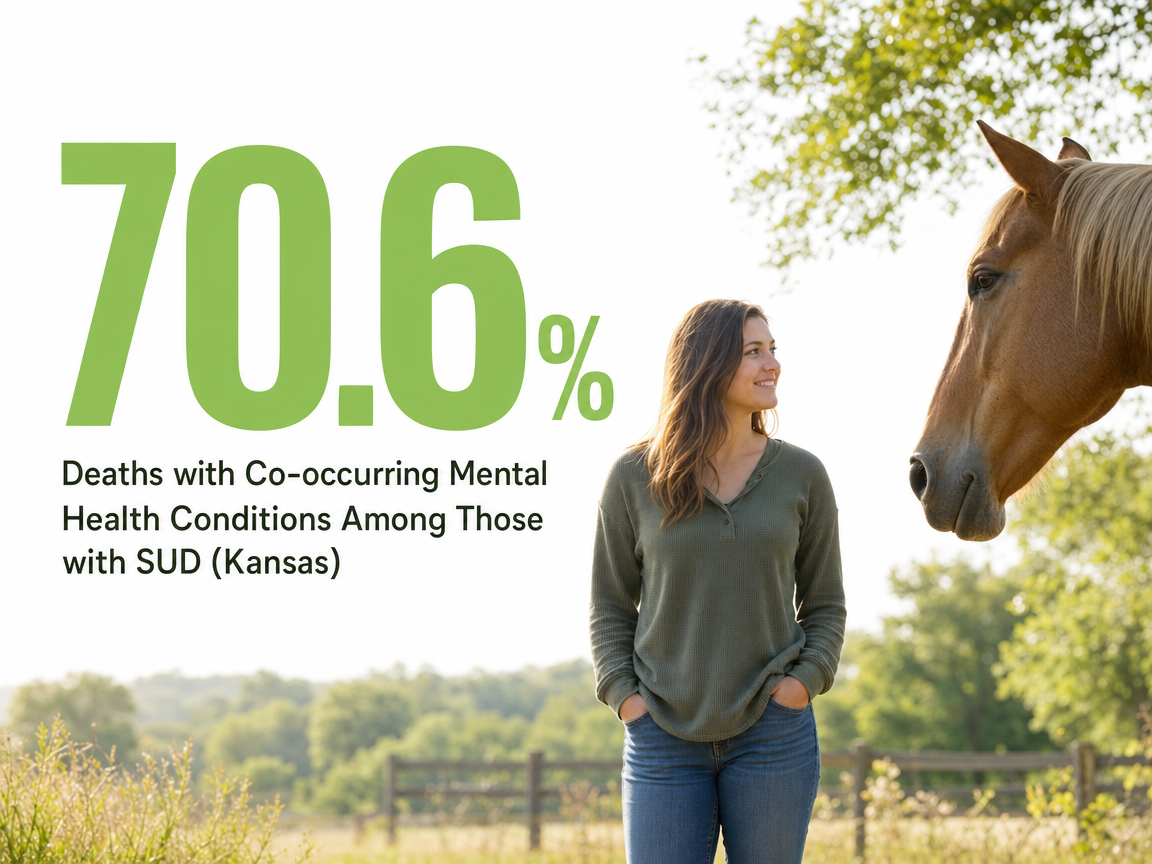
Kansas data tells a hard story, and it's one worth sitting with for a moment. In the state's most recent health statistics report, among people who died with a substance use disorder, 70.6% had co-occurring mental health conditions 11. Seven out of ten. That is not a small overlap or a rounding error. That is a pattern.
Think about what that number really says. It's not that mental illness caused those deaths. It's not that substance use alone did, either. It's that the two conditions were traveling together, often untreated as a pair, right up until the end. When someone gets help for the drinking but never for the depression underneath, or vice versa, the risk doesn't disappear. It just moves.
If you're the person weighing treatment, or the family member making calls on someone's behalf, this is the piece to hold onto. Treating both conditions at the same time isn't a nice-to-have. In this state, right now, it's what the mortality data is asking programs to do.
The Under-Identification Problem in Kansas Public Mental Health
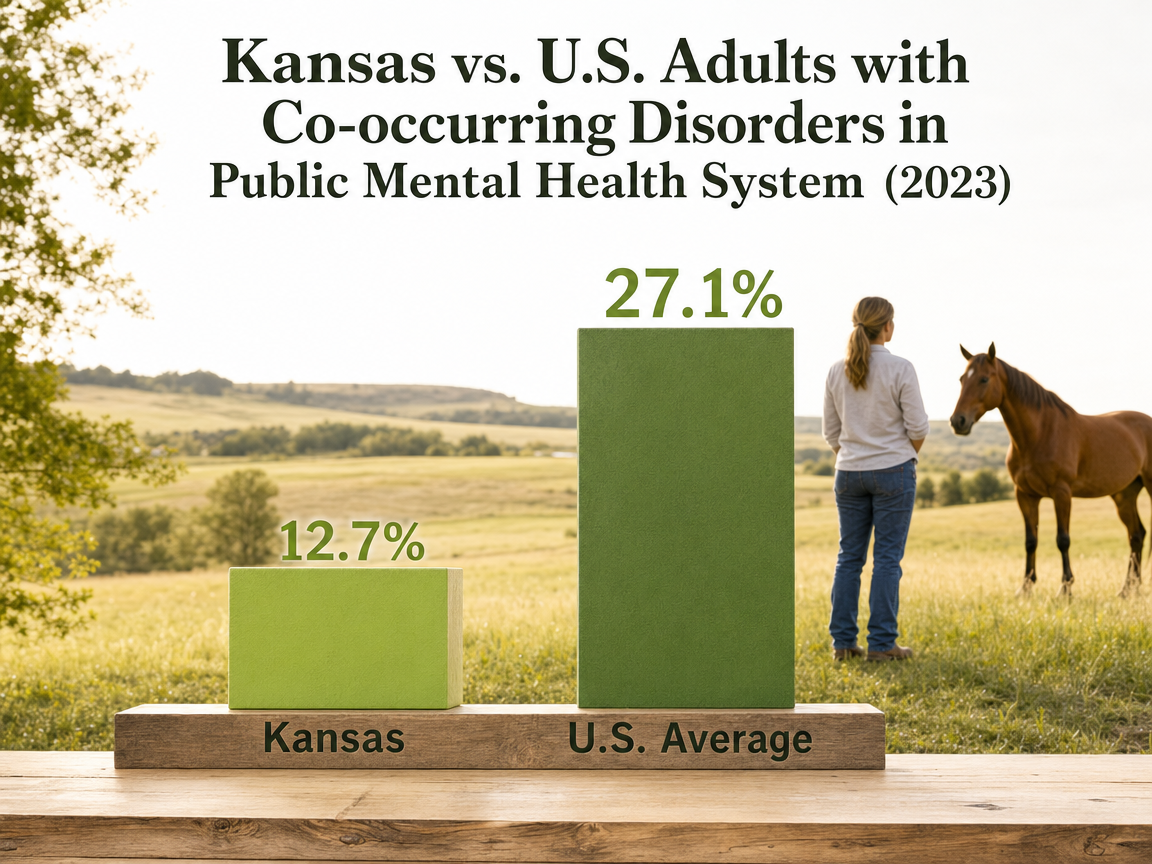
Here is where the picture gets uncomfortable. In 2023, only 12.7% of adults served through the Kansas State Mental Health Authority were identified as having a co-occurring mental and substance use disorder. The U.S. average that same year was 27.1% 12. Kansas is running at less than half the national rate of detection inside its own public mental health system.
Read that carefully, because it matters. This doesn't mean Kansans are somehow healthier than the rest of the country. The NSDUH prevalence estimates already showed us the opposite. What it means is that when people do walk into the public mental health system in Kansas, the substance use side of what they're dealing with often isn't being flagged, coded, or addressed.
For someone in Miami County, that gap has a real cost. If your first stop is a mental health clinician who asks about mood but not about drinking, or a substance use counselor who asks about drug history but not about panic attacks, you can walk out with a treatment plan that only sees half of you. And half a plan for a whole-person problem is how people end up back at the beginning, blaming themselves for something the system missed.
This is why, when you're calling around, asking whether a program screens for both conditions at intake is not a picky question. It's the first honest test of whether they're set up to see what you're actually living with.
Signs the System Is Slowly Catching Up
There is some good news here, and it's worth naming. In 2024, the share of Kansas adults in the public mental health system identified with co-occurring conditions ticked up from 12.7% to 14.4% 13. That is not a transformation. It's not the national average. But it is movement in the right direction, and movement matters when you've been watching a system stay stuck for a long time.
What that small shift likely reflects is better screening, more clinicians trained to ask both sets of questions, and a slow rebuilding of the connection between mental health care and substance use care that got separated decades ago. Every additional person who gets identified is one more chance to offer treatment that actually fits.
So if you've held off on trying again because the last experience felt fragmented, know this: the ground is shifting, slowly, in a better direction. Your next call may land somewhere different than your last one did.
What Integrated Care Looks Like When It's Done Right
Same Team, Same Setting: SAMHSA's Standard
The federal definition of integrated treatment is refreshingly plain. SAMHSA describes it as care where"the same clinicians or teams of clinicians, working in one setting, provide appropriate mental health and substance abuse interventions in a coordinated fashion"4. One team. One setting. One plan that holds both sides of what you're living with.
That standard exists for a reason. When your therapist knows about your drinking and your substance use counselor knows about your PTSD, they stop working around each other. Notes get shared. Medication decisions account for both diagnoses. Group work is built for people carrying both conditions at once, not squeezed in as an afterthought 6. The peer-reviewed literature backs this up: concurrent treatment by the same provider or team is consistently linked to better outcomes than parallel or sequential care 9.
What this looks like on the ground is simple. You tell your story once. You don't get handed off between agencies who never call each other. And no one asks you to prove sobriety before you're allowed to talk about the trauma that started it.
Three Ways Programs Deliver It: Coordinated, Co-Located, Fully Integrated
Not every program labeled "dual diagnosis" delivers care the same way. SAMHSA describes three distinct models, and knowing the difference will save you weeks of frustration 1.
- Coordinated care
- The loosest version. You have a mental health provider at one clinic and a substance use provider at another. They communicate—phone calls, shared records, occasional case conferences—but you're still driving to two places and telling two sets of intake staff about the same panic attacks. This is better than nothing, and in rural stretches of Kansas it may be the only option locally. It also asks a lot of you to keep the pieces connected.
- Co-located care
- Puts both services under one roof. Same building, sometimes the same waiting room, but often still separate treatment plans and separate clinicians. Warmer handoffs, less driving. Still two sets of appointments.
- Fully integrated care
- What SAMHSA's evidence base actually endorses 4. One clinician or one team treats both conditions together. Your medication for anxiety and your medication-assisted treatment for opioid use disorder are prescribed with the whole picture in view. Group therapy is designed specifically for co-occurring needs 6. This is the model with the strongest outcomes, and it's what "done right" means in practice.
The Question to Ask on Your First Call
When you pick up the phone, ask this: "Will the same clinician or team treat both my mental health condition and my substance use, or will I be working with separate providers?"
Listen closely to the answer. If they say the same team handles both, ask how psychiatric medication decisions get made and whether group therapy is built for co-occurring needs specifically 10. If they hesitate, or say something like "we'll refer you out for the mental health piece," that's a coordinated model, not a fully integrated one. Both can help. Only one matches the standard the evidence supports.
You're allowed to ask. In fact, asking is the first act of taking your treatment seriously.
What a Real Dual Diagnosis Program Includes
Screening That Looks at Both Conditions from Day One
The first appointment tells you a lot. In a real integrated program, the intake paperwork and the conversation that follows both ask about mental health and substance use. Not one, then the other months later. Both, from the start 6.
That means you'll be asked about your mood, sleep, trauma history, and any diagnoses you carry, and in the same sitting you'll be asked about what you use, how often, and what happens when you try to stop. The clinician is listening for how the two are woven together, not sorting you into one lane or the other 1.
If a program only asks about substances at intake and tells you the mental health assessment comes later, that's a flag. You deserve to be seen whole on day one.
Stage-Wise Care: Meeting You Where You Are
Not everyone walking into treatment is ready to stop using tomorrow. Some people are, and that's real. Others are still weighing whether change is possible, or trying to hold down a job while the ground shifts under them. A good dual diagnosis program plans for all of that.
SAMHSA calls this stage-wise care, and it's exactly what it sounds like: your treatment plan matches where you actually are, not where the program wishes you'd be 3. The stages usually run something like this:
- Engagement is the earliest phase, when the goal is simply building a relationship with a clinician you trust.
- Persuasion is when you're starting to see the costs of using and considering change.
- Active treatment is when you're doing the work of changing use patterns and treating the mental health condition together.
- Relapse prevention is the longer arc of protecting what you've built 3.
Why does this matter for you? Because a program that only serves people who are already in active treatment won't know what to do with you if you're still in engagement. And a program that uses motivational techniques, meets you at your stage, and doesn't punish ambivalence gives you room to move forward at a pace that will actually hold 3.
Therapy, Groups, and Medication Working Together
The clinical toolkit inside a real integrated program has three legs, and they lean on each other.
Individual therapy does the deep work. Cognitive behavioral therapy helps you notice the thoughts that pull you toward using. Trauma-focused approaches address the memories that never got processed. Dialectical behavioral therapy gives you skills for the moments when emotions feel unbearable. In an integrated program, the same therapist knows about both sides of what you're carrying 9.
Group therapy in a real dual diagnosis program is built specifically for people with co-occurring conditions 6. That matters. A group where half the room is only working on substance use and half is only working on depression rarely gets to the place where the two overlap. A co-occurring group does.
Medication rounds it out. Psychiatric medications for depression, anxiety, or PTSD are prescribed alongside medication-assisted treatment for opioid or alcohol use disorder when appropriate, with one prescriber holding the whole picture 3, 10. No one is treating your anxiety without knowing what you're using, and no one is starting MAT without knowing what psychiatric medications you're on. That coordination is the point.
The Local Landscape Around Paola
Miami County's Coordinated Response
Paola isn't starting from zero. The Miami County Mental Health Initiative (MCMHI) was established with a $44,000 state grant and brings together the Miami County Sheriff's Office, County Attorney, Emergency Medical Services, and the Elizabeth Layton Center to improve how residents in crisis get connected to care 17. That kind of interagency wiring matters more than it might sound at first read.
Here's why. When law enforcement, EMS, and the local community mental health center are actually talking to each other, someone who ends up in a wellness check or a jail booking has a shorter path back to treatment. That path is exactly where people with co-occurring conditions tend to get lost. The mental health crisis gets triaged in one place, the substance use side gets triaged somewhere else, and the person in the middle falls through.
A dual diagnosis program that plugs into this local coordination, rather than sitting outside it, is worth more than the same program dropped into a town with no interagency backbone. Ask any Paola-area provider you're considering how they work with these partners.
Rural-Adjacent Access and the KC Metro Question
Paola sits in a specific kind of geography. You're not in the middle of nowhere, and you're not in the middle of Kansas City either. The metro is about an hour north, which means specialty psychiatric care is technically within reach but not exactly around the corner.
That matters for dual diagnosis treatment in two ways. First, staying close to home keeps you connected to the family, sponsors, and work life that recovery has to fit inside. A program in the metro can look shinier on paper and still fail you if the drive burns out your support system by month two. Second, the local option needs to actually offer integrated care, not just be geographically convenient. Proximity without the right clinical model is still a coordinated-referral experience 1.
Weigh both. Distance is real. So is fit.
How to Evaluate a Program Before You Walk In
You don't need a clinical degree to size up a program. You need a short list of questions and the willingness to ask them out loud on the phone.
- Start with the integration model. Ask whether the same clinician or team will treat both conditions in the same setting, or whether the mental health piece gets referred out 4. The answer tells you everything about how coordinated your care will actually feel.
- Ask about intake. A real program screens for both mental illness and substance use at the first assessment, not weeks apart 6. If the phone screener only asks about substances, that's your answer about how the rest of it will go.
- Ask about medication. Who prescribes psychiatric medications, who prescribes medication-assisted treatment, and do those two people talk? Ideally, they're the same person or work on the same team 3, 10.
- Ask about stage. If you're not ready to stop using tomorrow, will they still see you? Programs built on stage-wise care can meet you in engagement or persuasion, not just active treatment 3.
- Ask about groups. Are they designed for co-occurring conditions specifically, or is it a general substance use group with a mental health track bolted on 6?
- Ask how they connect with local partners like the Elizabeth Layton Center, county EMS, or the Sheriff's Office through the Miami County Mental Health Initiative 17. A program plugged into that network can catch you if you fall between appointments.
Write the answers down. Compare two or three programs side by side. The one that answers directly, without deflection, is usually the one worth visiting.
The Honest Next Step
You don't have to have this all figured out to make one call. That's worth saying plainly, because a lot of people wait until they feel ready, and readiness is not usually how this starts. It starts with picking up the phone tired, or scared, or unsure whether you can do this again.
Here's what an honest next step looks like. Make a list of two or three programs in the Paola area. Ask each one whether the same team will treat both your mental health and your substance use in the same setting 4. Ask how they handle intake, medication, and where you are in the process today. If one program answers directly and meets you where you are, that's the one worth visiting.
Whatever brought you here counts. Reading this far counts. The next call counts too, and Arista Recovery is one of the numbers you can dial.
Frequently Asked Questions
How is dual diagnosis treatment different from regular substance use or mental health treatment?
In regular care, you often see two providers who never talk to each other. In dual diagnosis treatment, the same clinician or team treats both conditions together, in one setting, with one plan 4. That coordination is what SAMHSA's evidence base actually endorses, and it's why outcomes tend to hold better 9.
How do I know if a program in the Paola area actually offers integrated care?
Ask one question on the phone: will the same team treat both my mental health and substance use, or will one part get referred out? If it's the same team in the same setting, that's fully integrated 4. If they refer the mental health piece elsewhere, that's a coordinated model, which is looser 1.
What conditions count as co-occurring disorders?
Any combination of a mental health disorder and a substance use disorder that show up in the same person at the same time 2. Depression with alcohol use, PTSD with opioid use, anxiety with benzodiazepines, bipolar disorder with stimulants—all fit. The specific diagnoses matter for your treatment plan, but the umbrella term is broad on purpose.
What should I expect during the first assessment?
A real integrated program screens for both mental illness and substance use in the same intake, not weeks apart 6. Expect questions about mood, sleep, trauma, and diagnoses alongside questions about what you use and how often. The clinician is listening for how the two connect, not sorting you into one lane.
Do I need to be sober before starting mental health treatment?
No. That old rule is exactly what integrated care exists to correct. SAMHSA's guidance calls for concurrent treatment of both conditions from the start, matched to whatever stage of readiness you're in—engagement, persuasion, active treatment, or relapse prevention 3. You don't have to prove anything before someone starts helping with the mental health side.
Should I look for care in Paola or drive into the Kansas City metro?
Weigh two things: distance and fit. Staying local keeps you connected to family, work, and the Miami County coordination network that includes the Elizabeth Layton Center and county EMS through MCMHI 17. The metro offers more specialty options but a longer drive. Pick the program whose clinical model actually integrates both conditions, wherever it sits.
References
- Managing Life with Co-Occurring Disorders - SAMHSA. https://www.samhsa.gov/mental-health/serious-mental-illness/co-occurring-disorders
- Co-Occurring Disorders and Other Health Conditions | SAMHSA. https://www.samhsa.gov/substance-use/treatment/co-occurring-disorders
- Substance Use Disorder Treatment for People with Co-Occurring Mental Disorders. https://library.samhsa.gov/sites/default/files/pep20-06-04-006.pdf
- Integrated Treatment for Co-Occurring Disorders: The Evidence. https://library.samhsa.gov/sites/default/files/ebp-kit-the-evidence-10242019.pdf
- Integrated Treatment for Co-Occurring Disorders: Evidence-based treatment works. https://library.samhsa.gov/sites/default/files/ebp-kit-brochure-english-10242019.pdf
- Integrated Treatment for Co-Occurring Disorders: Building Your Program. https://library.samhsa.gov/sites/default/files/ebp-kit-building-your-program-10112019.pdf
- Integrated Treatment for Co-Occurring Disorders: How to Use the Evidence-Based Practices KITs. https://library.samhsa.gov/sites/default/files/ebp-kit-how-to-use-the-ebp-kit-10112019_0.pdf
- Integrated Treatment for Co-Occurring Disorders Evidence-Based Practices (EBP) KIT. https://library.samhsa.gov/product/integrated-treatment-co-occurring-disorders-evidence-based-practices-ebp-kit/sma08-4366
- Integrating Treatment for Co-Occurring Mental Health Conditions. https://pmc.ncbi.nlm.nih.gov/articles/PMC6799972/
- Co-Occurring Disorders Integrated Dual Disorders Treatment (IDDT) Toolkit. https://portal.ct.gov/-/media/dmhas/cosig/iddttoolkitpdf.pdf
- Kansas Health Statistics Report January 2026. https://www.kdhe.ks.gov/DocumentCenter/View/56412/Kansas-Health-Statistics-Report-January-2026-PDF
- Kansas 2023 Uniform Reporting System Mental Health Data Results. https://www.samhsa.gov/data/sites/default/files/reports/rpt53119/Kansas.pdf
- Kansas 2024 Uniform Reporting System Mental Health Data Results. https://www.samhsa.gov/data/sites/default/files/reports/rpt56450/Kansas.pdf
- KANSAS - National Survey on Drug Use and Health State Tables (2023). https://www.samhsa.gov/data/sites/default/files/reports/rpt56188/2023-nsduh-sae-state-tables_0/2023-nsduh-sae-state-tabs-kansas.pdf
- Behavioral Health Barometer: Kansas, Volume 5. https://catalog.data.gov/dataset/behavioral-health-barometer-kansas-volume-5
- Overdose Data Dashboard | Kansas Department of Health and Environment. https://www.kdhe.ks.gov/1309/Data-Dashboard
- Miami County Mental Health Initiative. https://www.miamicountyks.gov/1065/Miami-County-Mental-Health-Initiative