.webp)


Finding Integrated Depression Treatment Near Me: A Guide
Key Takeaways
- Depression paired with substance use calls for one team treating both conditions together, not separate clinics handing you off between mental health and addiction care 5.
- Integrated care means shared treatment plans and coordinated clinicians, while co-located just means shared address—ask whether therapists and prescribers actually communicate about your chart 9.
- Build a shortlist of three to five programs through FindTreatment.gov and SAMHSA's locators, filtering for places that list both mental health and substance use services 4.
- On the first call, confirm one team, one plan, universal depression screening, an on-staff psychiatric provider, and symptom tracking over time 6, 9.
- Ask about crisis coverage between appointments, written safety planning, and how the program handles a return to substance use without discharging you 6, 7.
- Federal parity law bars insurers from applying stricter limits to behavioral-health care than to comparable medical care, so request written denials and appeal them 10.
- If you're searching for a loved one, quietly prepare the shortlist and insurance notes now so a specific program is ready the moment they agree to call 4.
When depression and substance use travel together, the search changes
You opened a browser and typed "depression treatment near me." That counts. Even if the tab is one of six open right now, and your chest feels tight, and you're not sure what you're actually looking for—you started.
Here's what a lot of search results won't tell you upfront: if depression is showing up alongside drinking, pills, stimulants, or anything else you've been using to get through the day, the kind of care you need is different. You don't need two clinics that don't talk to each other. You need one team that treats both at the same time.
That combination is more common than you might think. In 2024, about 6.9 million U.S. adults—roughly 2.6% of the adult population—had a serious mental illness together with a substance use disorder in the past year, according to the national survey SAMHSA runs each year 11. That number covers a narrower slice than "depression plus any substance use," so the real overlap of people in your situation is larger. You are not an outlier.
Federal guidance is pretty clear on what should happen next. Mental health and substance use conditions are meant to be addressed together, in a coordinated plan, not treated in sequence with one condition waiting its turn 5. That single shift—looking for integrated care instead of just a therapist or just a rehab—changes what you search for, which programs make your shortlist, and what you ask on the first phone call.
The rest of this guide walks you through it, step by step. Take your time. You don't have to figure it all out today.
What integrated care actually means (and what it doesn't)
The 'no wrong door' principle in plain language
Here's the idea in one sentence: whichever door you walk through—mental health clinic or substance use program—that door should lead to help for both.
SAMHSA calls this "no wrong door." If you show up at a substance use program, someone should screen you for depression. If you show up at a mental health clinic, someone should ask about drinking, prescription use, and other substances 5. You shouldn't have to know which condition is "primary" before you get in. That's the clinician's job to sort out with you.
Why does this matter for your search? Because a lot of programs still work the old way. You call a therapist about depression, and if you mention you've been drinking more than you'd like, they refer you out. You call a rehab, and if you mention you're crying every morning and haven't left the house in a month, they say "get stable first, then find a therapist." That handoff is where people fall through.
A program working from the no-wrong-door framework treats screening for the second condition as routine, not as a reason to send you somewhere else. The specific protocol SAMHSA publishes for depressive symptoms in substance use treatment says every client should be screened for depression—not just the ones who bring it up 6.
When you call a program, you can literally ask: "Do you screen every client for depression and substance use, or only if I mention it?" The answer tells you a lot.
Integrated vs. co-located: how to tell the difference
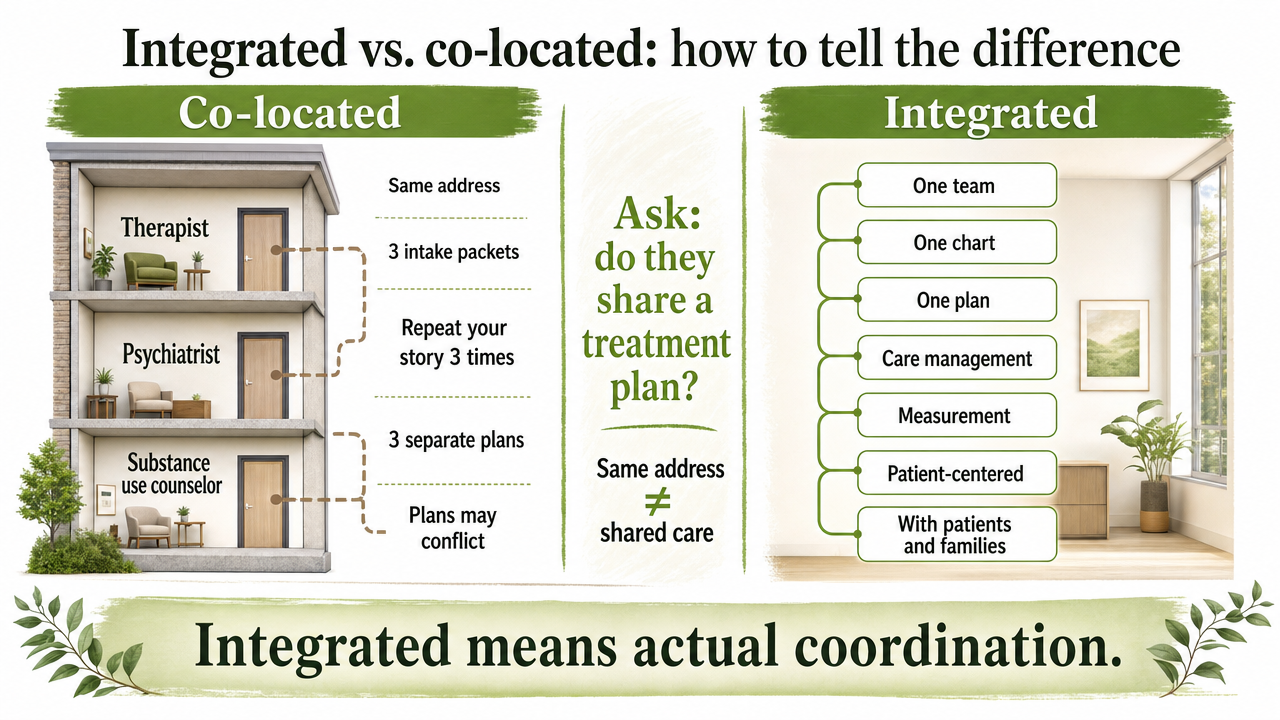
Co-located means two services share an address. Integrated means they share a treatment plan.
That distinction sounds small. It's not. A building can house a therapist, a psychiatrist, and a substance use counselor on three different floors who never talk to each other about you. You'd fill out three intake packets. You'd repeat your story three times. You'd get three different plans that might contradict each other on medication, on goals, on how to handle a hard week.
AHRQ describes real integration as a practice team of primary-care and behavioral-health clinicians working with patients and families through a systematic, patient-centered approach—with actual coordination, care management, and measurement built in 9. In plain terms: one team, one chart, one plan, and someone whose job it is to make sure the parts fit together.
Here's what to listen for on the phone. In a genuinely integrated program:
- A single intake covers both depression and substance use, and a psychiatrist or psychiatric provider is part of the team, not a referral you chase later.
- Your therapist and your prescriber talk to each other—same week, same chart, no fax machine in between.
- Someone tracks your depression symptoms over time using a short questionnaire, so progress is measured, not guessed at 9.
- The plan names both conditions and how they interact, including what happens on a bad depression day that raises the risk of a return to substance use 6.
In a co-located setup, you'll hear things like "we can refer you to someone in the same building," or "our therapists don't handle medication questions," or "you'll want to see our substance use side separately." That's not integration. That's a hallway.
Neither model is inherently bad. A co-located clinic can be the right fit if you already have a strong outside team. But if you're starting from scratch and juggling both conditions, integration saves you the exhausting work of being your own case manager.
Why the depression-vs-substance-induced distinction matters
Not all depression is the same, and this shapes the plan.
Sometimes what looks like a depressive disorder is actually your brain and body reacting to a substance—during heavy use, during withdrawal, or in the weeks after stopping. Sometimes it's a depressive disorder that existed before the substance use ever started, or one that would stay even if the substance went away tomorrow. Sometimes it's both, tangled together.
SAMHSA's clinical protocol on depressive symptoms in substance use treatment is direct about this: depressive symptoms can be substance-induced, independent, withdrawal-related, or part of another condition, and figuring out which one you're dealing with often takes more than a single screening 6. It may take a few weeks of stability, careful monitoring, and repeat assessment before a clinician can say with confidence what kind of depression this is.
That's not a delay tactic. It's the reason integrated care matters so much. A team that treats both conditions together can watch how your mood shifts as substances leave your system, adjust medication if needed, and start therapy that works for either scenario—rather than guessing and locking you into the wrong treatment.
When mental health challenges and addiction intersect, it can feel isolating. At Arista, we offer compassionate, evidence-based, and trauma-informed care to help you heal, grow, and move forward.
Building your local shortlist with federal locators
Start with FindTreatment.gov and SAMHSA's locators
Before you call anyone, you need a list. A short one. Three to five programs is plenty for a first pass.
The best free starting point is FindTreatment.gov, run by SAMHSA. You can search by state, county, and distance from where you are, which is exactly what "near me" means in practice 4. SAMHSA also keeps a broader locators page that links to tools for mental health services, substance use programs, and opioid treatment programs, so if your situation involves more than one of those, you're not bouncing between random directories 3.
A few practical notes as you search. Filter for programs that list both mental health services and substance use treatment—not one or the other. If a program only shows up under substance use, that doesn't automatically rule it out, but it does move it lower on your list until you can ask about depression care directly. Same in reverse: a therapy clinic that doesn't mention substance use is probably not set up for integrated care.
Here's the honest limit of these tools. A listing tells you a program exists and what categories it claims. It does not tell you whether they screen every client for depression, whether a psychiatrist is on staff this month, or whether they take your insurance today 3. That verification happens on the phone. The locator just gets you to a short list worth calling.
Write the names down. Add a phone number and one blank column for notes. You're building a tool, not memorizing everything.
Understanding the levels of care you'll see listed
When you scan a program's website or read its locator entry, you'll see terms like detox, residential, PHP, IOP, and outpatient. Those aren't marketing labels. They're distinct levels of care, and knowing which one fits your situation makes the first phone call much shorter.
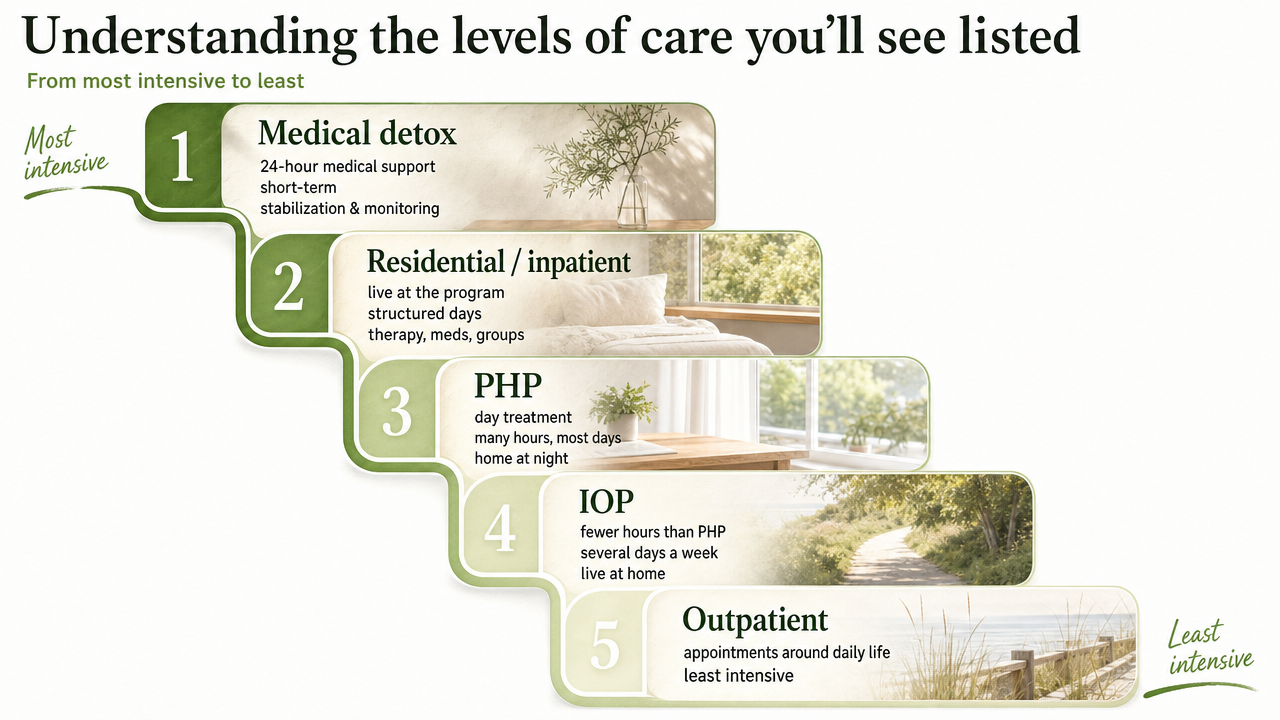
Here's a plain-language map, moving from most intensive to least:
- Medical detox. Short-term, 24-hour medical support while a substance leaves your body. Useful when withdrawal is dangerous or miserable enough that you can't safely stop on your own. Depression care during detox is mostly stabilization and monitoring.
- Residential or inpatient treatment. You live at the program, usually for a few weeks. Days are structured around therapy, medication management, and group work. Good fit when home isn't safe or stable enough to focus on treatment.
- Partial hospitalization (PHP). You attend the program most of the day, five days a week, and sleep at home or in supported housing. It's a step down from residential, or a step up from outpatient when things are getting worse.
- Intensive outpatient (IOP). Usually three days a week, three hours a day. You keep working or caring for family while getting real clinical hours.
- Standard outpatient. Weekly therapy, medication check-ins, and case management. This is where most people land after a higher level of care, or start if symptoms are milder.
- Recovery support. Sober living homes, peer support, alumni groups. Not clinical treatment, but often what keeps the plan working.
SAMHSA's guidance is that integrated care should coordinate mental health and substance use interventions across whatever level you're at—not restart from scratch when you step down 5. So one of the questions worth asking any program on your list: what does the handoff between levels look like inside your own program? A team that treats you through detox and residential and IOP will know you better than three separate handoffs to strangers.
You don't have to pick the level yourself. Programs assess and recommend. But walking in knowing the vocabulary means you can push back if a recommendation feels wrong.
The first phone call: a script that tests for real integration
Questions about the clinical team and treatment plan
The first call is short. Ten minutes, maybe fifteen. You don't need to explain your whole life. You need to find out if this program can actually hold both conditions at once.
Start with the team. Ask: "Who would be involved in my care, and do they work together in the same practice?" You're listening for a therapist, a psychiatric provider who can prescribe medication, a substance use counselor, and a case manager or care coordinator. AHRQ's definition of integrated care leans on that team structure—clinicians working with patients through a systematic, coordinated approach, not a stack of separate referrals 9.
Then ask about the plan itself. "If I come in with depression and a substance use disorder, will I have one treatment plan that names both conditions, or two separate plans?" One plan is the answer you want. SAMHSA's protocol on depressive symptoms in substance use treatment describes integrated care as addressing substance use, depressive symptoms, and how they interact inside a single coordinated plan 6.
Ask about screening: "Do you screen every client for depression at intake, or only if I bring it up?" Every client is the right answer 6.
And ask about measurement: "How will we know if I'm getting better?" A program that tracks depression symptoms with a short questionnaire every few weeks is measuring, not guessing 9.
If the person on the phone can't answer these, ask to speak with a clinical intake coordinator. It's a fair request.
Questions about therapy formats and medication
Next, ask what the actual week looks like.
"What kinds of therapy do you offer, and which ones would fit someone dealing with both depression and substance use?" NIMH describes psychotherapy as work to identify and change troubling emotions, thoughts, and behaviors, and lists it alongside medication as the most common forms of mental health treatment 8. A solid program should be able to name specific approaches—cognitive behavioral therapy, dialectical behavioral therapy, trauma-focused therapy—and explain why they'd recommend one for you.
Ask about formats: "Do you offer individual therapy, group therapy, and family sessions? Are virtual visits an option if I can't get there some days?" 8Group work matters for substance use recovery. Individual sessions matter for depression. Both should be on the table.
Then medication. "Is a psychiatrist or psychiatric nurse practitioner on your team, and how soon after intake would I see them?" NIMH is clear that depression treatment usually involves psychotherapy, medication, or both, and in some cases brain stimulation treatments 7. If you need medication, waiting three weeks for a first appointment is too long.
Ask specifically: "If I'm on medication for a substance use disorder—like buprenorphine or naltrexone—can your prescriber manage that alongside an antidepressant?" A yes here signals real integration. A pause or a referral out signals a gap.
Write the answers down. You'll compare notes across programs later, and by call three, everything blurs.
Questions about crisis coverage and safety
Save time at the end of the call for this. It matters more than anything on the website.
Ask: "What happens if I have a crisis at 2 a.m. between appointments?" You want a real answer—an on-call clinician, a 24-hour line staffed by someone who knows the program, a plan for a same-day appointment when things spike. Not just "call 911." NIMH directs anyone with suicidal thoughts to call or text 988 and to call 911 in a life-threatening situation, and that guidance applies no matter what program you're in 7. But a good treatment program layers its own crisis response on top of that.
Ask how they handle safety planning. SAMHSA's protocol on depressive symptoms in substance use treatment includes safety interventions as a standard part of care, not an add-on 6. A clinician should sit down with you and build a written plan: warning signs, coping steps, people to call, how to make your environment safer during a bad stretch.
Ask about the handoff between levels of care. "If I step down from residential to IOP, does your same team keep seeing me?" Continuity through transitions is where a lot of people lose momentum.
One last question: "What happens if I have a return to substance use during treatment?" A program that treats that as a clinical event to work with, not grounds for discharge, understands what recovery actually looks like.
Insurance, parity, and getting past the first 'no'
What parity actually protects—and what it doesn't
Insurance is where a lot of people stall. You do the calls, you find a program that sounds right, and then a voice on the phone says your plan won't cover residential, or only covers ten IOP sessions, or wants a prior authorization that takes a week. That is the moment to know what federal law actually says.
The Mental Health Parity and Addiction Equity Act—MHPAEA—is the short version of the rule. CMS explains it this way: your plan generally cannot put more restrictive financial requirements or treatment limitations on mental health and substance use benefits than it does on comparable medical or surgical benefits 10. In plainer words: if your plan pays for a week of hospital care after a heart attack without a fight, it can't demand extra hoops for a week of residential treatment for depression and a substance use disorder. Copays, visit limits, prior authorizations, and medical-necessity rules for behavioral health have to line up with the medical side.
Medicaid follows the same principle, including Medicaid managed care 1, 2. And on September 9, 2024, federal agencies issued new MHPAEA final rules that tightened requirements around the vaguer restrictions—things like how a plan writes its medical-necessity criteria or applies prior authorization—by requiring insurers to produce comparative analyses showing behavioral-health limits aren't stricter than medical ones 10.
Here's what parity does not do. It doesn't force every plan to cover every service, and it doesn't guarantee that a specific program is in your network 1, 10. Disputes usually turn on medical necessity, network status, or how a nonquantitative limit is applied—not on whether the benefit exists at all 10. Knowing the difference tells you when to push and when to pivot.
How to verify coverage before you commit
Two phone calls, not one. Call the program's billing or admissions team first, then call the member services number on the back of your insurance card. Compare what they say.
Ask the program: "Are you in-network with my plan? What levels of care do you bill for—detox, residential, PHP, IOP, outpatient? What's my likely out-of-pocket cost after benefits, and do you offer a written estimate?" Then call your insurer and ask the same questions in reverse. "Is this program in-network? What's covered at each level of care? What prior authorizations do I need, and how long do they take?"
If you hear a no, ask which specific rule is being applied—benefit exclusion, medical necessity, prior authorization, or network status 10. Then ask for the denial in writing and the appeal process. Under parity, your insurer has to be able to show that the limit it's applying to your care isn't stricter than what applies to comparable medical care 2, 10.
One more step: ask the program if they help with appeals. Many admissions teams do this every week and know the language that works.
If you're helping a loved one instead of yourself
A quick shift: this section is for the parent, partner, sibling, or friend doing the searching. You're carrying a different kind of weight. The person you love may not be ready to call anyone yet, or may be ready one hour and not the next. Both are normal.
Start with what you can do without their permission. Build the shortlist yourself. Use FindTreatment.gov to pull three to five nearby programs that list both mental health and substance use services 4. Save the numbers. Note which ones take your loved one's insurance. When they say yes—even a small yes, like "okay, make the call"—you won't lose an hour to Google.
When you do call, ask the same questions you'd ask for yourself: one team, one plan, screening for both conditions at intake, a psychiatric provider on staff, a real crisis protocol, and family involvement as part of treatment 6, 9. Ask specifically about family programming. NIMH lists family sessions as a standard therapy format worth having on the table 8.
If they mention suicide or you see signs of a crisis, call or text 988, and call 911 if life is in danger 7. Take care of yourself while you wait. This is a long walk, not a sprint, and you're allowed to rest.
Frequently Asked Questions
Do I have to get sober before I can start depression treatment?
No. Federal guidance actually says the opposite. SAMHSA's approach is that mental health and substance use should be treated together, in one coordinated plan, without making you handle one condition before the other gets attention 5. A program that insists on sobriety first isn't following current best practice. Look for one that starts screening, safety planning, and treatment for both from day one 6.
How can I tell if a nearby program actually treats both depression and substance use together?
Ask three questions on the first call. Does one team share your chart and build a single treatment plan that names both conditions? Is a psychiatric provider on staff, not a referral? Do they screen every client for depression at intake, not just when someone brings it up 6, 9? Real integration also includes measuring your symptoms over time with a short questionnaire, so progress is tracked rather than guessed 9.
What should I do if my insurance denies coverage for residential or intensive outpatient care?
Ask which specific rule they're applying—benefit exclusion, medical necessity, prior authorization, or network status—and request the denial in writing with the appeal steps 10. Under federal parity law, your insurer can't apply stricter limits to behavioral-health care than to comparable medical care, and updated rules require them to show that comparison when asked 2, 10. Ask the program's admissions team to help with the appeal. Many do this weekly.
What levels of care will I see listed, and which one do I need?
You'll see detox, residential or inpatient, partial hospitalization (PHP), intensive outpatient (IOP), standard outpatient, and recovery support like sober living. They move from most intensive to least. You don't pick the level yourself—programs assess and recommend based on symptoms, safety, and home stability. What matters is that mental health and substance use care stay coordinated across whichever level you're at, without restarting from scratch when you step down 5.
What should I do right now if I or my loved one is having thoughts of suicide?
Call or text 988 to reach the Suicide and Crisis Lifeline. If life is in immediate danger, call 911. NIMH gives this same guidance for anyone experiencing suicidal thoughts, no matter where you are in the treatment search 7. You don't need to have a program picked out first. Reach out now, and come back to the shortlist when you're safe. That order is the right one.
How do I help a family member who isn't ready to call a program yet?
Do the searching quietly in the background. Pull three to five nearby programs from FindTreatment.gov that list both mental health and substance use services, and save the numbers with insurance notes 4. When your loved one says yes—even a small yes—you'll have a name ready. You can't force an adult into treatment in most cases. What works is staying steady, keeping the door open, and being prepared for the shift.
References
- Parity - Medicaid. https://www.medicaid.gov/medicaid/benefits/behavioral-health-services/parity
- Parity for Mental Health and Substance Use Disorder Benefits. https://www.medicaid.gov/medicaid/managed-care/guidance/parity-for-mental-health-and-substance-use-disorder-benefits
- Treatment Locators: Mental Health, Drug, Alcohol Issues. https://www.samhsa.gov/find-help/locators
- FindTreatment.gov (English). https://www.samhsa.gov/resource/dbhis/findtreatmentgov-english
- Managing Life with Co-Occurring Disorders. https://www.samhsa.gov/mental-health/serious-mental-illness/co-occurring-disorders
- TIP 48 Managing Depressive Symptoms in Substance Abuse Clients. https://library.samhsa.gov/sites/default/files/sma13-4353.pdf
- Depression. https://www.nimh.nih.gov/health/publications/depression
- Psychotherapies. https://www.nimh.nih.gov/health/topics/psychotherapies
- Behavioral Health and Substance Use Disorders. https://www.ahrq.gov/ncepcr/reports/2024-annual-report/recent-grants-behavioral-health.html
- The Mental Health Parity and Addiction Equity Act (MHPAEA). https://www.cms.gov/marketplace/private-health-insurance/mental-health-parity-addiction-equity
- Results from the 2024 National Survey on Drug Use and Health. https://www.samhsa.gov/data/sites/default/files/reports/rpt56287/2024-nsduh-annual-national-report.pdf
You’re not alone in this.
When mental health challenges and addiction intersect, it can feel isolating. At Arista, we offer compassionate, evidence-based, and trauma-informed care to help you heal, grow, and move forward.
Support that moves with you.
You’ve taken a brave first step. At Arista Recovery, we’re here to help you continue with best-in-class care designed for long-term healing and support.